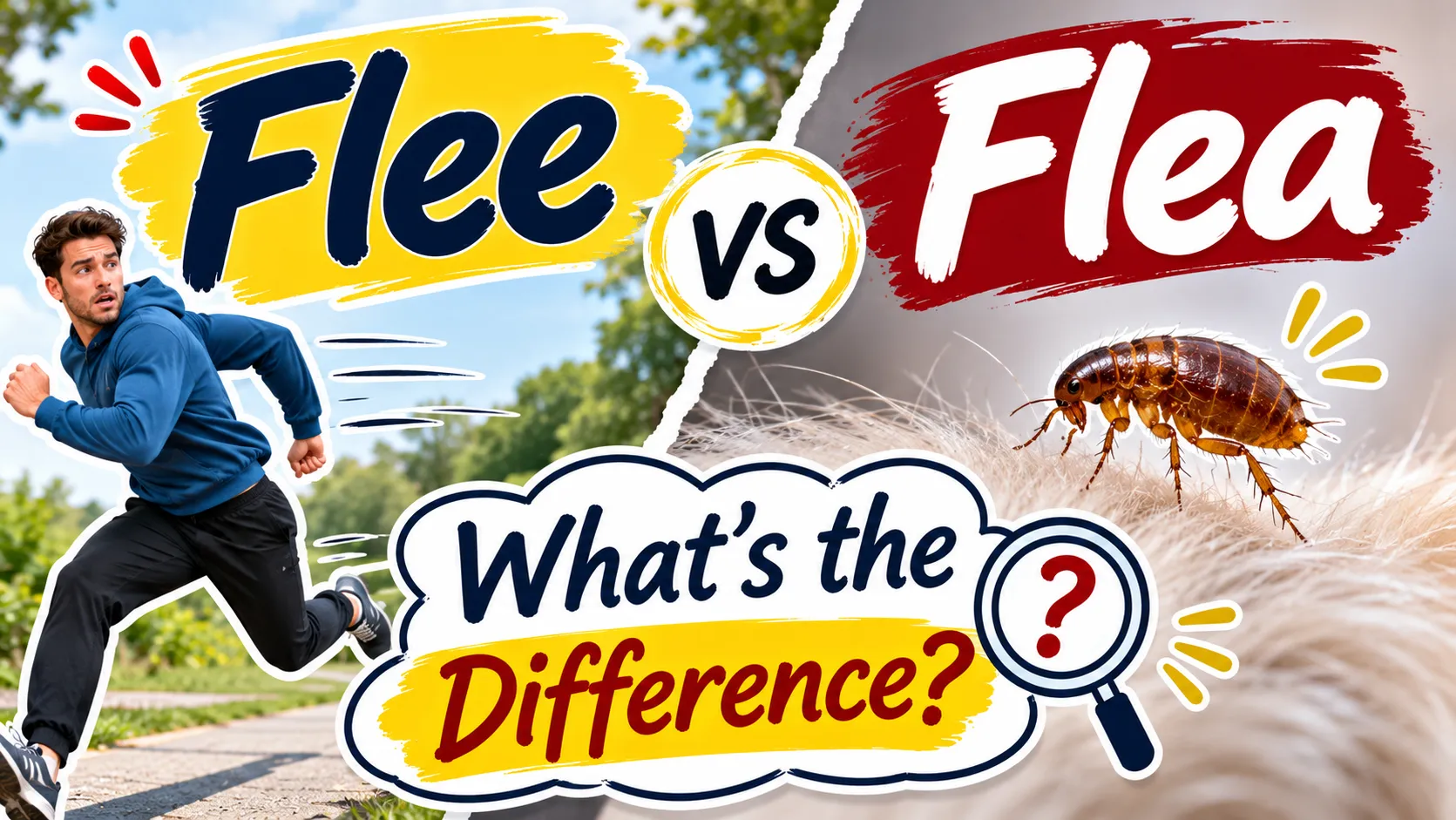
The words “flee” and “flea” sound identical, differ by just one letter, and appear in completely different contexts. The flee vs flea confusion ranks among the most common homophone errors in English writing, appearing in everything from news reports to pet care guides.
“Flee” is a verb meaning to run away from danger or escape. “Flea” is a noun referring to a small, jumping insect that feeds on blood. These words share identical pronunciation but no shared meaning. This comprehensive guide explains the difference, explores their origins, provides practical examples, and helps you choose the correct word every time you write.
Quick Answer
“Flee” is a verb meaning to run away or escape from danger, as in “they fled the building.” “Flea” is a noun referring to a tiny, bloodsucking insect that jumps, as in “the dog has fleas.” Remember: flee has “ee” like “escape” (you flee from danger); flea has “ea” like “insect” (a flea bites). They sound the same but mean completely different things.
Meaning Overview Table
| Aspect | Meaning |
|---|---|
| Definition | Flee: to run away or escape. Flea: a small jumping insect that feeds on blood |
| Pronunciation | Both: /fliː/ |
| Part of Speech | Flee: verb. Flea: noun |
| Usage | “They fled the scene” vs. “The flea bit my arm” |
| Context | Flee: danger, emergencies, news reports. Flea: pets, pest control, biology |
Main Meaning
Definition
Flee is a verb meaning to run away from danger, danger, or an unpleasant situation; to escape swiftly. It can also mean to pass away quickly, as in “time flees.” Flea is a noun referring to any of numerous small, wingless, bloodsucking insects of the order Siphonaptera that jump and feed on the blood of mammals and birds.
Origin
“Flee” comes from the Old English flēon, meaning “to run away.” It has Germanic roots related to German fliehen and Dutch vluchten. The word has been used in English since before the 12th century.
“Flea” comes from the Old English flēa, with Germanic roots related to German Floh and Dutch vlo. The word has always referred to the jumping insect.
Context
The distinction matters across several contexts:
- News and Emergencies: “Flee” appears constantly in reports of disasters, wars, and crimes
- Pet Care and Pest Control: “Flea” appears in discussions of pet health and home infestation
- Biology and Entomology: “Flea” appears in scientific descriptions of the insect
- Everyday Writing: Confusing the two creates embarrassing errors in emails, essays, and social media posts
Modern Usage
Today, “flee” appears frequently in news reports about refugees, disasters, and crime scenes. “Flea” appears in pet care discussions, veterinary contexts, and pest control. The phrase “flea market” uses the word in a commercial context. The confusion between the two persists because they sound identical and spell-check often fails to catch the error.
Detailed Explanation
Literal Meaning
Literally, “flee” means to run away swiftly from danger. “Flea” literally means the small jumping insect.
Common Meaning
Commonly, people use “flee” to describe escaping dangerous situations. “They fled the burning building.” They use “flea” when discussing pets, infestations, or the insect itself.
Emergency Meaning
In emergency contexts, “flee” describes urgent escape. “Residents fled the wildfire.” “Refugees fled the war zone.” The word carries a sense of urgency and danger.
Pet Care Meaning
In pet care, “flea” describes the parasitic insect that infests dogs, cats, and other animals. Flea treatments, flea collars, and flea combs all use the word. Fleas can transmit diseases and cause itching.
Commercial Meaning
In commercial contexts, “flea market” refers to a market selling secondhand goods. The term possibly comes from the French marché aux puces (“market of fleas”), referring to the pests found in old goods.
Biological Meaning
In biology, fleas are wingless insects with strong hind legs adapted for jumping. They feed on the blood of mammals and birds. Over 2,500 species exist worldwide.
Examples Table
| Example | Meaning |
|---|---|
| The family fled the burning house. | Escaped from danger |
| The dog has fleas. | Small jumping insects |
| Refugees fled the war zone. | Escaped from conflict |
| She bought a flea collar for her cat. | Insecticide product |
| The suspect fled the scene. | Ran away |
| The flea jumped onto the carpet. | Small insect |
| They fled the country before the arrest. | Escaped |
| The flea market opens on Sundays. | Secondhand market |
| He fled from the approaching danger. | Ran away |
| Fleas can carry diseases. | Small insects |
Related Meanings Table
| Related Term | Meaning |
|---|---|
| Flee | To run away or escape |
| Flea | A small jumping bloodsucking insect |
| Fled | Past tense of flee |
| Fleeing | Present participle of flee |
| Fleas | Plural of flea |
| Refugee | A person who flees for safety |
| Escape | To get away from danger; similar to flee |
| Flea market | A market selling secondhand goods |
| Flea collar | A collar treated with insecticide |
| Flea bite | A bite from a flea |
| Flea comb | A fine-toothed comb for removing fleas |
| Flea bath | A bath to remove fleas from a pet |
| Flea treatment | Medication or product to eliminate fleas |
| Siphonaptera | The scientific order of fleas |
| Pest control | Management of insects and other pests |
Common Uses
People use “flee” and “flea” across numerous contexts:
News Reporting: “Flee” appears constantly in reports of disasters, conflicts, and crimes. “Thousands fled the hurricane.” “The suspect fled on foot.”
Pet Care: “Flea” appears frequently in discussions of pet health. Flea treatments, flea collars, and flea shampoos are common products. Veterinarians diagnose flea infestations.
Pest Control: “Flea” appears in discussions of home infestations. Fleas can live in carpets and bedding. Pest control professionals treat flea problems.
Biology and Science: “Flea” appears in entomological descriptions. Fleas are studied for their jumping ability and disease transmission.
Shopping and Commerce: “Flea market” appears in discussions of secondhand shopping. The phrase describes markets selling used goods at low prices.
Common Mistakes
| Mistake | Correction |
|---|---|
| Writing “flea from danger” | Write “flee from danger” (escape) |
| Writing “the dog has flee” | Write “the dog has fleas” (insects) |
| Writing “they fled the scene” as “they fleaed the scene” | The past tense of flee is “fled,” not “fleaed” |
| Writing “flee market” | Write “flea market” (secondhand market) |
| Writing “flee collar” | Write “flea collar” (insecticide product) |
| Writing “the flea fled” | Write “the flea jumped” or “the person fled” (different meanings) |
| Writing “refugees flea the country” | Write “refugees flee the country” (escape) |
| Writing “flea bite” when meaning escape | Write “flee” for escape; “flea bite” for the insect bite |
| Assuming spell-check will catch the error | Spell-check often misses homophones; proofread manually |
| Writing “flee treatment” | Write “flea treatment” (for insects) |
Related Questions
Is it “flee” or “flea”?
It depends on meaning. Use “flee” for escaping or running away. Use “flea” for the small jumping insect.
What does “flee” mean?
“Flee” is a verb meaning to run away from danger or escape swiftly.
What does “flea” mean?
“Flea” is a noun referring to a small, wingless, bloodsucking insect that jumps and feeds on mammals and birds.
What is the difference between “flee” and “flea” in a sentence?
“Flee” relates to escape and danger. “Flea” relates to the insect.
What is the past tense of “flee”?
The past tense of “flee” is “fled,” not “fleaed.”
What is a “flea market”?
A flea market is a market selling secondhand goods at low prices. The term possibly comes from the French marché aux puces.
Why do people confuse “flee” and “flea”?
They sound identical and differ by only one letter. Spell-check often misses homophones, so the error persists in written communication.
How can I remember the difference?
Remember: flee has “ee” like “escape” (you flee from danger). Flea has “ea” like “insect” (a flea bites).
FAQs
What does “flee” mean?
“Flee” is a verb meaning to run away from danger or escape swiftly. It can also mean to pass away quickly.
What does “flea” mean?
“Flea” is a noun referring to a small, wingless, bloodsucking insect that jumps and feeds on mammals and birds.
Is it “flee from danger” or “flea from danger”?
The correct phrase is “flee from danger.” Flee means to escape.
Is it “the dog has fleas” or “the dog has flees”?
The correct phrase is “the dog has fleas.” Fleas are the insects.
Can “flea” be a verb?
No. “Flea” is only a noun. “Flee” is the verb.
What is the past tense of “flee”?
The past tense of “flee” is “fled.” For example, “They fled the building.”
What is a “flea collar”?
A flea collar is a collar treated with insecticide to kill or repel fleas on pets.
How can I remember the difference?
Remember: flee has “ee” like “escape” (you flee from danger). Flea has “ea” like “insect” (a flea bites).
Conclusion
Mastering the flee vs flea distinction protects your writing from embarrassing homophone errors. “Flee” is a verb meaning to run away or escape from danger. “Flea” is a noun referring to the small jumping insect that feeds on blood. Remember the simple rule: flee has “ee” like “escape” (you flee from danger); flea has “ea” like “insect” (a flea bites). Whether you’re writing a news report, a pet care guide, or a social media post, choosing the correct word ensures your meaning is clear. Practice using “flee” for escape and “flea” for insects, and your readers will understand exactly what you intend. Small distinctions like this separate careful writers from careless ones.

Natalie Brooks is a content researcher and writer with a strong interest in word meanings, dream interpretations, symbolism, and cultural insights. She is passionate about creating clear, informative, and easy-to-understand content that helps readers discover the deeper meanings behind words, names, dreams, and symbols. Through her work at Meanzly, Natalie aims to make knowledge accessible and valuable for readers around the world.