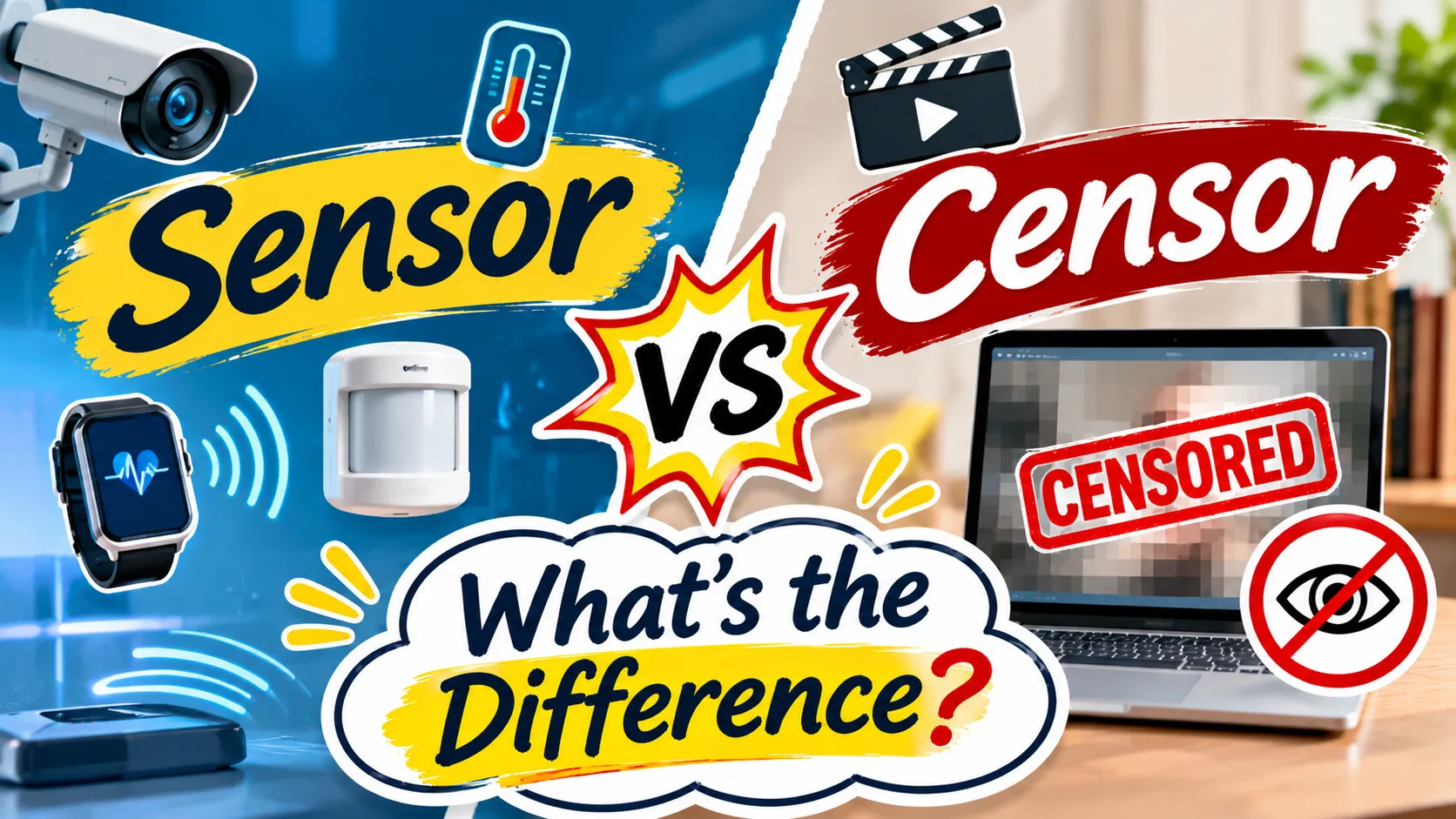
The words “sensor” and “censor” differ by just one letter and sound nearly identical, yet they describe completely different concepts. The sensor vs censor confusion appears frequently in technology discussions, news reports, and everyday writing. One word belongs to the world of engineering and measurement; the other belongs to the world of information control and scrutiny.
A sensor detects physical changes like temperature, light, or motion. A censor examines information and removes content deemed objectionable. A sensor collects data; a censor restricts it. This comprehensive guide explains the difference, explores their origins, provides practical examples, and helps you choose the correct word every time you write.
Quick Answer
A “sensor” is a device that detects and measures physical conditions like light, heat, or motion, as in “the motion sensor triggered the alarm.” A “censor” is a person or authority that examines and suppresses objectionable content, as in “the government censored the news.” Remember: a sensor senses things; a censor removes things. They sound similar but mean completely different things.
Meaning Overview Table
| Aspect | Meaning |
|---|---|
| Definition | Sensor: a device that detects physical conditions. Censor: a person or body that suppresses objectionable content |
| Pronunciation | Sensor: /ˈsɛnsər/; Censor: /ˈsɛnsər/ |
| Part of Speech | Both are nouns; both have verb forms (sensor is rare as a verb; censor is common as a verb) |
| Usage | “The temperature sensor failed” vs. “The editor censored the article” |
| Context | Sensor: technology, engineering, science. Censor: media, government, publishing, psychology |
Main Meaning
Definition
Sensor is a noun referring to a device that detects or measures a physical property—such as light, heat, pressure, motion, or sound—and responds to it. Sensors convert physical inputs into signals that can be read or processed. Censor functions as both a noun and a verb. As a noun, it refers to an official who examines material and suppresses parts considered objectionable. As a verb, it means to examine and remove or restrict content.
Origin
“Sensor” comes from the Latin sensus, meaning “sense” or “feeling,” from the verb sentire (“to feel or perceive”). The word entered English in the 20th century as technology developed. “Censor” also comes from Latin, specifically censor, a Roman magistrate who conducted censuses and supervised public morals. The word entered English in the 16th century and developed its modern meaning of content suppression.
Context
The distinction matters across several contexts:
- Technology and Engineering: “Sensor” appears constantly in discussions of smart devices, cars, and industrial equipment
- Media and Publishing: “Censor” appears in discussions of free speech, journalism, and content moderation
- Government and Politics: “Censor” describes official suppression of information
- Psychology: “Censor” appears in Freudian theory describing the mental mechanism that represses unacceptable thoughts
Modern Usage
Today, “sensor” appears constantly in technology news, from smartphone cameras to self-driving cars to smart home devices. “Censor” appears in news coverage of censorship, social media moderation, and debates about free expression. The confusion between the two persists because they sound nearly identical and spell-check often fails to catch the error.
Detailed Explanation
Literal Meaning
Literally, “sensor” means a device that senses or detects something. “Censor” literally means an official who assesses and regulates, from the Latin magistrate’s role.
Common Meaning
Commonly, people use “sensor” when discussing electronics, cars, and smart devices. They use “censor” when discussing media control, government suppression, or content moderation.
Technological Meaning
In technology, sensors detect physical conditions and convert them into signals. Motion sensors detect movement. Temperature sensors measure heat. Light sensors detect brightness. Pressure sensors measure force. These devices appear everywhere in modern life.
Political Meaning
In politics, “censor” describes official suppression of information. Governments censor news, books, and internet content. Censorship raises debates about free speech and public interest.
Psychological Meaning
In psychology, “censor” refers to the mental mechanism that represses unacceptable thoughts or desires. Freud described the censor as the part of the mind that blocks forbidden impulses from reaching consciousness.
Media Meaning
In media, “censor” describes the act of removing offensive content from films, television, books, or online platforms. Editors censor profanity. Platforms censor hate speech. Broadcasters censor sensitive material.
Examples Table
| Example | Meaning |
|---|---|
| The motion sensor triggered the lights. | A device that detects movement |
| The government censored the newspaper. | Suppressed content |
| The temperature sensor failed in the heat. | A device that measures temperature |
| The editor censored the offensive paragraph. | Removed objectionable content |
| The car’s sensors detected an obstacle. | Devices that detect conditions |
| The film was censored for violence. | Content was removed |
| The light sensor adjusts screen brightness. | A device that detects light |
| The platform censors hate speech. | Removes prohibited content |
| The pressure sensor measures tire inflation. | A device that measures pressure |
| The censor approved the film with cuts. | An official who regulates content |
Related Meanings Table
| Related Term | Meaning |
|---|---|
| Sensor | A device that detects physical conditions |
| Censor | A person or body that suppresses content; to suppress content |
| Censorship | The practice of suppressing content |
| Sensing | Detecting or perceiving |
| Sensor technology | Technology using sensors |
| Sensor data | Information collected by sensors |
| Censored | Content that has been suppressed |
| Uncensored | Content that has not been suppressed |
| Self-censorship | Suppressing one’s own expression |
| Censorious | Highly critical or disapproving |
| Sensory | Relating to the senses |
| Sensorimotor | Relating to sensory and motor functions |
| Motion sensor | A device that detects movement |
| Temperature sensor | A device that measures heat |
| Censorship laws | Laws regulating content suppression |
Common Uses
People use “sensor” and “censor” across numerous contexts:
Technology and Devices: Sensors appear in smartphones, cars, smart homes, medical devices, and industrial equipment. Motion sensors, light sensors, and temperature sensors are common.
Media and Journalism: Censors and censorship appear in discussions of press freedom, content moderation, and information control. Journalists report on censorship attempts.
Government and Politics: Governments censor information in some countries. Debates about censorship and free speech appear constantly in political discourse.
Psychology: Freudian theory describes the censor as a mental mechanism. Psychological discussions of repression use the term.
Everyday Language: People discuss sensors in cars and phones. They discuss censorship in media and social platforms.
Common Mistakes
| Mistake | Correction |
|---|---|
| Writing “censor” for the device | Write “sensor” for the detecting device |
| Writing “sensor” for content suppression | Write “censor” for suppressing content |
| Writing “the censor detected motion” | Write “the sensor detected motion” (device) |
| Writing “the government sensored the news” | Write “the government censored the news” (suppressed) |
| Writing “motion censor” | Write “motion sensor” (device) |
| Writing “temperature censor” | Write “temperature sensor” (device) |
| Writing “sensor the film” | Write “censor the film” (suppress content) |
| Writing “light sensor” as “light censor” | Write “light sensor” (device) |
| Assuming spell-check will catch the error | Spell-check often misses homophones; proofread manually |
| Writing “self-sensorship” | Write “self-censorship” (suppressing one’s own expression) |
Related Questions
Is it “sensor” or “censor”?
It depends on meaning. Use “sensor” for a device that detects physical conditions. Use “censor” for a person or body that suppresses content.
What does “sensor” mean?
“Sensor” is a noun referring to a device that detects or measures physical properties like light, heat, motion, or pressure.
What does “censor” mean?
“Censor” is a noun referring to an official who examines and suppresses objectionable content, or a verb meaning to suppress content.
What is the difference between “sensor” and “censor” in a sentence?
“Sensor” relates to detection and measurement. “Censor” relates to content suppression.
Can “censor” be a verb?
Yes. “Censor” functions as a verb meaning to examine and suppress content. For example, “The editor censored the article.”
Can “sensor” be a verb?
Rarely. “Sensor” is almost always a noun. The verb form “sense” describes detecting something.
Why do people confuse “sensor” and “censor”?
They sound nearly identical and differ by only one letter. Spell-check often misses homophones, so the error persists in written communication.
How can I remember the difference?
Remember: a sensor senses things (both start with “sens-“). A censor removes things (think of “censorship”).
FAQs
What does “sensor” mean?
“Sensor” is a device that detects or measures physical conditions such as light, heat, motion, or pressure. It converts physical inputs into signals.
What does “censor” mean?
“Censor” is a person or authority that examines and suppresses objectionable content, or the act of suppressing content.
Is it “motion sensor” or “motion censor”?
The correct phrase is “motion sensor.” A sensor is the device that detects movement.
Is it “government censor” or “government sensor”?
The correct phrase is “government censor” when referring to content suppression. “Government sensor” would refer to a device used by the government.
Can “censor” be used as a verb?
Yes. “Censor” is commonly used as a verb meaning to examine and suppress content.
What is “censorship”?
Censorship is the practice of suppressing content considered objectionable, offensive, or dangerous. It can be practiced by governments, media outlets, or platforms.
How can I remember the difference?
Remember: a sensor senses things. A censor removes things. Both words relate to their meanings: sensing detects, censorship suppresses.
What is a “temperature sensor”?
A temperature sensor is a device that measures heat or cold and converts it into a signal for monitoring or control.
Conclusion
Mastering the sensor vs censor distinction protects your writing from embarrassing word-choice errors. “Sensor” refers to a device that detects and measures physical conditions like light, heat, or motion. “Censor” refers to a person or body that suppresses objectionable content, or the act of suppressing content. Remember the simple rule: a sensor senses things; a censor removes things. Whether you’re writing a technology review, a news article, or a social media post, choosing the correct word ensures your meaning is clear. Practice using “sensor” for devices and “censor” for content control, and your readers will understand exactly what you intend. Small distinctions like this separate careful writers from careless ones.

Natalie Brooks is a content researcher and writer with a strong interest in word meanings, dream interpretations, symbolism, and cultural insights. She is passionate about creating clear, informative, and easy-to-understand content that helps readers discover the deeper meanings behind words, names, dreams, and symbols. Through her work at Meanzly, Natalie aims to make knowledge accessible and valuable for readers around the world.