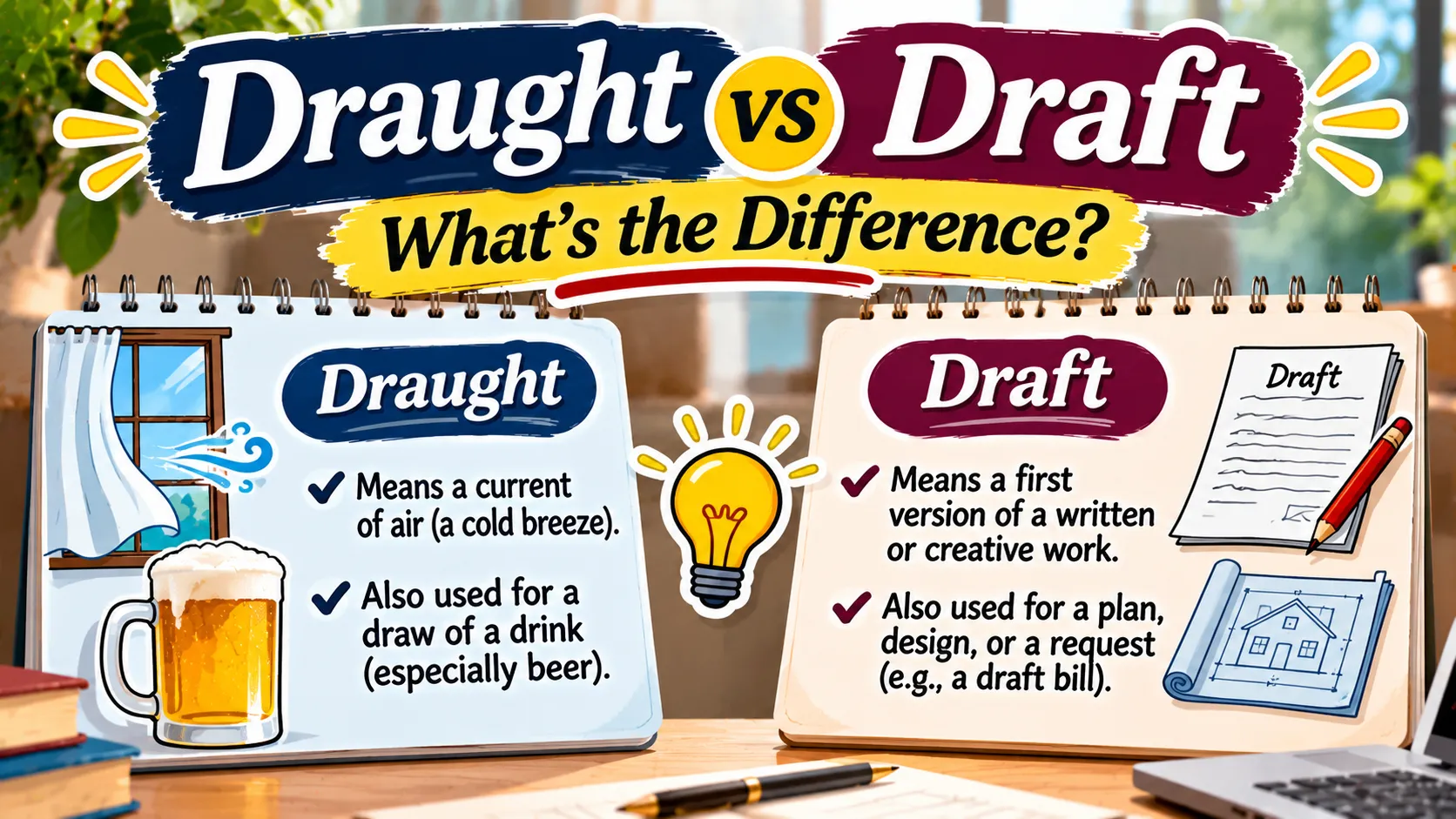
The words “draught” and “draft” represent one of the most persistent spelling variations in English. Both are pronounced the same way, both share the same etymological roots, and both appear in reputable publications across the English-speaking world. Yet the draught vs draft distinction comes down to regional preference and specific contexts rather than grammatical correctness.
“Draft” is the standard spelling in American English for all meanings, while “draught” dominates in British English for specific senses like a current of air, beer on tap, and animals used for pulling loads . The confusion arises because the two spellings coexist, often appearing side by side in the same document. This comprehensive guide explains the regional differences, explores the origins of both forms, provides practical examples, and helps you choose the right spelling for your audience.
Quick Answer
Both “draught” and “draft” are correct spellings of the same word. “Draft” is standard in American English for all meanings, including a preliminary version of a document, a current of air, and beer on tap. “Draught” is the British spelling used for a current of air, beer on tap, and draft animals, while “draft” remains standard in British English for preliminary versions and financial orders . Choose based on your audience’s regional conventions.
Meaning Overview Table
| Aspect | Meaning |
|---|---|
| Definition | Spelling variants of the same word meaning a preliminary version, a current of air, beer on tap, or pulling a load |
| Pronunciation | Both: /drɑːft/ or /dræft/ |
| Part of Speech | Nouns, verbs, and adjectives |
| Usage | “A rough draft” (US) vs. “a draught of air” (UK) |
| Context | Writing, publishing, brewing, engineering, agriculture |
Main Meaning
Definition
Draught and draft are spelling variants of the same word, which has multiple related meanings. The word can refer to a preliminary version of a document, a current of cool air, beer stored and served from a large container, the act of pulling a load, or the depth of water a boat requires to float . The choice between the two spellings depends on regional conventions and, in British English, the specific meaning.
Origin
The word traces back to Middle English and relates to the Old English verb dragan, meaning “to pull, draw, or drag” . This etymological root explains the word’s semantic development: pulling a load (draft animals), drawing up plans (draft a document), drawing beer from a cask (draught beer), and drawing air into a space (a draught). In Middle English, the word appeared in various forms, including draht, drawt, drawght, and draught. The gh spelling produced the \f\ pronunciation, which eventually led to the phonetic spelling “draft” gaining ground by the 18th century .
Context
The distinction matters across several contexts:
- American English: “Draft” is used for all meanings, including air currents, beer, and preliminary versions
- British English: “Draft” is used for preliminary versions and financial orders, while “draught” is preferred for air currents, beer, and draft animals
- Australian English: Follows British conventions for air, beer, and animals, but uses “draft” for plans and sports
- Canadian English: Generally follows American conventions, though both spellings appear
- Specialized Contexts: Technical drawing, brewing, and agriculture maintain specific preferences
Modern Usage
Today, “draft” dominates in North America across all contexts. In the UK, both spellings coexist with distinct roles: “draft” for written documents and financial instruments, “draught” for air currents, beer, and working animals . Australian English is trending toward American usage, with the Macquarie Dictionary noting that Australian English is beginning to replace “draught” with “draft” in most contexts . The distinction persists in formal writing and regional publications.
Detailed Explanation
Literal Meaning
Literally, both words refer to the act of pulling or drawing. This original sense survives in “draft animals” (or “draught animals”), horses or oxen used for pulling loads, and in the nautical sense of a ship’s draft (the depth of water it draws) .
Common Meaning
Commonly, people use “draft” to describe a preliminary version of a document. “I wrote a rough draft of my essay.” They use “draught” (in British English) to describe a current of cold air entering a room. “There’s a draught coming from the window.”
Writing and Publishing Meaning
In writing and publishing, “draft” is the standard spelling in all varieties of English. Writers produce first drafts, rough drafts, and final drafts. Editors review drafts. This sense consistently uses “draft” regardless of region .
Brewing Meaning
In brewing, “draft” (American) or “draught” (British) describes beer stored in and served from a cask or keg rather than bottles or cans. American bars often use “draught” for imported or premium beers to signal a European or craft aesthetic . The phrase “on tap” serves as a synonym in both regions.
Nautical Meaning
In nautical contexts, “draft” (American) or “draught” (British) refers to the depth of water a vessel requires to float. A ship with a deep draft needs deeper water. This technical usage follows regional spelling conventions .
Agricultural Meaning
In agriculture, “draft” (American) or “draught” (British) describes animals used for pulling heavy loads. Draft horses, draft oxen, and draft mules perform agricultural work. The spelling follows regional conventions .
Examples Table
| Example | Meaning |
|---|---|
| She wrote a rough draft of her speech. | Preliminary version (standard in all regions) |
| A cold draught came under the door. | Air current (British spelling) |
| The bar serves draft beer. | Beer on tap (American spelling) |
| The pub serves draught beer. | Beer on tap (British spelling) |
| The ship has a shallow draft. | Depth of water required (American) |
| The vessel has a shallow draught. | Depth of water required (British) |
| The farmer used draft horses. | Animals for pulling loads (American) |
| The farmer used draught horses. | Animals for pulling loads (British) |
| The bank issued a draft for the payment. | Financial order (standard in all regions) |
| He took a long draught of water. | A swallow of liquid (British spelling) |
Related Meanings Table
| Related Term | Meaning |
|---|---|
| Draft | American spelling for all meanings; British spelling for documents and finance |
| Draught | British spelling for air, beer, and draft animals |
| Drafty | American spelling for a place with cold air currents |
| Draughty | British spelling for a place with cold air currents |
| Draftsman | American spelling for someone who draws plans |
| Draughtsman | British spelling for someone who draws technical plans |
| Draft animal | American spelling for a working animal |
| Draught animal | British spelling for a working animal |
| On draft | American phrase for beer from a keg |
| On draught | British phrase for beer from a keg |
| Draft pick | Sports selection system (American) |
| Bank draft | Financial instrument (standard in all regions) |
| First draft | Preliminary version (standard in all regions) |
| Rough draft | Unpolished version (standard in all regions) |
| Final draft | Completed version (standard in all regions) |
Common Uses
People use “draught” and “draft” across numerous contexts:
Writing and Publishing: Writers and editors use “draft” universally for preliminary versions of documents. This usage is consistent across American, British, and Australian English .
Home and Architecture: British English uses “draught” for cold air entering a building. American English uses “draft.” Homeowners seal windows and doors to block drafts or draughts.
Brewing and Hospitality: Pubs in the UK serve draught beer. American bars serve draft beer, though some use “draught” for premium or imported beers .
Engineering and Technical Drawing: British English uses “draughtsman” for someone who prepares technical drawings, while “draftsman” refers to someone who draws up legal documents .
Agriculture: Farmers use draft horses (American) or draught horses (British) for pulling loads.
Finance: Banks issue bank drafts in all English-speaking countries. This usage consistently uses “draft” .
Common Mistakes
| Mistake | Correction |
|---|---|
| Using “draught” in American English for air currents | Use “draft” in American English |
| Using “draft” in British English for air currents | Use “draught” in British English |
| Writing “rough draught” | Write “rough draft” (standard in all regions) |
| Writing “draft beer” in British English | Write “draught beer” in British English |
| Writing “draught horse” in American English | Write “draft horse” in American English |
| Using “draught” for financial orders in British English | Use “draft” for financial orders |
| Writing “draughtsman” for legal document preparation | Use “draftsman” for legal documents in British English |
| Assuming the spellings are always interchangeable | Regional and contextual rules apply |
| Using “draught” in American sports contexts | Use “draft” for sports selection in American English |
| Forgetting that “draft” is standard for writing in all regions | “Draft” is universal for documents |
Related Questions
Is it “draught” or “draft”?
Both are correct. “Draft” is standard in American English for all meanings. “Draught” is the British spelling for air currents, beer, and draft animals, while British English uses “draft” for documents and financial orders .
What is the difference between draught and draft?
The difference is regional and contextual. American English uses “draft” universally. British English uses “draught” for air, beer, and animals, and “draft” for documents and finance.
Is “draught” British or American?
“Draught” is primarily British. American English uses “draft” for all meanings, though “draught” occasionally appears for imported or premium beer .
Why do British and American English spell it differently?
The spelling difference stems from historical pronunciation changes and Noah Webster’s American spelling reforms, which favored simpler phonetic spellings .
Can I use “draft” in British English?
Yes. “Draft” is standard in British English for preliminary versions and financial orders. It is increasingly used for other meanings as well .
What does “draught” mean in a pub?
In British English, “draught” refers to beer stored in and served from a keg or cask rather than bottles or cans.
FAQs
What does “draught” mean?
“Draught” is the British spelling of “draft.” It refers to a current of air, beer on tap, the act of pulling a load, or the depth of water a boat requires to float .
What does “draft” mean?
“Draft” is the American spelling for all meanings. It refers to a preliminary version of a document, a current of air, beer on tap, conscription, or a sports selection system .
Is it “draft beer” or “draught beer”?
Both are correct. “Draft beer” is standard in American English. “Draught beer” is standard in British English .
What is a “draft horse”?
A draft horse (American) or draught horse (British) is a horse bred for pulling heavy loads, such as plowing or hauling.
What is a “bank draft”?
A bank draft is a financial instrument in which a bank orders payment to a third party. This usage consistently uses “draft” in all varieties of English .
Why do Americans say “draft” and British say “draught”?
American English adopted “draft” as part of broader spelling reforms that favored phonetic simplicity. British English retained “draught” for specific meanings while accepting “draft” for others .
Can “draught” be used in American English?
Rarely. American English uses “draft” for all meanings, though “draught” sometimes appears for imported or premium beer to signal a European aesthetic .
How do you pronounce “draught”?
“Draught” is pronounced /drɑːft/ or /dræft/, exactly like “draft.” The “gh” is silent .
Conclusion
Mastering the draught vs draft distinction comes down to understanding regional conventions. American English uses “draft” for everything: air currents, beer, documents, and animals. British English uses “draught” for air currents, beer, and working animals, while reserving “draft” for preliminary versions and financial orders. Australian English follows British conventions for some meanings but trends toward American usage overall . Neither spelling is wrong, and the choice depends entirely on your audience. Whether you write “draft beer” or “draught beer,” “rough draft” or “rough draught,” your meaning remains clear. Choose the spelling that matches your region and context, apply it consistently, and write with confidence knowing that both forms are standard English.

Natalie Brooks is a content researcher and writer with a strong interest in word meanings, dream interpretations, symbolism, and cultural insights. She is passionate about creating clear, informative, and easy-to-understand content that helps readers discover the deeper meanings behind words, names, dreams, and symbols. Through her work at Meanzly, Natalie aims to make knowledge accessible and valuable for readers around the world.