The words “vary” and “very” differ by just one letter, sound similar in casual speech, and appear in completely different grammatical roles. The vary vs very confusion ranks among the most common spelling errors in English writing, appearing in everything from business emails to academic essays.
“Vary” is a verb meaning to change, differ, or alternate. “Very” is an adverb meaning to a high degree or extremely. The confusion arises because the words look similar and spell-check often fails to catch the error when the wrong word is technically a real word. This comprehensive guide explains the difference, explores their origins, provides practical examples, and helps you choose the correct word every time you write.
Quick Answer
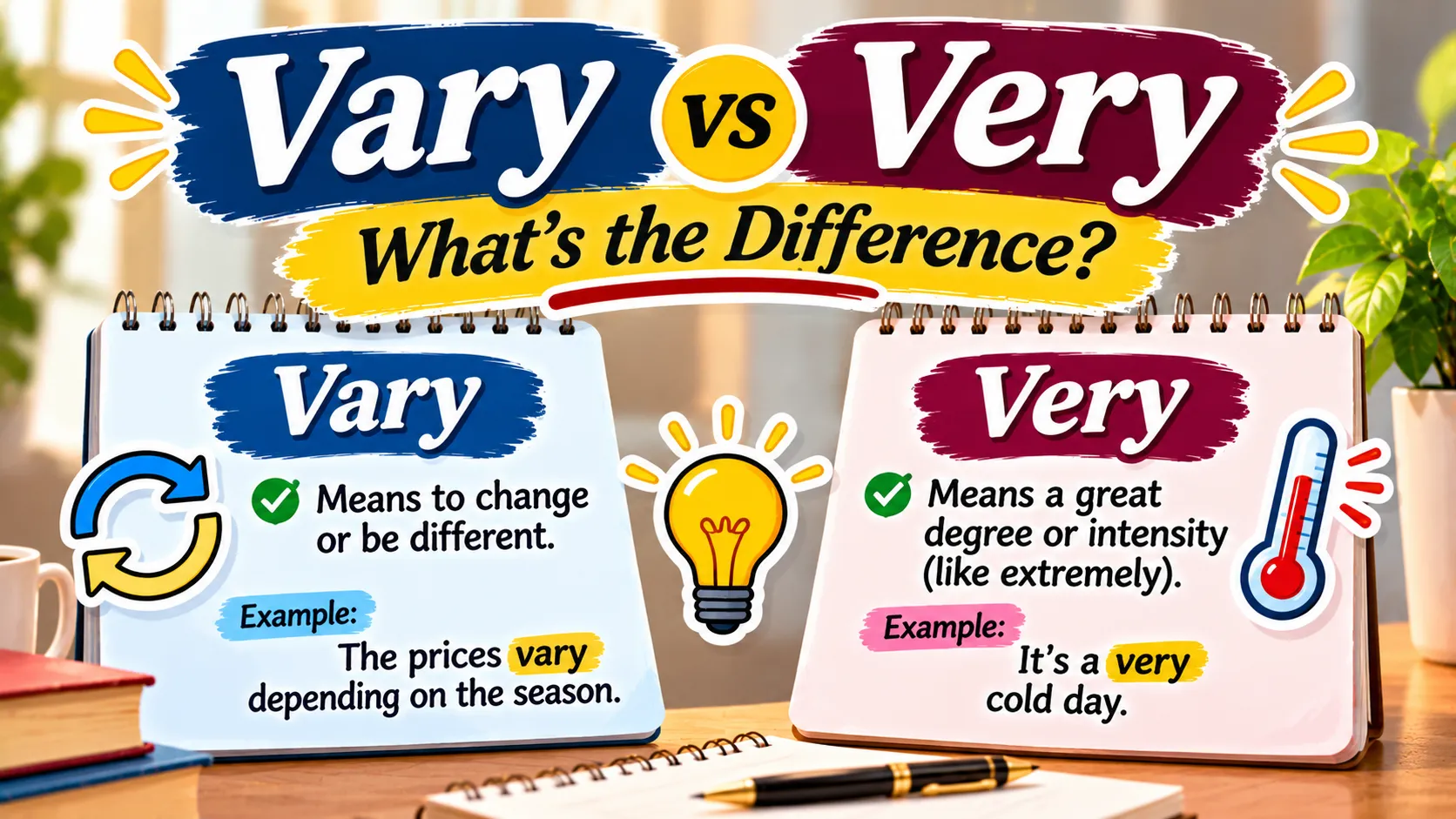
“Vary” is a verb meaning to change or differ, as in “prices vary by location.” “Very” is an adverb meaning extremely or to a high degree, as in “she was very happy.” Remember: vary has an “a” for “alter”; very has an “e” for “extremely.” They look similar but serve completely different grammatical functions.
Meaning Overview Table
| Aspect | Meaning |
|---|---|
| Definition | Vary: to change, differ, or alternate. Very: to a high degree; extremely |
| Pronunciation | Vary: /ˈveəri/ or /ˈveri/; Very: /ˈveri/ |
| Part of Speech | Vary: verb. Very: adverb (and sometimes adjective) |
| Usage | “Results vary widely” vs. “The results were very good” |
| Context | Vary: statistics, science, descriptions of change. Very: emphasis, intensification, everyday speech |
Main Meaning
Definition
Vary is a verb meaning to undergo change, to differ from one another, or to alternate between different forms or conditions. It describes the act of changing or the state of being different. Very is an adverb meaning to a high degree, extremely, or in a great measure. It intensifies adjectives, adverbs, and sometimes nouns.
Origin
“Vary” comes from the Latin verb variare, meaning “to change” or “to make different,” from varius (“various, diverse”). It entered English in the 14th century through Old French varier. “Very” comes from the Old French verai, meaning “true” or “genuine,” from the Latin veracus, related to verus (“true”). The meaning shifted from “truly” to “extremely” over centuries.
Context
The distinction matters across several contexts:
- Academic and Scientific Writing: “Vary” appears in discussions of data, results, and conditions that change
- Everyday Speech: “Very” appears constantly as an intensifier
- Business Writing: “Vary” describes fluctuating prices, conditions, or outcomes; “very” adds emphasis
- Creative Writing: “Vary” describes change and diversity; “very” intensifies descriptions
Modern Usage
Today, “vary” appears frequently in statistical, scientific, and descriptive contexts. “Very” appears constantly in everyday speech and writing as an intensifier. The confusion between the two persists because they look similar, sound similar in some accents, and spell-check often fails to catch the error when both words are real.
Detailed Explanation
Literal Meaning
Literally, “vary” means to change or differ. “Very” literally meant “truly” or “genuinely” in its earliest English usage, but modern usage emphasizes degree rather than truth.
Common Meaning
Commonly, people use “vary” to describe differences or changes. “Prices vary by region.” They use “very” to intensify. “That was very kind of you.”
Grammatical Meaning
Grammatically, “vary” is a verb and takes subjects, objects, and verb forms. “Very” is an adverb that modifies adjectives, other adverbs, and sometimes nouns. It cannot function as a verb.
Scientific Meaning
In science and statistics, “vary” describes how data points differ from one another. “Results vary across trials.” “The temperature varies throughout the day.” This usage is precise and technical.
Emphatic Meaning
“Very” serves as an intensifier. It strengthens adjectives (“very happy”), adverbs (“very quickly”), and sometimes nouns (“the very best”). It adds emphasis without changing the basic meaning.
Examples Table
| Example | Meaning |
|---|---|
| Prices vary by location. | Change or differ |
| She was very tired after work. | Extremely tired |
| Results vary from person to person. | Differ |
| The food was very delicious. | Extremely delicious |
| Temperatures vary throughout the year. | Change |
| He was very careful with the glass. | Extremely careful |
| Opinions vary on this topic. | Differ |
| That was a very good idea. | Extremely good |
| The colors vary in intensity. | Change or differ |
| She spoke very softly. | Extremely softly |
Related Meanings Table
| Related Term | Meaning |
|---|---|
| Vary | To change, differ, or alternate |
| Very | To a high degree; extremely |
| Various | Different from one another |
| Variety | A range of different things |
| Variable | Something that can change |
| Variation | A change or difference |
| Varied | Having different forms or types |
| Varying | Changing or differing (present participle) |
| Verily | Truly; certainly (archaic) |
| Veritable | Genuine; true |
| Extremely | To a very high degree |
| Highly | To a great degree |
| Really | Truly; very |
| Quite | To a considerable degree |
| Truly | Genuinely; very |
Common Uses
People use “vary” and “very” across numerous contexts:
Statistics and Science: Researchers describe how results vary across conditions. “The data varies significantly between groups.”
Everyday Conversation: People use “very” constantly to intensify descriptions. “That’s very interesting” or “She’s very smart.”
Business Writing: Analysts note that prices, conditions, and outcomes vary. “Costs vary depending on the supplier.”
Creative Writing: Writers vary sentence structure and use “very” sparingly to avoid weak prose. Strong writing often replaces “very” with more precise words.
Academic Writing: Scholars describe variables that vary and use “very” cautiously to maintain precision.
Common Mistakes
| Mistake | Correction |
|---|---|
| Writing “prices very by location” | Write “prices vary by location” (change) |
| Writing “she was vary tired” | Write “she was very tired” (extremely) |
| Writing “results vary from person to person” correctly | “Vary” is correct here; “very” would be wrong |
| Writing “the food was vary delicious” | Write “the food was very delicious” (extremely) |
| Writing “temperatures very throughout the year” | Write “temperatures vary throughout the year” (change) |
| Writing “he was vary careful” | Write “he was very careful” (extremely) |
| Writing “opinions very on this topic” | Write “opinions vary on this topic” (differ) |
| Assuming spell-check will catch the error | Spell-check often misses real-word errors; proofread manually |
| Writing “that was a vary good idea” | Write “that was a very good idea” (extremely) |
| Writing “the colors very in intensity” | Write “the colors vary in intensity” (change) |
Related Questions
Is it “vary” or “very”?
It depends on meaning. Use “vary” as a verb meaning to change or differ. Use “very” as an adverb meaning extremely.
What does “vary” mean?
“Vary” is a verb meaning to change, differ, or alternate. It describes differences or changes in conditions, data, or opinions.
What does “very” mean?
“Very” is an adverb meaning to a high degree or extremely. It intensifies adjectives, adverbs, and sometimes nouns.
What is the difference between “vary” and “very” in a sentence?
“Vary” functions as a verb describing change or difference. “Very” functions as an adverb intensifying another word.
Why do people confuse “vary” and “very”?
They look similar and sound similar in some accents. Spell-check often misses the error because both words are real.
Can “very” be a verb?
No. “Very” is an adverb. The verb form is “vary.”
Can “vary” be an adverb?
No. “Vary” is a verb. The adverb form is “variously.”
How can I remember the difference?
Remember: “vary” has an “a” for “alter” (change). “Very” has an “e” for “extremely.”
FAQs
What does “vary” mean?
“Vary” is a verb meaning to change, differ, or alternate. It describes differences in conditions, data, or opinions.
What does “very” mean?
“Very” is an adverb meaning to a high degree or extremely. It intensifies adjectives, adverbs, and sometimes nouns.
Is it “prices vary” or “prices very”?
The correct phrase is “prices vary.” Vary is the verb meaning to change or differ.
Is it “very good” or “vary good”?
The correct phrase is “very good.” Very is the adverb meaning extremely.
Can “vary” be used as an adverb?
No. “Vary” is a verb. The adverb form is “variously.”
Can “very” be used as an adjective?
Yes, “very” can function as an adjective meaning “actual” or “precise,” as in “the very best” or “the very same day.” However, its most common use is as an adverb.
What is the noun form of “vary”?
The noun form is “variation” or “variety.” “Variation” refers to a change or difference. “Variety” refers to a range of different things.
How can I remember the difference?
Remember: “vary” has an “a” for “alter” (change). “Very” has an “e” for “extremely.”
Conclusion
Mastering the vary vs very distinction protects your writing from embarrassing real-word errors. “Vary” is a verb meaning to change, differ, or alternate. “Very” is an adverb meaning extremely or to a high degree. Remember the simple rule: vary has an “a” for “alter”; very has an “e” for “extremely.” Whether you’re writing a statistical report, an academic essay, or a casual email, choosing the correct word ensures your meaning is clear. Practice using “vary” for change and difference, and “very” for emphasis, and your readers will understand exactly what you intend. Small distinctions like this separate careful writers from careless ones.

Natalie Brooks is a content researcher and writer with a strong interest in word meanings, dream interpretations, symbolism, and cultural insights. She is passionate about creating clear, informative, and easy-to-understand content that helps readers discover the deeper meanings behind words, names, dreams, and symbols. Through her work at Meanzly, Natalie aims to make knowledge accessible and valuable for readers around the world.