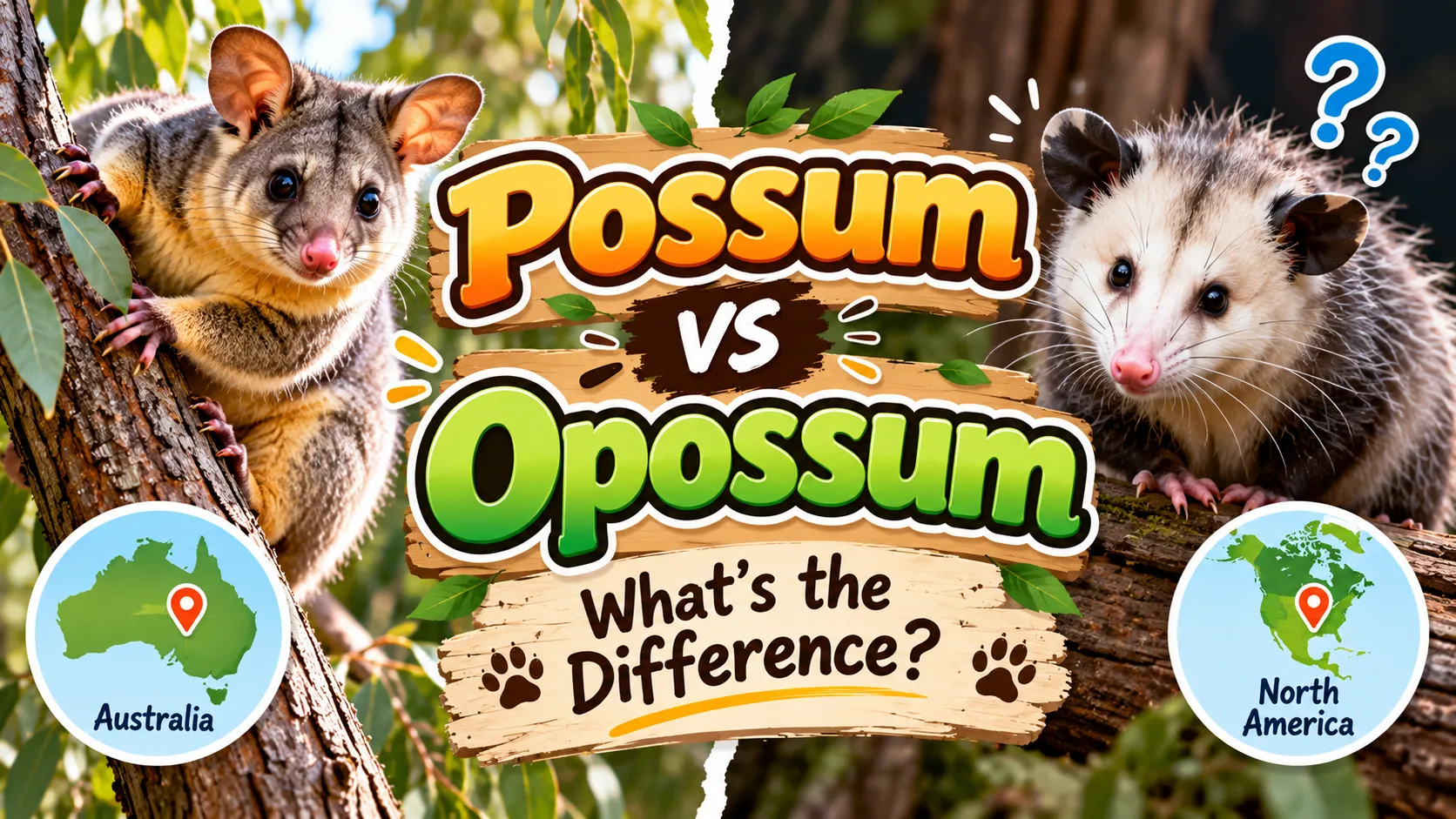
The words “possum” and “opossum” confuse even native English speakers, and for good reason. In everyday American speech, both words describe the same fuzzy, white-faced marsupial that rummages through backyard trash cans. Yet in scientific and international contexts, the distinction matters more than most people realize. The possum vs opposum debate—note that “opposum” is a common misspelling—centers on geography, taxonomy, and a silent letter that has puzzled writers for centuries.
“Opossum” is the formal name for the North American marsupial, derived from an Algonquian word meaning “white animal.” “Possum” is the informal shortening that most Americans use in daily conversation. However, “possum” also refers to a completely different group of marsupials native to Australia and New Zealand. This guide untangles the confusion, explains the origins of both words, and helps you use each correctly.
Quick Answer
“Opossum” is the formal name for the North American marsupial, while “possum” is the common informal term for the same animal in the US. However, “possum” also refers to a different family of marsupials native to Australia and New Zealand. In scientific contexts, use “opossum” for the American animal and “possum” for the Australasian ones.
Meaning Overview Table
| Aspect | Meaning |
|---|---|
| Definition | Opossum: North American marsupial. Possum: informal US term for opossum, or Australian/New Zealand marsupials |
| Pronunciation | Opossum: /əˈpɒsəm/ or /ˈpɒsəm/ (silent O). Possum: /ˈpɒsəm/ |
| Part of Speech | Nouns |
| Usage | “An opossum crossed the road” (formal US) / “A possum crossed the road” (informal US) / “Possums live in Australian trees” |
| Context | Zoology, everyday conversation, wildlife writing, regional usage |
Main Meaning
Definition
Opossum is the formal name for the Virginia opossum (Didelphis virginiana), the only marsupial native to North America north of Mexico. It belongs to the family Didelphidae, which includes over 100 species found across the Americas. Possum serves two functions: it is the common informal term Americans use for the opossum, and it is the correct scientific and common name for the tree-dwelling marsupials of Australia, New Guinea, and nearby islands, which belong to the order Phalangeriformes.
Origin
Both words trace to the Algonquian word wapathemwa or aposoum, meaning “white animal” or “white beast,” which English colonists recorded in the early 1600s as “opossum” . The shortened form “possum” appeared almost immediately, with records dating to 1613, just three years after the first recorded “opossum” . This shortening resulted from aphesis—the loss of an unstressed initial vowel—a common process in English word borrowing .
The Australian connection came later. When English explorers reached Australia, they applied the familiar name “possum” to the similar-looking marsupials they found there, even though those animals belong to a completely different taxonomic family . The name stuck, creating the modern confusion.
Context
The distinction matters across several contexts:
- American English: “Possum” dominates everyday speech and writing, while “opossum” appears in scientific, academic, and formal contexts
- Australian and New Zealand English: “Possum” is the standard term for native marsupials, with “opossum” sometimes used in legislation or older scientific texts
- Scientific Writing: Zoologists distinguish clearly between opossums (Didelphidae, Americas) and possums (Phalangeriformes, Australasia)
- International Communication: Using the wrong term can cause confusion about which continent’s animal you mean
Modern Usage
In the United States, “possum” remains far more common in general speech and writing, while “opossum” dominates textbooks, encyclopedias, and scientific publications . Most Americans pronounce “opossum” without the initial O, saying it exactly like “possum” . The phrase “playing possum”—meaning to pretend to be dead—always uses the shortened form, never “playing opossum” . In Australia and New Zealand, “possum” is the accepted term, though some official documents still use “opossum” .
Detailed Explanation
Literal Meaning
Literally, “opossum” refers to the North American marsupial with a white face, bare tail, and a tendency to play dead when threatened. “Possum” literally refers to the Australasian marsupials with furry tails and large ears, or informally to the American opossum.
Common Meaning
Commonly, Americans use “possum” for the animal they see in their yards, while “opossum” appears in formal writing. Australians use “possum” for their native animals, which are protected and often seen in urban areas . The confusion arises because both words describe marsupials, but they are not closely related.
Scientific Meaning
In zoology, the distinction is strict. Opossums belong to the order Didelphimorphia, found only in the Americas. Possums belong to the order Diprotodontia, suborder Phalangeriformes, found in Australasia . The two groups diverged tens of millions of years ago and share only distant evolutionary connections.
Regional Meaning
Region determines usage. In the US, “possum” is informal and “opossum” is formal. In Australia and New Zealand, “possum” is the standard term regardless of formality, while “opossum” appears in some legal and historical documents . And In the UK, both terms appear, though “opossum” is more common for the American animal.
Internet and Social Media Meaning
Online, the confusion persists. Memes and videos often caption the American animal as “possum” for relatability and humor. Wildlife rescue organizations typically use “opossum” in educational materials but acknowledge “possum” as the common name. Search results mix both terms, making it difficult for curious readers to find clear answers.
Cultural Meaning
Culturally, the opossum holds a place in American folklore as a clever survivor—hence “playing possum.” In Australia, the possum is a beloved native animal, often featured in children’s books and wildlife tourism. The word’s dual meaning reflects the history of English exploration and the tendency to name new creatures after familiar ones.
Examples Table
| Example | Meaning |
|---|---|
| An opossum rummaged through the trash. | Formal term for the North American marsupial |
| I saw a possum in my backyard. | Informal American term for the opossum |
| Possums are native to Australia. | Correct term for Australasian marsupials |
| The opossum played dead when threatened. | Scientific/formal reference to the American animal |
| Opossums eat thousands of ticks each year. | Formal reference to the North American species |
| The brushtail possum is common in Sydney. | Australian marsupial, distinct from the American opossum |
| She wrote “opossum” in her biology paper. | Scientific writing favors the formal term |
| He joked about “playing possum” to avoid work. | Common idiom uses the shortened form |
| New Zealand possums damage native forests. | Australasian marsupial, an invasive species there |
| The zoo has both opossums and possums. | Distinguishes the two different groups of animals |
Related Meanings Table
| Related Term | Meaning |
|---|---|
| Opossum | North American marsupial; formal term |
| Possum | Informal US term for opossum; or Australasian marsupial |
| Virginia opossum | The specific North American species (Didelphis virginiana) |
| Brushtail possum | Common Australian possum species |
| Playing possum | Idiom meaning to pretend to be dead |
| Marsupial | Mammal that carries young in a pouch |
| Didelphidae | Scientific family of American opossums |
| Phalangeriformes | Scientific order of Australasian possums |
| Aphesis | Loss of an unstressed initial vowel (how “opossum” became “possum”) |
| Algonquian | Native American language family that gave us “opossum” |
| White animal | Literal meaning of the Algonquian root word |
| Scavenger | Opossums are opportunistic scavengers |
| Tick control | Opossums eat thousands of ticks, reducing disease risk |
| Nocturnal | Both opossums and possums are active at night |
| Prehensile tail | Opossums have bare, grasping tails; possums have furry tails |
Common Uses
People use these terms across several contexts:
Everyday American Speech: Most Americans say “possum” when describing the animal in their yard or on the road. “I saw a possum” is far more common than “I saw an opossum” in casual conversation .
Scientific and Academic Writing: Biologists, ecologists, and wildlife researchers use “opossum” for the North American animal and “possum” for Australasian species. Textbooks and encyclopedias follow this convention .
Australian and New Zealand English: “Possum” is the standard term for native marsupials. New Zealanders discuss “possum control” because the introduced Australian possum damages native forests .
Wildlife Rehabilitation: Rescue organizations typically use “opossum” in formal materials but recognize that the public searches for “possum.” They often use both terms to reach a wider audience.
Idioms and Expressions: “Playing possum” is the most common phrase involving either word. It always uses the shortened form, never “playing opossum” .
Common Mistakes
| Mistake | Correction |
|---|---|
| Spelling it “opposum” | The correct spellings are “opossum” or “possum”—never “opposum” |
| Using “possum” in scientific writing about the American animal | Use “opossum” in formal scientific contexts |
| Using “opossum” for the Australian animal | Use “possum” for Australasian marsupials |
| Assuming “opossum” and “possum” are always the same animal | They can refer to different animals depending on context |
| Pronouncing “opossum” with a hard O | The O is typically silent: say “possum” |
| Saying “playing opossum” | The idiom is “playing possum” |
| Writing “a opossum” instead of “an opossum” | Use “an” before the pronounced vowel sound, though “a possum” is correct |
| Assuming all marsupials are opossums | Marsupials include kangaroos, koalas, and many others |
| Believing opossums carry rabies frequently | Opossums have low body temperatures, making rabies rare |
| Thinking possums are rodents | Possums are marsupials, not rodents |
Related Questions
Is it possum or opossum?
Both are correct for the North American animal. “Possum” is the common informal term; “opossum” is the formal scientific term. For the Australian animal, “possum” is correct. The possum vs opossum distinction depends entirely on context and region.
Why is there an O in opossum if it’s silent?
The word comes from an Algonquian term recorded as “opossum” in the early 1600s. The initial O was often dropped in speech, creating “possum” by 1613. The silent O remains in the formal spelling but is typically not pronounced. This quirk explains much of the possum vs opossum confusion.
What is the difference between a possum and an opossum?
Opossums are native to North and South America. Possums are native to Australia, New Guinea, and nearby islands. They are different animals belonging to different taxonomic orders. Understanding the possum vs opossum difference prevents international confusion.
Is “opposum” a correct spelling?
No. “Opposum” is a common misspelling. The correct spellings are “opossum” (with one P) and “possum” (with one O). The possum vs opossum debate never includes “opposum” as a valid option.
Do opossums really play dead?
Yes. When threatened, opossums enter an involuntary shock-like state that can last minutes to hours. They foam at the mouth and emit a foul smell, convincing predators they are dead. This behavior gives us the phrase “playing possum,” a key part of possum vs opossum trivia.
FAQs
What is the correct spelling: possum or opossum?
Both are correct depending on context. Use “opossum” for formal writing about the North American animal. Use “possum” in everyday American speech or when referring to Australasian marsupials.
Is it “a opossum” or “an opossum”?
Grammatically, “an opossum” is correct because the word begins with a vowel sound when the O is pronounced. However, since most people say “possum,” they write “a possum.” The possum vs opossum distinction matters here because pronunciation determines the article you choose.
In formal writing, use “an opossum.” The possum vs opossum rule also explains why “a possum” sounds natural—the shortened form begins with a consonant sound.
Many writers stumble over this because the possum vs opossum spelling difference creates a pronunciation gap. When you pronounce the silent O, “an opossum” is correct. When you drop it, “a possum” is correct.
What does “playing possum” mean?
“Playing possum” means pretending to be dead or unconscious to avoid danger or responsibility. The phrase comes from the opossum’s involuntary defense mechanism.
Are opossums and possums related?
Only distantly. Both are marsupials, but they belong to different orders and evolved on different continents. They share a common ancestor from millions of years ago but are not close relatives.
Why do Australians call them possums?
English explorers applied the name “possum” to Australian marsupials because they resembled the American opossum. The name stuck, even though the animals are taxonomically different. This history fuels the possum vs opossum confusion.
Do opossums carry diseases?
Opossums have a lower body temperature than most mammals, making them poor hosts for rabies and other diseases. They eat ticks and clean up carrion, providing ecological benefits.
What is the plural of opossum?
The plural is “opossums.” The plural of “possum” is “possums.”
Can I use “possum” in a scientific paper?
Only if you are writing about Australasian marsupials. For the North American animal, scientific convention requires “opossum.” Mastering the possum vs opossum rule ensures accuracy in academic writing.
Conclusion
The possum vs opossum distinction comes down to context, geography, and formality. In everyday American speech, “possum” rules. In scientific writing and formal documents, “opossum” is the correct choice for the North American marsupial. And in Australia and New Zealand, “possum” refers to an entirely different group of animals. The possum vs opossumconfusion persists because both words sound nearly identical and describe animals that look superficially similar.
The silent O in “opossum” reflects centuries of linguistic evolution, from Algonquian roots to modern pronunciation. Understanding the possum vs opossum difference helps writers avoid embarrassing errors in academic papers, wildlife articles, and everyday messages. Whether you’re writing a biology paper, chatting with a neighbor about the animal in your yard, or discussing wildlife in Australia, knowing which word to use shows attention to detail and respect for scientific accuracy. The possum vs opossum rule is simple: formal American writing takes the O, casual American speech drops it, and Australasian wildlife always uses “possum.” Choose wisely, and your readers will know exactly which marsupial you mean.

Natalie Brooks is a content researcher and writer with a strong interest in word meanings, dream interpretations, symbolism, and cultural insights. She is passionate about creating clear, informative, and easy-to-understand content that helps readers discover the deeper meanings behind words, names, dreams, and symbols. Through her work at Meanzly, Natalie aims to make knowledge accessible and valuable for readers around the world.