The words “foreword” and “forward” look similar, sound nearly identical, and appear in related but distinct contexts. The foreword vs forward distinction trips up many writers, especially those composing book introductions or drafting directional instructions. Understanding this difference helps you write with precision and avoid embarrassing errors in published work.
“Foreword” is a noun referring to a short introductory section at the beginning of a book, typically written by someone other than the author. “Forward” functions as an adverb, adjective, verb, and noun, primarily meaning toward the front or ahead. These words share similar spelling but serve completely different grammatical functions. This comprehensive guide explains the distinction, explores their origins, provides practical examples, and helps you choose the correct word every time you write.
Quick Answer
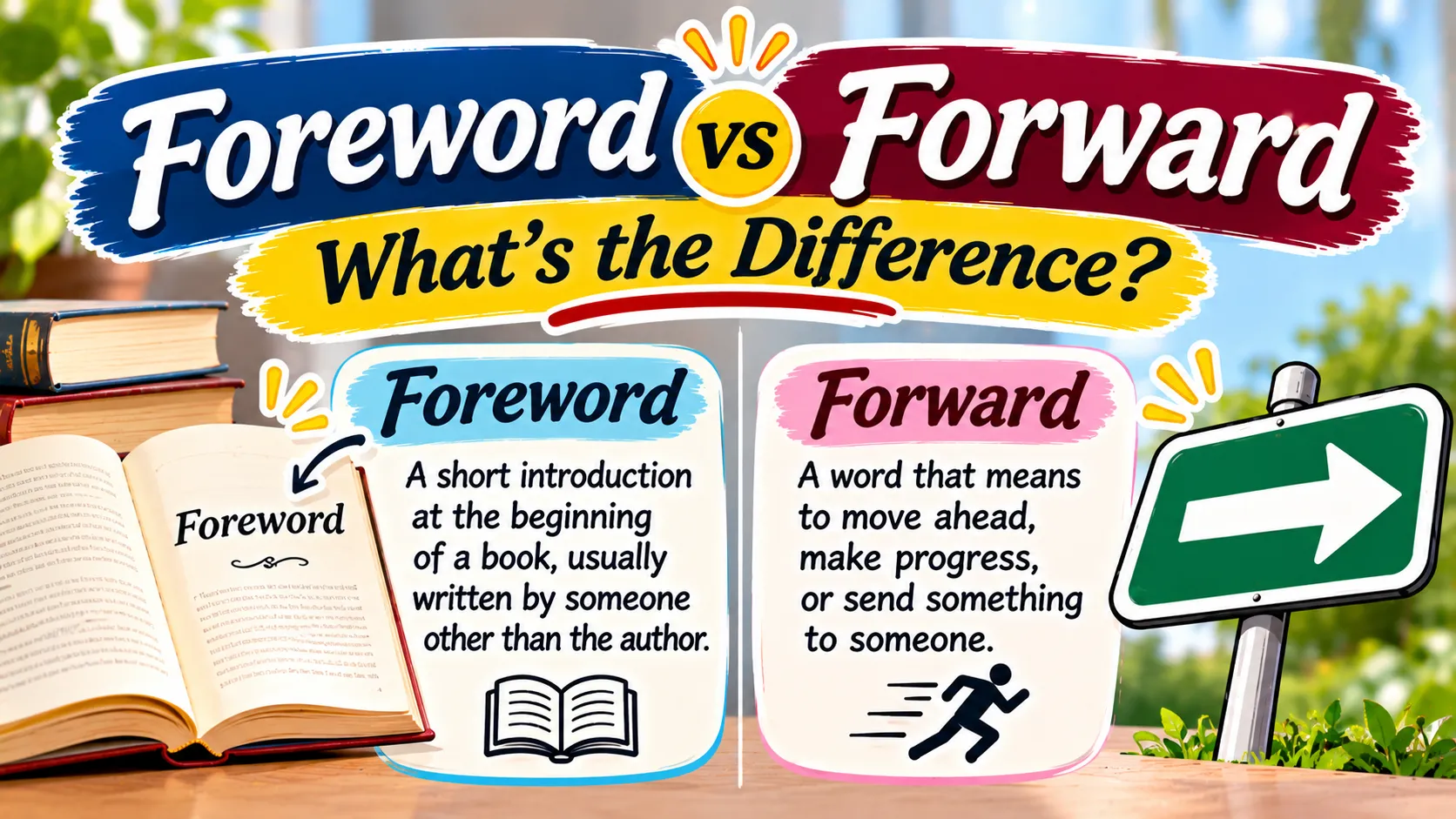
“Foreword” is a noun meaning an introductory section at the start of a book, usually written by someone other than the author. “Forward” is an adverb, adjective, verb, or noun meaning toward the front, ahead in time, or to send onward. Remember: a foreword is a word at the front of a book; forward means moving ahead. They sound alike but mean completely different things.
Meaning Overview Table
| Aspect | Meaning |
|---|---|
| Definition | Foreword: an introductory section in a book. Forward: toward the front, ahead, or to send onward |
| Pronunciation | Both: /ˈfɔːrwərd/ |
| Part of Speech | Foreword: noun. Forward: adverb, adjective, verb, noun |
| Usage | “The author wrote a foreword” vs. “Move forward slowly” |
| Context | Foreword: publishing, literature, books. Forward: directions, sports, business, military |
Main Meaning
Definition
Foreword is a noun referring to a brief introductory statement at the beginning of a book, typically written by someone other than the author—often an expert, celebrity, or notable figure who lends credibility to the work. It precedes the preface and the main text.
Forward functions as multiple parts of speech. As an adverb, it means toward the front or ahead in time. As an adjective, it means at or near the front. And As a verb, it means to send something onward. As a noun, it refers to a position in sports or a type of player.
Origin
“Foreword” combines “fore-” (meaning “before” or “in front”) and “word,” literally meaning “a word before.” The term emerged in the 19th century to distinguish the introductory section from the “preface,” which the author typically writes.
“Forward” comes from Old English foreweard, combining “fore” (before) and “-weard” (toward). The word has been used for over a thousand years to indicate direction and progress.
Context
The distinction matters across several contexts:
- Publishing and Literature: “Foreword” appears in book descriptions, publishing contracts, and author acknowledgments
- Directions and Movement: “Forward” appears in navigation, sports, and everyday instructions
- Business and Communication: “Forward” appears in email instructions, strategic planning, and logistics
- Military and Sports: “Forward” describes positions, movements, and players
Modern Usage
Today, “foreword” appears primarily in publishing contexts. “Forward” appears constantly in everyday language, from directions to business strategy. The confusion between the two persists because they sound identical and spell-check often fails to catch the error.
Detailed Explanation
Literal Meaning
Literally, “foreword” means “a word before”—an introductory statement placed at the front of a book. “Forward” literally means “toward the front” or “in the direction ahead.”
Common Meaning
Commonly, people use “foreword” when discussing book introductions. “The foreword was written by a famous historian.” They use “forward” when giving directions, discussing progress, or sending emails. “Move forward two steps” or “Please forward this message.”
Publishing Meaning
In publishing, a foreword serves several purposes. It lends credibility to the book through the endorser’s reputation. It offers a personal perspective on the author or subject. The foreword typically appears before the preface and the table of contents.
Directional Meaning
In everyday language, “forward” indicates movement toward the front. “Step forward” means move toward the speaker or the front of a line. “Looking forward” means anticipating something in the future.
Business Meaning
In business, “forward” appears in phrases like “forward-looking statement,” “forward planning,” and “forward this email.” The word suggests progress, anticipation, and movement toward goals.
Sports Meaning
In sports, “forward” refers to an attacking player positioned near the opponent’s goal. Soccer, hockey, and basketball all use “forward” for players in offensive positions.
Examples Table
| Example | Meaning |
|---|---|
| The foreword was written by a Nobel laureate. | Introductory section in a book |
| Please forward this email to your manager. | Send onward |
| The book includes a foreword by the president. | Introductory section |
| Move forward to the next page. | Toward the front |
| She wrote the foreword for her mentor’s memoir. | Introductory section |
| The team moved forward with the project. | Ahead in progress |
| The foreword explains the book’s importance. | Introductory section |
| He stepped forward to volunteer. | Toward the front |
| The author thanked the foreword writer. | Introductory section contributor |
| The forward line scored two goals. | Attacking players in sports |
Related Meanings Table
| Related Term | Meaning |
|---|---|
| Foreword | Introductory section at the start of a book |
| Forward | Toward the front; ahead; to send onward |
| Preface | Author’s own introduction to a book |
| Introduction | Opening section of a book or document |
| Prologue | Opening section of a literary work, often narrative |
| Forward pass | A pass thrown toward the opponent’s goal |
| Look forward | Anticipate with pleasure |
| Forward-looking | Focused on the future |
| Fast forward | Advance quickly through recorded material |
| Forwarding address | A new address where mail should be sent |
| Forearm | The part of the arm between elbow and wrist; similar spelling |
| Forehead | The front part of the head; similar spelling |
| Foresight | The ability to predict the future; similar prefix |
| Foreground | The part of a scene nearest the viewer |
| Forefront | The leading position |
Common Uses
People use “foreword” and “forward” across numerous contexts:
Publishing: Authors invite notable figures to write forewords. Publishers highlight forewords in book marketing. Readers often read forewords to understand a book’s significance.
Everyday Directions: People say “move forward” in lines, traffic, and sports. “Forward” appears in navigation instructions and maps.
Email and Communication: People forward emails to colleagues. “Forwarding” appears in email headers and auto-reply messages.
Business Strategy: Companies use “forward planning” and “forward-looking statements.” “Moving forward” means progressing toward goals.
Sports: “Forward” describes attacking players in soccer, hockey, and basketball. The word appears in commentary and team formations.
Common Mistakes
| Mistake | Correction |
|---|---|
| Writing “forward” when meaning the book introduction | Write “foreword” for the book introduction |
| Writing “foreword” when meaning to send an email | Write “forward” for sending emails |
| Writing “the author wrote a forward” | Write “the author wrote a foreword” (book introduction) |
| Writing “move foreword” | Write “move forward” (direction) |
| Writing “foreword this message” | Write “forward this message” (send onward) |
| Writing “looking foreword to it” | Write “looking forward to it” (anticipation) |
| Writing “fast foreword” | Write “fast forward” (advance quickly) |
| Writing “foreword-thinking” | Write “forward-thinking” (progressive) |
| Assuming spell-check will catch the error | Spell-check often misses homophones; proofread manually |
| Writing “the foreword line scored” | Write “the forward line scored” (sports position) |
Related Questions
Is it “foreword” or “forward”?
It depends on meaning. Use “foreword” for a book’s introductory section. Use “forward” for direction, progress, or sending something onward.
What does “foreword” mean?
“Foreword” is a noun referring to a brief introductory statement at the beginning of a book, typically written by someone other than the author.
What does “forward” mean?
“Forward” means toward the front, ahead in time, or to send something onward. It functions as an adverb, adjective, verb, and noun.
What is the difference between “foreword” and “forward” in a sentence?
“Foreword” relates to book introductions. “Forward” relates to direction, progress, or sending.
Why do people confuse “foreword” and “forward”?
They sound nearly identical and differ by only one letter. Spell-check often misses homophones, so the error persists in written communication.
How can I remember the difference?
Remember: “foreword” contains the word “word”—it’s a word at the front of a book. “Forward” contains “ward,” relating to direction.
What is a “forward-looking statement”?
A forward-looking statement is a prediction or projection about future events, often used in business and finance.
FAQs
What does “foreword” mean?
“Foreword” is a noun referring to a brief introductory section at the beginning of a book, usually written by someone other than the author to lend credibility or context.
What does “forward” mean?
“Forward” means toward the front, ahead in time, or to send something onward. It functions as an adverb, adjective, verb, and noun.
Is it “foreword” or “forward” in a book?
The correct term is “foreword.” A foreword is the introductory section written by someone other than the author.
Is it “looking forward” or “looking foreword”?
The correct phrase is “looking forward.” It means anticipating something with pleasure.
Can “forward” be a verb?
Yes. “Forward” as a verb means to send something onward, as in “Please forward this email.”
What is the difference between a foreword and a preface?
A foreword is written by someone other than the author. A preface is written by the author. Both introduce the book but from different perspectives.
How can I remember the difference?
Remember: “foreword” has “word” in it—it’s a word at the front of a book. “Forward” has “ward”—it’s about direction.
What is a “forward” in sports?
In sports like soccer and hockey, a forward is an attacking player positioned near the opponent’s goal.
Conclusion
Mastering the foreword vs forward distinction protects your writing from embarrassing homophone errors. “Foreword” is a noun referring to a book’s introductory section, usually written by someone other than the author. “Forward” is an adverb, adjective, verb, or noun meaning toward the front, ahead in time, or to send onward. Remember the simple rule: a foreword is a word at the front of a book; forward means moving ahead. Whether you’re writing a book review, an email, or a sports report, choosing the correct word ensures your meaning is clear. Practice using “foreword” for book introductions and “forward” for direction and progress, and your readers will understand exactly what you intend. Small distinctions like this separate careful writers from careless ones.

Natalie Brooks is a content researcher and writer with a strong interest in word meanings, dream interpretations, symbolism, and cultural insights. She is passionate about creating clear, informative, and easy-to-understand content that helps readers discover the deeper meanings behind words, names, dreams, and symbols. Through her work at Meanzly, Natalie aims to make knowledge accessible and valuable for readers around the world.