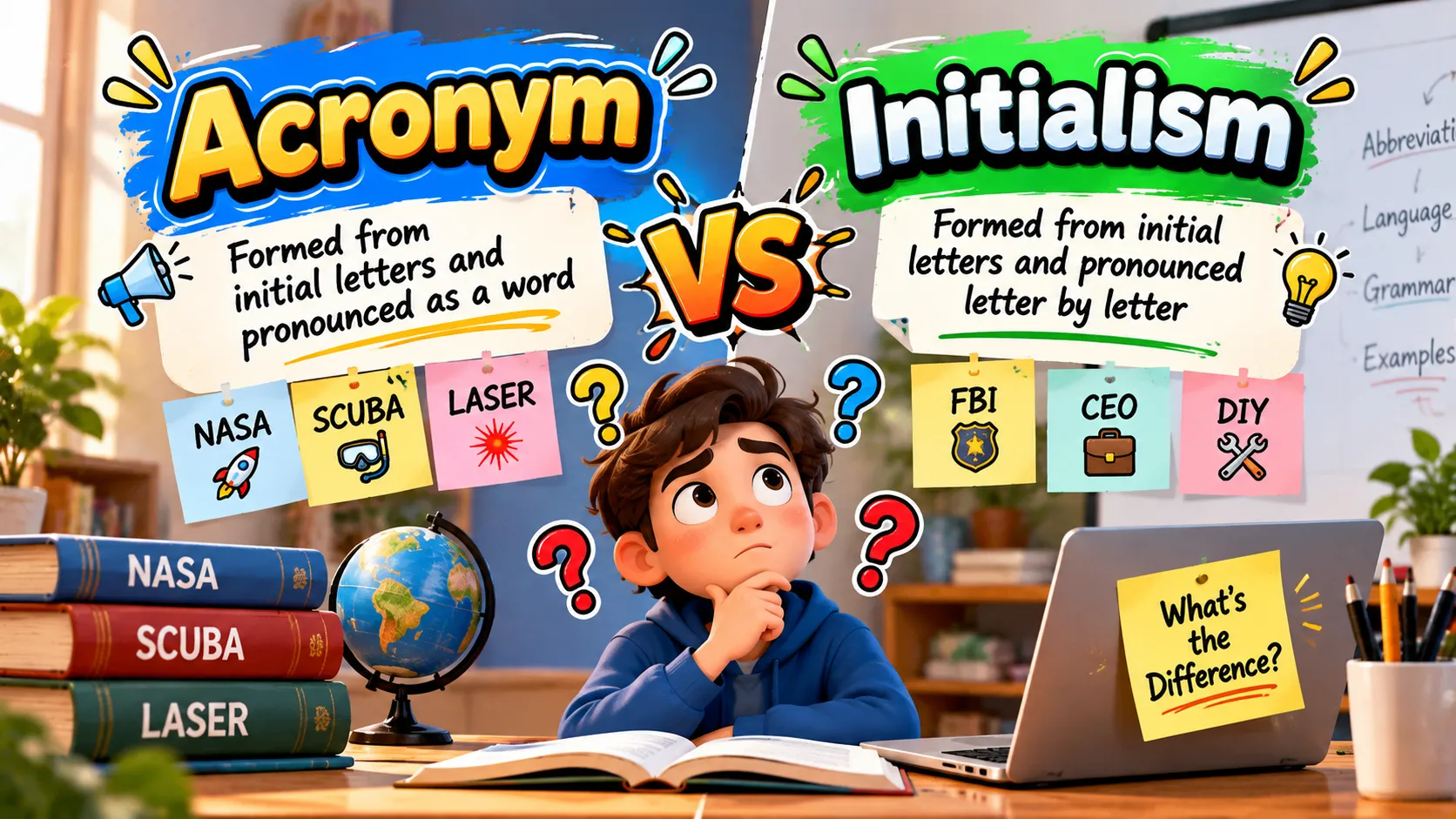
The words “acronym” and “initialism” describe two types of abbreviations that appear everywhere in modern English. From NASA and FBI to LOL and FAQ, these shortened forms saturate our writing, speech, and digital communication. Yet the acronym vs initialism distinction confuses even careful writers and editors.
An acronym is an abbreviation pronounced as a single word, like NASA or SCUBA. An initialism is an abbreviation pronounced letter by letter, like FBI or ATM. The difference lies entirely in pronunciation, not in spelling or structure. This comprehensive guide explains the distinction, explores their origins, provides practical examples, and helps you use both terms correctly. Understanding this difference sharpens your writing and clarifies your explanations of how abbreviations work.
Quick Answer
An acronym is an abbreviation pronounced as a word, like NASA (National Aeronautics and Space Administration) or AIDS. An initialism is an abbreviation pronounced letter by letter, like FBI (Federal Bureau of Investigation) or ATM.
Meaning Overview Table
| Aspect | Meaning |
|---|---|
| Definition | Acronym: an abbreviation pronounced as a word. Initialism: an abbreviation pronounced letter by letter |
| Pronunciation | Acronym: /ˈækrənɪm/; Initialism: /ɪˈnɪʃəlɪzəm/ |
| Part of Speech | Nouns |
| Usage | “NASA is an acronym” vs. “FBI is an initialism” |
| Context | Linguistics, writing, editing, business communication |
Main Meaning
Definition
An acronym is an abbreviation formed from the initial letters or components of a phrase and pronounced as a single word. Examples include NASA, SCUBA, and RADAR. The key feature is that speakers treat the abbreviation as a word, not as a sequence of letters .
An initialism is an abbreviation formed from the initial letters of a phrase and pronounced letter by letter. Examples include FBI, ATM, and BBC. The key feature is that speakers pronounce each letter individually rather than blending them into a word .
Origin
The word “acronym” comes from the Greek akros (“tip” or “end”) and onyma (“name”), meaning “tip name” or “end name.” It entered English in the 1940s during World War II, when military abbreviations like RADAR and SCUBA became common .
The word “initialism” comes from the Latin initialis, meaning “of the beginning.” It entered English in the 19th century as a term for abbreviations formed from initial letters.
Context
The distinction matters across several contexts:
- Writing and Editing: Style guides distinguish between acronyms (which may use lowercase after first mention) and initialisms (which typically remain uppercase)
- Linguistics: The study of abbreviations and word formation relies on this distinction
- Business Communication: Knowing whether to pronounce an abbreviation as a word or letter by letter affects clarity
- Everyday Speech: Speakers naturally distinguish between the two without conscious thought
Modern Usage
Today, both terms appear in style guides, linguistics textbooks, and writing handbooks. The Associated Press Stylebook, the Chicago Manual of Style, and other guides distinguish between the two, though terminology varies slightly. In everyday speech, people use both types of abbreviations constantly without thinking about the difference. The distinction matters most when writing formally or teaching language rules.
Detailed Explanation
Literal Meaning
Literally, “acronym” means “a name formed from the ends of words.” “Initialism” means “a word formed from initial letters.” Both describe abbreviations, but the literal meanings reflect their different structures.
Common Meaning
Commonly, people use “acronym” as a catch-all term for any abbreviation, including initialisms. This loose usage appears constantly in casual writing and speech.
Linguistic Meaning
In linguistics, the distinction is precise. Acronyms undergo a process called “acronymization,” where the abbreviation becomes a word with its own pronunciation, sometimes even developing new meanings. NASA, for example, functions as a proper noun. Initialisms remain sequences of letters, each pronounced separately.
Writing and Editing Meaning
Style guides treat acronyms and initialisms differently. The Chicago Manual of Style recommends spelling out acronyms on first use and using the abbreviation thereafter. Initialisms follow similar rules but always remain uppercase. Some style guides suggest using periods between initials (F.B.I.) while others omit them (FBI).
Business Meaning
In business communication, understanding the difference helps with clarity. Saying “NASA” as a word feels natural. Saying “FBI” as “fib-ee” would confuse listeners. Knowing which abbreviations are acronyms and which are initialisms prevents pronunciation errors.
Examples Table
| Example | Meaning |
|---|---|
| NASA | Acronym: pronounced “NAH-suh” |
| SCUBA | Acronym: pronounced “SKOO-buh” |
| RADAR | Acronym: pronounced “RAY-dar” |
| AIDS | Acronym: pronounced “AYDZ” |
| FAQ | Acronym or initialism: can be pronounced “fak” or “F-A-Q” |
| FBI | Initialism: pronounced “F-B-I” |
| ATM | Initialism: pronounced “A-T-M” |
| BBC | Initialism: pronounced “B-B-C” |
| CEO | Initialism: pronounced “C-E-O” |
| LASER | Acronym: pronounced “LAY-zer” |
| GIF | Contested: pronounced “jif” or “G-I-F” |
| HTML | Initialism: pronounced “H-T-M-L” |
| NATO | Acronym: pronounced “NAY-toh” |
| UNICEF | Acronym: pronounced “YOO-nih-sef” |
| USA | Initialism: pronounced “U-S-A” |
Related Meanings Table
| Related Term | Meaning |
|---|---|
| Abbreviation | Any shortened form of a word or phrase |
| Acronym | An abbreviation pronounced as a word |
| Initialism | An abbreviation pronounced letter by letter |
| Contraction | A shortened form with omitted letters, like “don’t” |
| Clipping | A shortened word, like “gym” from “gymnasium” |
| Portmanteau | A word blending two others, like “brunch” |
| Abbreviation | A general term covering acronyms and initialisms |
| Backronym | A phrase created to fit an existing acronym |
| Recursive acronym | An acronym that refers to itself, like GNU |
| Alphabetism | Another term for initialism, used in British English |
| Pronounceable acronym | An acronym that sounds like a word |
| Unpronounceable acronym | An initialism that cannot be pronounced as a word |
| Expansion | The full phrase an abbreviation stands for |
| Definition | The meaning of an abbreviation |
| Glossary | A list of abbreviations and their meanings |
Common Uses
People use acronyms and initialisms across numerous contexts:
Government and Organizations: Government agencies and organizations use both forms. NASA and NATO are acronyms. FBI and CIA are initialisms. The choice often depends on pronounceability.
Technology: Tech terminology overflows with both. LASER and RADAR are acronyms. HTML and CPU are initialisms. “GIF” remains contested, with some pronouncing it “jif” (acronym style) and others “G-I-F” (initialism style).
Business and Finance: Business communication uses both. CEO, CFO, and ROI are initialisms. NASDAQ is an acronym. Knowing which is which helps with pronunciation.
Medicine: Medical terminology uses both. AIDS and SARS are acronyms. MRI and CPR are initialisms. Medical professionals pronounce them naturally based on convention.
Everyday Language: Casual communication uses both. LOL and OMG are acronyms in casual speech. FYI and BTW are initialisms. These appear constantly in texting and social media.
Common Mistakes
| Mistake | Correction |
|---|---|
| Calling every abbreviation an “acronym” | Use “initialism” for abbreviations pronounced letter by letter |
| Pronouncing an initialism as a word | FBI is “F-B-I,” not “fib-ee” |
| Pronouncing an acronym letter by letter | NASA is “NAH-suh,” not “N-A-S-A” |
| Assuming all acronyms are uppercase | Some acronyms become lowercase words, like “scuba” and “laser” |
| Confusing acronyms with abbreviations | All acronyms are abbreviations, but not all abbreviations are acronyms |
| Using “initialism” in American English when “acronym” is meant | Use “acronym” for word-pronounced abbreviations |
| Forgetting that some abbreviations can be both | FAQ can be pronounced “fak” or “F-A-Q” |
| Assuming pronunciation rules are fixed | Pronunciation varies by region, generation, and context |
| Writing “ATM machine” | ATM already includes “machine”; write “ATM” |
| Writing “PIN number” | PIN already includes “number”; write “PIN” |
Related Questions
What is the difference between an acronym and an initialism?
An acronym is pronounced as a word, like NASA.
Is FBI an acronym or an initialism?
FBI is an initialism because people pronounce it letter by letter: “F-B-I.”
Is NASA an acronym or an initialism?
NASA is an acronym because people pronounce it as a word: “NAH-suh.”
Are all acronyms abbreviations?
Yes. All acronyms are abbreviations, but not all abbreviations are acronyms. Abbreviations include contractions, clippings, and other shortened forms .
Can a word be both an acronym and an initialism?
FAQ can be “fak” (acronym) or “F-A-Q” (initialism). GIF can be “jif” or “G-I-F.” Pronunciation varies by preference and region .
Why is the distinction important?
The distinction helps with pronunciation, clarity, and precise writing. Style guides and linguistics rely on it to describe how abbreviations function .
What is a backronym?
A backronym is a phrase created to fit an existing acronym. For example, “GIF” is sometimes explained as “Graphics Interchange Format,” but the term was created first, and the phrase was fitted to it.
Is “initialism” a common term?
“Initialism” is less common than “acronym” in everyday speech, but it appears in linguistics, style guides, and writing handbooks. Many people use “acronym” as a catch-all term for both types.
FAQs
What does acronym mean?
An acronym is an abbreviation formed from initial letters and pronounced as a single word, like NASA, SCUBA, or RADAR .
What does initialism mean?
An initialism is an abbreviation formed from initial letters and pronounced letter by letter, like FBI, ATM, or BBC .
Is “LOL” an acronym or an initialism?
“LOL” is an acronym in casual speech because many people pronounce it as a word: “lol.” However, some pronounce it letter by letter: “L-O-L.” Pronunciation varies by context and generation .
Is “CEO” an acronym or an initialism?
“CEO” is an initialism because people pronounce it letter by letter: “C-E-O” .
Is “AIDS” an acronym or an initialism?
“AIDS” is an acronym because people pronounce it as a word: “AYDZ.” It stands for Acquired Immune Deficiency Syndrome .
Is “HTML” an acronym or an initialism?
“HTML” is an initialism because people pronounce it letter by letter: “H-T-M-L.” It stands for HyperText Markup Language .
Can initialisms become acronyms over time?
Yes. Some initialisms evolve into acronyms when speakers begin pronouncing them as words. “FAQ” is an example, as some speakers say “fak” while others say “F-A-Q.”
Why do style guides distinguish between acronyms and initialisms?
Style guides distinguish between them because the two types follow different capitalization and pronunciation rules. Acronyms may become lowercase words over time (like “scuba”), while initialisms typically remain uppercase .
Conclusion
The acronym vs initialism distinction comes down to pronunciation. Acronyms sound like words: NASA, SCUBA, RADAR. Initialisms sound like letter sequences: FBI, ATM, CEO. Understanding the difference sharpens your writing, improves your explanations, and prevents pronunciation errors. Whether you’re writing a formal report, teaching a language lesson, or simply explaining a term to a friend, this distinction helps you communicate with precision. Small distinctions like this separate careful writers from careless ones.

Natalie Brooks is a content researcher and writer with a strong interest in word meanings, dream interpretations, symbolism, and cultural insights. She is passionate about creating clear, informative, and easy-to-understand content that helps readers discover the deeper meanings behind words, names, dreams, and symbols. Through her work at Meanzly, Natalie aims to make knowledge accessible and valuable for readers around the world.