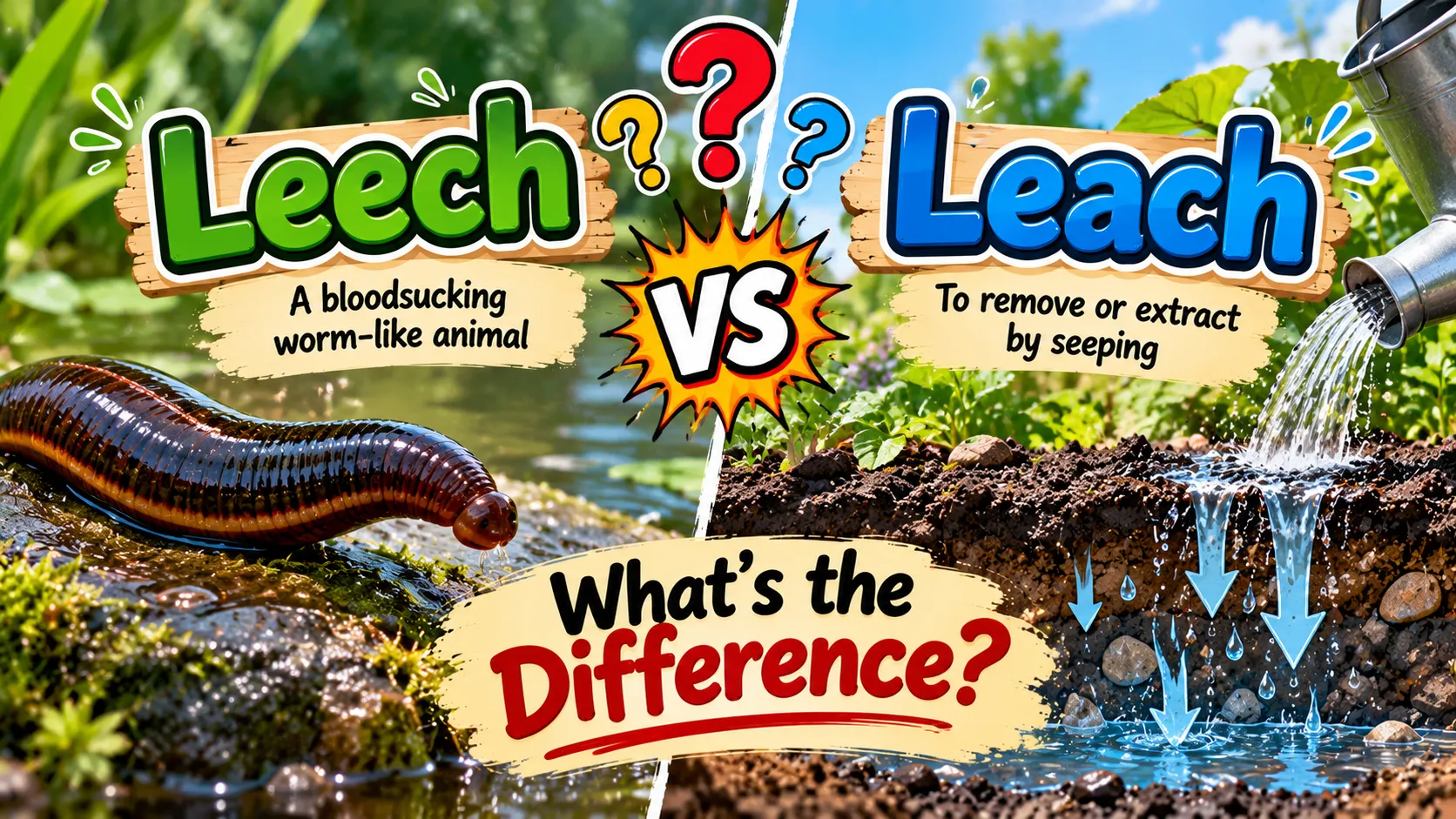
The words “leech” and “leach” sound identical, yet they describe completely different processes and creatures. One refers to a bloodsucking worm or a person who drains resources; the other describes the movement of liquids through materials. The leech vs leach confusion ranks among the most common homophone errors in English writing, appearing in environmental reports, medical texts, and everyday correspondence.
“Leech” is a noun for the parasitic worm or a metaphorical hanger-on, and a verb meaning to cling to someone like a parasite. “Leach” is a verb describing the process by which water or other liquids dissolve and carry away substances from soil or materials. These words share identical pronunciation but no shared meaning. This comprehensive guide explains the difference, explores their origins, provides practical examples, and helps you choose the correct word every time you write.
Quick Answer
“Leech” refers to a bloodsucking worm or a person who drains resources, and as a verb means to cling like a parasite. “Leach” describes the process of liquids dissolving and carrying away substances from soil or materials. Remember: a leech sucks blood; liquids leach chemicals. They sound the same but mean completely different things.
Meaning Overview Table
| Aspect | Meaning |
|---|---|
| Definition | Leech: a bloodsucking worm or parasitic person. Leach: the process of liquid dissolving and carrying away substances |
| Pronunciation | Both: /liːtʃ/ |
| Part of Speech | Leech: noun and verb. Leach: verb (and sometimes noun) |
| Usage | “The leech attached to his leg” vs. “Chemicals leached into the groundwater” |
| Context | Leech: medicine, biology, metaphor. Leach: environmental science, agriculture, chemistry |
Main Meaning
Definition
Leech functions as both a noun and a verb. As a noun, it refers to any of numerous carnivorous or bloodsucking freshwater annelid worms that have a sucker at each end and were formerly used by physicians for bleeding patients. Metaphorically, it refers to a person who hangs around others seeking advantage without giving anything in return. As a verb, it means to attach oneself to a person like a leech, draining their resources. Leach is primarily a verb meaning to dissolve out by the action of a percolating liquid, to remove soluble components from soil or materials, or to pass out or through by percolation.
Origin
“Leech” comes from the Old English lǣce, which originally meant “physician” or “healer.” The word’s meaning shifted over centuries to refer to the bloodsucking worm used in medical treatments. The parasitic meaning developed from the worm’s behavior. “Leach” has a different origin, probably inherited from Germanic roots, and has been used since the Old English period to describe the action of water percolating through material.
Context
The distinction matters across several contexts:
- Medicine and Biology: “Leech” appears in discussions of the worm, historical medical practices, and modern wound treatment
- Environmental Science: “Leach” appears in discussions of soil contamination, groundwater pollution, and chemical movement
- Agriculture: “Leach” describes nutrient loss from soil; “leech” does not belong in agricultural contexts
- Metaphorical Writing: “Leech” describes parasitic people or behaviors; “leach” describes abstract depletion
Modern Usage
Today, “leech” appears frequently in biological contexts and metaphorical descriptions of parasitic behavior. “Leach” appears constantly in environmental reports, agricultural discussions, and chemistry texts. The confusion between the two persists because they sound identical and spell-check often fails to catch the error.
Detailed Explanation
Literal Meaning
Literally, a “leech” is a segmented worm with suckers at both ends that feeds on blood. “Leach” literally describes the process of liquid passing through a material and dissolving soluble substances along the way.
Common Meaning
Commonly, people use “leech” to describe someone who takes advantage of others without giving back. They use “leach” to describe how chemicals or nutrients move through soil when water passes through it.
Medical Meaning
Historically, leeches were used in medicine for bloodletting, a practice based on the ancient theory of humorism. Today, medicinal leeches are still used in some surgical procedures to promote blood flow in reattached tissue and to prevent clotting.
Environmental Meaning
In environmental science, “leach” describes how water carries dissolved substances through soil. This process can be natural (nutrients leaching from soil) or harmful (toxic chemicals leaching into groundwater from landfills or industrial sites).
Metaphorical Meaning
“Leech” carries a strong metaphorical meaning: a person who drains others emotionally, financially, or socially. “Leach” also has a metaphorical use, as in “the meaning leached from my life,” describing a gradual draining away of intangible qualities.
Examples Table
| Example | Meaning |
|---|---|
| The leech attached itself to the swimmer’s leg. | The bloodsucking worm |
| Chemicals leached into the groundwater. | Liquid carried away substances |
| He’s a leech who never pays for anything. | A parasitic person |
| Nutrients leach from the soil after heavy rain. | Dissolved and carried away |
| The doctor used leeches to promote healing. | The medicinal worm |
| Lead leached from the old pipes into the water. | Dissolved and entered the water supply |
| She felt the energy leeching out of her. | Draining away gradually |
| The landfill leaches toxins into the surrounding soil. | Chemicals dissolve and move through soil |
| Stop leeching off your parents and get a job. | Clinging parasitically |
| Rainwater leaches salts from the earth. | Dissolves and carries away |
Related Meanings Table
| Related Term | Meaning |
|---|---|
| Bloodsucker | A leech; a parasitic person |
| Parasite | An organism that lives off another; a leech |
| Sponge | A person who lives off others; a leech |
| Percolate | To pass through a filter or material; what liquids do when they leach |
| Dissolve | To become incorporated into a liquid |
| Groundwater | Water beneath the earth’s surface that can be affected by leaching |
| Contamination | The presence of harmful substances; often caused by leaching |
| Runoff | Water that flows over land; can cause leaching |
| Nutrient loss | The removal of nutrients from soil by leaching |
| Leachate | The liquid that has percolated through a material and dissolved substances |
| Medicinal leech | Leeches used in surgery to promote blood flow |
| Leech therapy | Medical treatment using leeches |
| Infiltration | The movement of water into soil; related to leaching |
| Filtration | The process of passing liquid through a material; related to leaching |
| Soil salinity | Salt content in soil; often affected by leaching |
Common Uses
People use “leech” and “leach” across numerous contexts:
Environmental Reports: Scientists describe how chemicals “leach” into groundwater, soil, or rivers. This usage appears constantly in pollution studies and environmental impact assessments.
Medical Contexts: Doctors and historians discuss “leeches” in bloodletting and modern wound treatment. The worm’s bloodsucking behavior gives the word its metaphorical meaning.
Agriculture: Farmers and agronomists discuss how nutrients “leach” from soil after heavy rain or irrigation. This process affects crop yields and fertilizer efficiency.
Everyday Metaphors: People describe parasitic individuals as “leeches.” The verb form appears in phrases like “leeching off someone.”
Chemistry and Materials Science: Researchers study how substances “leach” from materials like plastics, treated wood, and industrial waste.
Common Mistakes
| Mistake | Correction |
|---|---|
| Writing “chemicals leech into the water” | Write “chemicals leach into the water” (dissolve and move) |
| Writing “the leach attached to his leg” | Write “the leech attached to his leg” (the worm) |
| Writing “he’s a leach” | Write “he’s a leech” (a parasitic person) |
| Writing “nutrients leech from the soil” | Write “nutrients leach from the soil” (dissolve and move) |
| Writing “stop leaching off your friends” | Write “stop leeching off your friends” (clinging parasitically) |
| Writing “the landfill leeches toxins” | Write “the landfill leaches toxins” (chemicals dissolve and move) |
| Assuming spell-check will catch the error | Spell-check often misses homophones; proofread manually |
| Writing “medicinal leach” | Write “medicinal leech” (the worm used in medicine) |
| Writing “leach therapy” | Write “leech therapy” (treatment using worms) |
| Using “leech” in environmental science contexts | Use “leach” for the movement of dissolved substances |
Related Questions
Is it “leech” or “leach”?
It depends on meaning. Use “leech” for the bloodsucking worm or a parasitic person. Use “leach” for the process of liquids dissolving and carrying away substances.
What does “leach” mean in environmental science?
“Leach” describes how water or other liquids pass through soil or materials and dissolve soluble substances, carrying them away. This process can move nutrients out of soil or toxins into groundwater.
What is a leech?
A leech is a segmented worm with suckers at both ends that feeds on blood. Historically, leeches were used in medicine for bloodletting. Metaphorically, a leech is a person who drains others’ resources.
Can “leach” be a noun?
Yes, “leach” can function as a noun referring to the process of leaching or the material that has been leached. However, it is more commonly used as a verb.
What is “leachate”?
Leachate is the liquid that has percolated through a material (like soil or waste) and dissolved substances from it. It is a noun form related to the verb “leach.”
Why do people confuse “leech” and “leach”?
They sound identical and differ by only one letter. Spell-check often misses homophones, so the error persists in written communication.
FAQs
What does “leech” mean?
“Leech” refers to a bloodsucking worm or a person who parasitically takes advantage of others. As a verb, it means to cling to someone like a parasite.
What does “leach” mean?
“Leach” means to dissolve out by the action of a percolating liquid, to remove soluble components from soil or materials, or to pass through by percolation.
Is it “chemicals leech into the water” or “chemicals leach into the water”?
The correct phrase is “chemicals leach into the water.” “Leach” describes the movement of dissolved substances through a liquid.
Is it “he’s a leech” or “he’s a leach”?
The correct phrase is “he’s a leech.” “Leech” refers to a parasitic person.
Can “leech” be used as a verb?
Yes. “Leech” as a verb means to attach oneself to someone and drain their resources, like a leech does to a host.
What is the difference between “leach” and “leech” in a sentence?
“Leach” relates to liquids dissolving and carrying away substances. “Leech” relates to the bloodsucking worm or a parasitic person.
Why do people say “leech off” but “leach into”?
“Leech off” describes clinging to someone parasitically. “Leach into” describes liquids carrying dissolved substances into something. The prepositions reflect the different meanings.
How can I remember the difference?
Remember: a leech has a mouth that sucks blood; liquids leach chemicals through soil. The “a” in “leach” stands for “away” (substances are carried away). The “ee” in “leech” looks like two suckers.
Conclusion
Mastering the leech vs leach distinction protects your writing from embarrassing homophone errors. “Leech” refers to the bloodsucking worm or a parasitic person, and as a verb means to cling like a parasite. “Leach” describes the process of liquids dissolving and carrying away substances from soil or materials. Remember the simple rule: a leech sucks blood; liquids leach chemicals. Whether you’re writing an environmental report, a medical text, or a social media post, choosing the correct word ensures your meaning is clear. Practice using “leech” for parasites and “leach” for percolation, and your readers will understand exactly what you intend. Small distinctions like this separate careful writers from careless ones.

Natalie Brooks is a content researcher and writer with a strong interest in word meanings, dream interpretations, symbolism, and cultural insights. She is passionate about creating clear, informative, and easy-to-understand content that helps readers discover the deeper meanings behind words, names, dreams, and symbols. Through her work at Meanzly, Natalie aims to make knowledge accessible and valuable for readers around the world.









