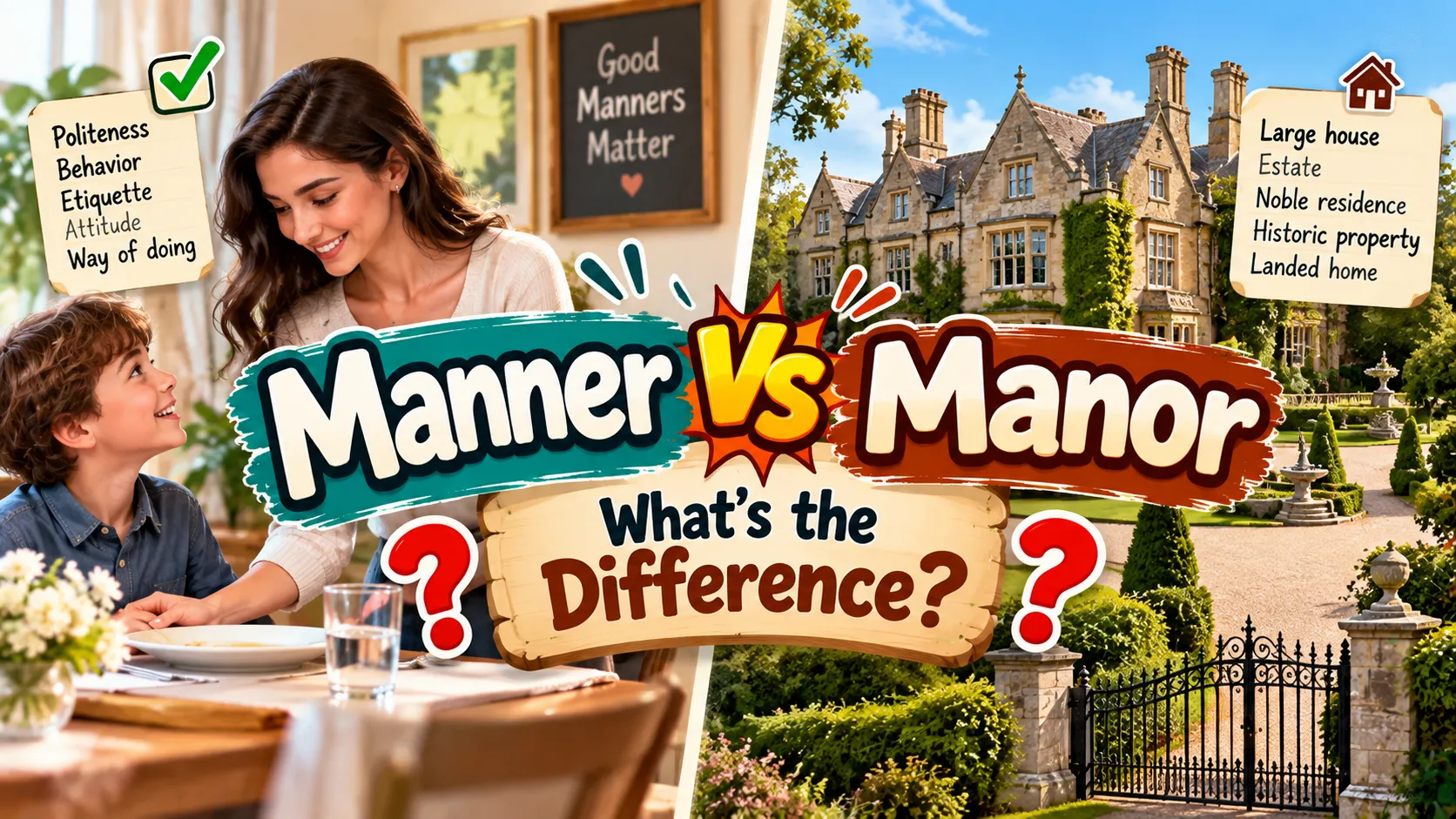
The words “manner” and “manor” sound nearly identical, yet they describe completely different concepts. One relates to behavior and way of doing things; the other refers to a large country house and its surrounding estate. The manner vs manor confusion ranks among the most common homophone errors in English writing, appearing in historical texts, etiquette discussions, and everyday correspondence.
“Manner” refers to a way of doing something or a person’s behavior and bearing. “Manor” refers to a large landed estate or the main house on such an estate. These words sound alike but share no meaning. This comprehensive guide explains the difference, explores their origins, provides practical examples, and helps you choose the correct word every time you write.
Quick Answer
“Manner” means a way of doing something or a person’s behavior, as in “she spoke in a polite manner” or “his manner was calm.” “Manor” refers to a large estate or country house, as in “the old manor stood on a hill.” Remember: manner relates to behavior and method; manor relates to property and buildings. They sound similar but mean completely different things.
Meaning Overview Table
| Aspect | Meaning |
|---|---|
| Definition | Manner: a way of doing something or a person’s behavior. Manor: a large estate or country house |
| Pronunciation | Both: /ˈmænər/ |
| Part of Speech | Manner: noun. Manor: noun |
| Usage | “She answered in a polite manner” vs. “They visited the historic manor” |
| Context | Manner: etiquette, behavior, style, method. Manor: history, real estate, aristocracy |
Main Meaning
Definition
Manner is a noun with several related meanings. It refers to a way in which a thing is done or happens, a person’s outward behavior or bearing, a style or fashion, and in plural form (“manners”), polite social conduct. Manor is a noun referring to a large landed estate, especially one with a country house, historically owned by a lord and worked by tenants. It also refers to the main house on such an estate.
Origin
“Manner” comes from the Old French maniere, meaning “way, fashion, or custom,” which derives from the Latin manuarius, meaning “of the hand.” The word entered English in the 12th century and originally referred to a way of handling something. “Manor” comes from the Old French manoir, meaning “dwelling place,” which derives from the Latin manere, meaning “to remain or stay.” The word entered English after the Norman Conquest and referred to a lord’s estate.
Context
The distinction matters across several contexts:
- Etiquette and Behavior: “Manner” appears in discussions of politeness, conduct, and social graces
- History and Real Estate: “Manor” appears in discussions of estates, aristocracy, and historic properties
- Style and Method: “Manner” describes ways of doing things, from art to speech
- Everyday Writing: Confusing the two creates embarrassing errors in emails, essays, and social media posts
Modern Usage
Today, “manner” appears constantly in both speech and writing, especially in phrases like “in a timely manner” and “bedside manner.” “Manor” appears less frequently but remains common in historical writing, real estate listings, and place names. The confusion between the two persists because they sound identical and spell-check often fails to catch the error.
Detailed Explanation
Literal Meaning
Literally, “manner” means a way or method of doing something. “Manor” literally means a dwelling place or estate. The two words have no overlap in meaning.
Common Meaning
Commonly, people use “manner” to describe how something is done or how someone behaves. “She spoke in a calm manner” means her way of speaking was calm. “He has a friendly manner” means his behavior is friendly. People use “manor” to describe a large historic house or estate.
Behavioral Meaning
“Manner” often describes a person’s outward conduct. “A confident manner” describes how someone carries themselves. “Bedside manner” describes how a doctor interacts with patients. “Mannerisms” are distinctive behavioral habits.
Historical Meaning
“Manor” carries strong historical connotations. In feudal England, a manor was the basic unit of land ownership, comprising the lord’s house, surrounding farmland, and the village where tenants lived. The manor court handled local legal matters.
Real Estate Meaning
In modern real estate, “manor” often appears in property names to evoke prestige or history. A “manor house” is a large country house. The word suggests elegance, history, and substantial land.
Examples Table
| Example | Meaning |
|---|---|
| She answered in a polite manner. | A way of doing something |
| The old manor stood on a hill. | A large country house and estate |
| His manner suggested he was nervous. | Behavior or bearing |
| They toured the historic manor. | A large estate |
| Please respond in a timely manner. | A way or method |
| The manor has been in the family for generations. | A landed estate |
| She has a warm and friendly manner. | Behavior or personality |
| The manor grounds include a lake and gardens. | The estate surrounding a country house |
| The doctor’s bedside manner reassured the patient. | Way of interacting |
| They bought a manor in the countryside. | A large country house |
Related Meanings Table
| Related Term | Meaning |
|---|---|
| Manner | A way of doing something; behavior |
| Manor | A large estate or country house |
| Manners | Polite social behavior |
| Mannerism | A distinctive behavioral habit |
| Manor house | The main house on a manor estate |
| Manor court | A historical court that handled local legal matters |
| Bedside manner | A doctor’s way of interacting with patients |
| Timely manner | A way of doing something within a deadline |
| Manner of speaking | A way of talking |
| Manor lord | A historical lord who owned a manor |
| Manor estate | A large landed property |
| All manner of | All kinds of |
| In a manner of speaking | In a way; figuratively |
| To the manner born | Naturally suited to something |
| Mannerly | Polite, well-behaved |
Common Uses
People use “manner” and “manor” across numerous contexts:
Etiquette and Behavior: “Manner” appears in discussions of politeness. “Manners” refers to social conduct. “Bedside manner” describes a doctor’s demeanor.
Business Communication: “Manner” appears in phrases like “in a timely manner” and “in a professional manner.” These phrases describe how tasks are completed.
History and Tourism: “Manor” appears in historical writing, tourism materials, and property listings. Visitors tour historic manors and learn about feudal estates.
Real Estate: “Manor” appears in property names and descriptions to evoke prestige and history. “Manor house” describes a large country home.
Everyday Speech: People use “manner” constantly to describe behavior and methods. “Manor” appears less often, usually in historical or property contexts.
Common Mistakes
| Mistake | Correction |
|---|---|
| Writing “in a timely manor” | Write “in a timely manner” (a way of doing something) |
| Writing “the manner house” | Write “the manor house” (the estate house) |
| Writing “his manor was calm” | Write “his manner was calm” (behavior) |
| Writing “they visited the historic manner” | Write “they visited the historic manor” (estate) |
| Writing “bedside manor” | Write “bedside manner” (a doctor’s behavior) |
| Writing “the manner grounds” | Write “the manor grounds” (estate grounds) |
| Assuming spell-check will catch the error | Spell-check often misses homophones; proofread manually |
| Writing “good manors” | Write “good manners” (polite behavior) |
| Writing “all manor of things” | Write “all manner of things” (all kinds of things) |
| Using “manor” in behavioral contexts | Use “manner” for behavior and methods |
Related Questions
Is it “manner” or “manor”?
It depends on meaning. Use “manner” for a way of doing something or behavior. Use “manor” for a large estate or country house.
What does “manner” mean?
“Manner” means a way of doing something, a person’s behavior or bearing, or a style or fashion. In plural, “manners” means polite social conduct.
What does “manor” mean?
“Manor” refers to a large landed estate, especially one with a country house, historically owned by a lord and worked by tenants.
Is it “bedside manner” or “bedside manor”?
The correct phrase is “bedside manner.” It describes a doctor’s way of interacting with patients.
Is it “in a timely manner” or “in a timely manor”?
The correct phrase is “in a timely manner.” It means within a deadline or without delay.
What is a manor house?
A manor house is the main house on a manor estate. It is typically a large country house associated with a historic estate.
Why do people confuse “manner” and “manor”?
They sound identical and differ by only one letter. Spell-check often misses homophones, so the error persists in written communication.
How can I remember the difference?
Remember: “manor” contains the word “man” and refers to a large estate historically owned by a lord (a man). “Manner” relates to behavior and method.
FAQs
What does “manner” mean?
“Manner” means a way of doing something, a person’s outward behavior or bearing, or a style. In plural, “manners” means polite social behavior.
What does “manor” mean?
“Manor” refers to a large landed estate, especially one with a country house, historically owned by a lord and worked by tenants. It also refers to the main house on such an estate.
Is it “all manner of” or “all manor of”?
The correct phrase is “all manner of.” It means “all kinds of.”
What is a manor court?
A manor court was a historical court that handled local legal matters on a manor estate, including disputes between tenants and the lord.
Can “manner” be used in formal writing?
Yes. “Manner” appears frequently in formal writing, especially in phrases like “in a timely manner” and “in a professional manner.”
What is “bedside manner”?
“Bedside manner” describes a doctor’s way of interacting with patients—their demeanor, communication style, and empathy.
Is “manor” only used in historical contexts?
No. “Manor” appears in modern real estate listings and property names to evoke prestige and history.
How can I remember the difference between “manner” and “manor”?
Remember: “manor” starts with “man” and refers to a large estate historically owned by a lord. “Manner” relates to behavior and methods—think of “manners” (polite behavior).
Conclusion
Mastering the manner vs manor distinction protects your writing from embarrassing homophone errors. “Manner” means a way of doing something or a person’s behavior, and appears constantly in phrases like “in a timely manner” and “bedside manner.” “Manor” refers to a large estate or country house, carrying historical weight and appearing in property listings and historical texts. Remember the simple rule: manner relates to behavior and method; manor relates to property and estates. Whether you’re writing an email, a historical essay, or a social media post, choosing the correct word ensures your meaning is clear. Practice using “manner” for behavior and methods, and “manor” for estates and houses, and your readers will understand exactly what you intend. Small distinctions like this separate careful writers from careless ones.

Natalie Brooks is a content researcher and writer with a strong interest in word meanings, dream interpretations, symbolism, and cultural insights. She is passionate about creating clear, informative, and easy-to-understand content that helps readers discover the deeper meanings behind words, names, dreams, and symbols. Through her work at Meanzly, Natalie aims to make knowledge accessible and valuable for readers around the world.









