The words “yoke” and “yolk” sound identical, yet they describe completely different things. One refers to a wooden harness for animals or a metaphor for burden; the other refers to the yellow center of an egg. The yoke vs yolk confusion ranks among the most common homophone errors in English writing, appearing in recipes, historical texts, and everyday correspondence.
“Yoke” is a noun and verb relating to harnesses, burdens, and connections. “Yolk” is a noun referring to the nutrient-rich center of an egg. These words share identical pronunciation but no shared meaning. This comprehensive guide explains the difference, explores their origins, provides practical examples, and helps you choose the correct word every time you write.
Quick Answer
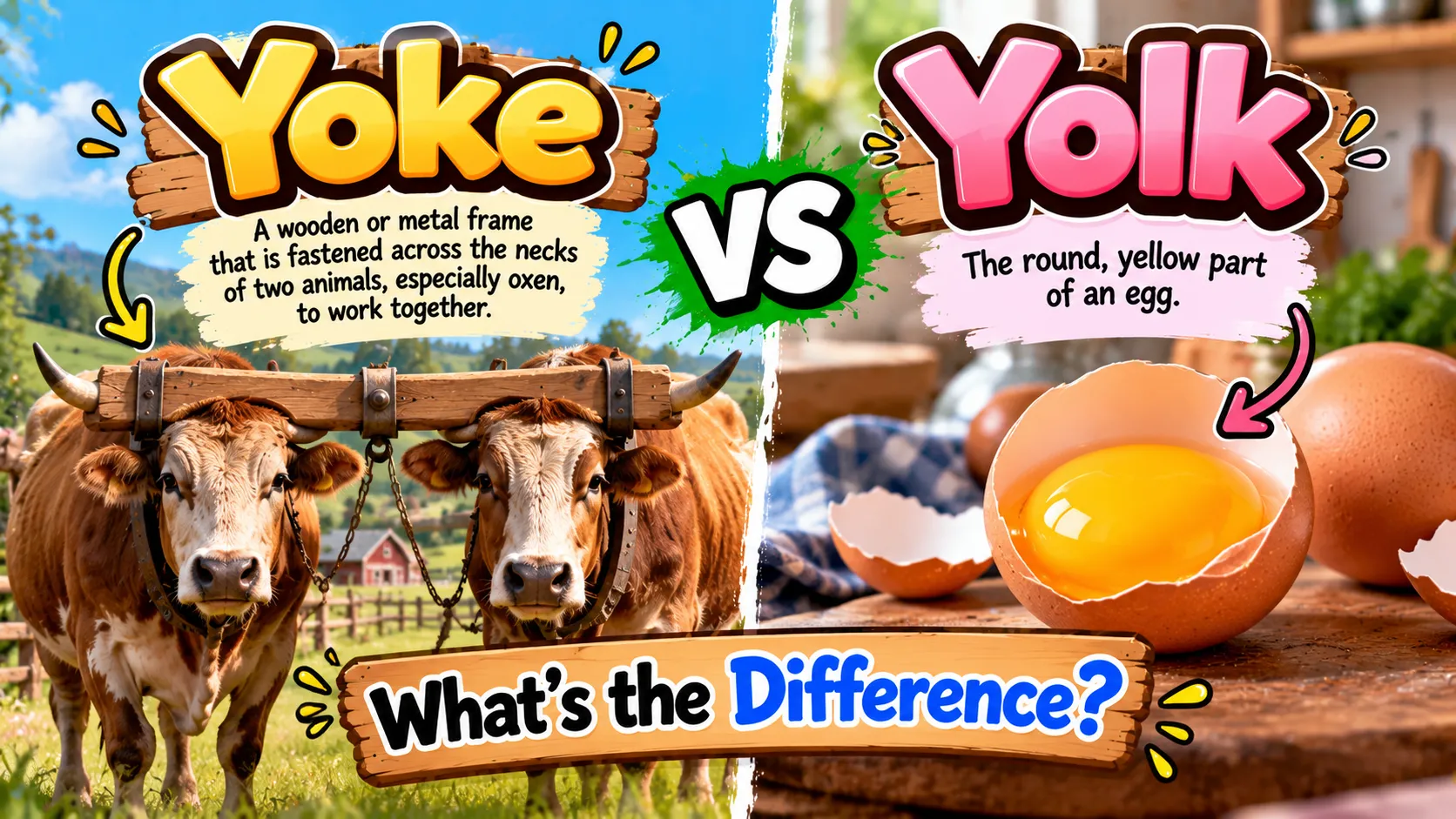
“Yoke” refers to a wooden harness used to join draft animals, or metaphorically to a burden or connection, as in “the yoke of oppression.” “Yolk” refers to the yellow center of an egg, as in “egg yolk.” Remember: yoke relates to joining or burden; yolk relates to eggs. They sound the same but mean completely different things.
Meaning Overview Table
| Aspect | Meaning |
|---|---|
| Definition | Yoke: a harness for animals; a burden or connection. Yolk: the yellow center of an egg |
| Pronunciation | Both: /joʊk/ |
| Part of Speech | Yoke: noun and verb. Yolk: noun |
| Usage | “The oxen wore a wooden yoke” vs. “The recipe calls for two egg yolks” |
| Context | Yoke: agriculture, history, metaphor. Yolk: cooking, nutrition, biology |
Main Meaning
Definition
Yoke functions as both a noun and a verb. As a noun, it refers to a wooden crosspiece fastened over the necks of two animals, such as oxen, to pull a plow or cart. Metaphorically, it means a burden, oppression, or a bond of union. As a verb, it means to join together or to harness animals. Yolk is a noun referring to the yellow, nutrient-rich portion of an egg that feeds the developing embryo.
Origin
“Yoke” comes from the Old English geoc, meaning a yoke for oxen. The word has Germanic roots, related to German Joch and Dutch juk. It has been used both literally and metaphorically for over a thousand years. The metaphorical sense of “burden” or “servitude” appears in biblical and literary texts.
“Yolk” comes from the Old English geolca, meaning the yellow part of an egg. It relates to the word “yellow,” reflecting the yolk’s color. The word has remained remarkably stable in meaning throughout English history.
Context
The distinction matters across several contexts:
- Cooking and Recipes: “Yolk” appears in instructions for baking, cooking, and nutrition
- Agriculture and History: “Yoke” appears in discussions of farming, draft animals, and historical farming methods
- Metaphorical Writing: “Yoke” appears in religious, political, and literary texts describing burdens or bonds
- Everyday Writing: Confusing the two creates embarrassing errors in emails, essays, and social media posts
Modern Usage
Today, “yolk” appears frequently in cooking content, nutrition discussions, and food packaging. “Yoke” appears less often in everyday speech but remains common in historical writing, biblical references, and metaphorical language. The phrase “yoke of oppression” and the verb “to yoke together” keep the word alive in modern English. The confusion between the two persists because they sound identical and spell-check often fails to catch the error.
Detailed Explanation
Literal Meaning
Literally, “yoke” means a wooden harness that joins two animals for work. “Yolk” literally means the yellow center of an egg. These literal meanings remain the primary definitions of both words.
Common Meaning
Commonly, people use “yolk” when discussing eggs, cooking, and nutrition. A recipe might call for “two egg yolks.” People use “yoke” when discussing farm animals or metaphorical burdens. “The yoke of tyranny” describes oppression.
Agricultural Meaning
In agriculture, a yoke is a wooden beam placed across the necks of two draft animals, usually oxen or horses. The yoke allows the animals to pull together as a team. Farmers have used yokes for thousands of years to plow fields and pull carts. The verb form describes the act of harnessing animals: “They yoked the oxen to the plow.”
Culinary Meaning
In cooking, “yolk” refers to the yellow center of an egg. Egg yolks are rich in fat, protein, and vitamins. They serve as emulsifiers in sauces like mayonnaise and hollandaise. Bakers use yolks to add richness and color to pastries, custards, and pasta dough.
Biological Meaning
Biologically, the yolk provides nutrients for a developing embryo. Eggs with large yolks, like chicken eggs, contain enough nutrition to support a chick until hatching. The yolk sac in mammals serves a similar function during early development.
Metaphorical Meaning
Metaphorically, “yoke” describes burdens, oppression, or bonds. The phrase “yoke of slavery” appears in religious texts. “Yoked together” describes two people or things joined in partnership or marriage. These metaphorical uses draw on the literal image of animals bound together for work.
Examples Table
| Example | Meaning |
|---|---|
| The oxen wore a wooden yoke. | A harness for draft animals |
| The recipe calls for two egg yolks. | The yellow center of eggs |
| They yoked the horses to the wagon. | Harnessed the animals |
| The yolk of the egg is rich in nutrients. | The yellow center of an egg |
| The people threw off the yoke of oppression. | A metaphor for burden or tyranny |
| She separated the yolks from the whites. | The yellow part of eggs |
| The two companies yoked together for the project. | Joined together in partnership |
| Egg yolk contains cholesterol and fat. | The nutrient-rich center of an egg |
| The farmer repaired the broken yoke. | A wooden harness for animals |
| The yoke of responsibility weighed heavily on him. | A metaphor for burden |
Related Meanings Table
| Related Term | Meaning |
|---|---|
| Yoke | A wooden harness for draft animals; a burden or bond |
| Yolk | The yellow center of an egg |
| Yoked | Past tense of yoke; joined or harnessed |
| Yolks | Plural of yolk; multiple egg yolks |
| Egg white | The clear part of an egg, opposite of yolk |
| Albumen | Technical term for egg white |
| Harness | Equipment for controlling animals |
| Oxen | Castrated male cattle used for draft work |
| Draft animal | An animal used for pulling loads |
| Emulsifier | A substance that stabilizes mixtures, like egg yolk |
| Yoke of oppression | A metaphor for tyranny or burden |
| Yoke of slavery | A biblical metaphor for servitude |
| Yoked together | Joined in partnership or marriage |
| Egg yolk | The yellow center of an egg |
| Yolk sac | A membrane that provides nutrients to embryos |
Common Uses
People use “yoke” and “yolk” across numerous contexts:
Cooking and Baking: “Yolk” appears constantly in recipes. Chefs separate yolks from whites for custards, sauces, and pastries. Nutrition labels list yolk content.
Agriculture and History: “Yoke” appears in discussions of traditional farming. Historical texts describe oxen yoked together for plowing. Museums display antique yokes.
Religious and Literary Texts: “Yoke” appears in biblical passages, such as “my yoke is easy and my burden is light.” Literary works use “yoke” as a metaphor for oppression or union.
Everyday Metaphors: People describe marriage as a “yoke” or say two things are “yoked together.” These metaphors draw on the literal image of animals joined for work.
Food Packaging and Marketing: Egg cartons and food products frequently mention “yolk” in descriptions of nutritional content and cooking instructions.
Common Mistakes
| Mistake | Correction |
|---|---|
| Writing “egg yoke” | Write “egg yolk” (the yellow center of an egg) |
| Writing “yolk of oppression” | Write “yoke of oppression” (a burden or tyranny) |
| Writing “yoke of an egg” | Write “yolk of an egg” (the yellow center) |
| Writing “the farmer repaired the yolk” | Write “the farmer repaired the yoke” (a harness) |
| Writing “yoked together” as “yolked together” | The correct phrase is “yoked together” (joined in partnership) |
| Writing “separate the yokes from the whites” | Write “separate the yolks from the whites” (egg parts) |
| Assuming spell-check will catch the error | Spell-check often misses homophones; proofread manually |
| Confusing the two in recipes | Precision matters; “yolk” refers to eggs, “yoke” to harnesses |
| Writing “the yolk of slavery” | Write “the yoke of slavery” (a burden or oppression) |
| Using “yolk” as a verb | “Yolk” is only a noun; “yoke” is the verb form |
Related Questions
Is it “yoke” or “yolk”?
It depends on meaning. Use “yoke” when referring to a harness, burden, or connection. Use “yolk” when referring to the yellow center of an egg.
What does “yoke of oppression” mean?
“Yoke of oppression” is a metaphor describing a burden of tyranny or servitude. It draws on the image of animals bound by a wooden yoke.
What is the difference between egg yolk and egg yoke?
“Egg yolk” is correct. It refers to the yellow center of an egg. “Egg yoke” is a misspelling.
Can “yoke” be a verb?
Yes. “Yoke” means to join together or harness animals. For example, “They yoked the oxen to the plow.”
What is a yolk sac?
A yolk sac is a membrane that provides nutrients to a developing embryo. It appears in birds, reptiles, and mammals.
Why do people confuse yoke and yolk?
They sound identical and differ by only one letter. Spell-check often misses homophones, so the error persists in written communication.
FAQs
What does “yoke” mean?
“Yoke” refers to a wooden harness used to join draft animals. Metaphorically, it means a burden, oppression, or a bond of union. It also functions as a verb meaning to join together.
What does “yolk” mean?
“Yolk” refers to the yellow, nutrient-rich center of an egg. It provides nutrition for a developing embryo and is used in cooking and baking.
Is it “egg yolk” or “egg yoke”?
The correct phrase is “egg yolk.” It refers to the yellow center of an egg.
What is the “yoke of slavery”?
“The yoke of slavery” is a metaphor for servitude or oppression. It appears in religious and historical texts.
Can “yolk” be used metaphorically?
No. “Yolk” only refers to the yellow part of an egg. Metaphorical burdens and connections use “yoke.”
What does “yoked together” mean?
“Yoked together” means joined in partnership or marriage. It draws on the image of animals bound by a yoke for work.
Is “yoke” related to “yoga”?
Both words share the same Indo-European root meaning “to join.” “Yoga” comes from Sanskrit, while “yoke” comes from Old English. Both relate to the concept of union.
How can I remember the difference?
Remember: “yolk” contains the word “yellow” (the yolk is yellow). “Yoke” relates to animals and burdens (the yoke joins oxen).
Conclusion
Mastering the yoke vs yolk distinction protects your writing from embarrassing homophone errors. “Yoke” refers to a wooden harness for animals or a metaphor for burden and connection. “Yolk” refers to the yellow center of an egg. Remember the simple rule: yolk is yellow (the egg center); yoke joins or burdens (the harness or oppression). Whether you’re writing a recipe, a historical essay, or a social media post, choosing the correct word ensures your meaning is clear. Practice using “yolk” for eggs and “yoke” for harnesses, burdens, and connections, and your readers will understand exactly what you intend. Small distinctions like this separate careful writers from careless ones.

Natalie Brooks is a content researcher and writer with a strong interest in word meanings, dream interpretations, symbolism, and cultural insights. She is passionate about creating clear, informative, and easy-to-understand content that helps readers discover the deeper meanings behind words, names, dreams, and symbols. Through her work at Meanzly, Natalie aims to make knowledge accessible and valuable for readers around the world.