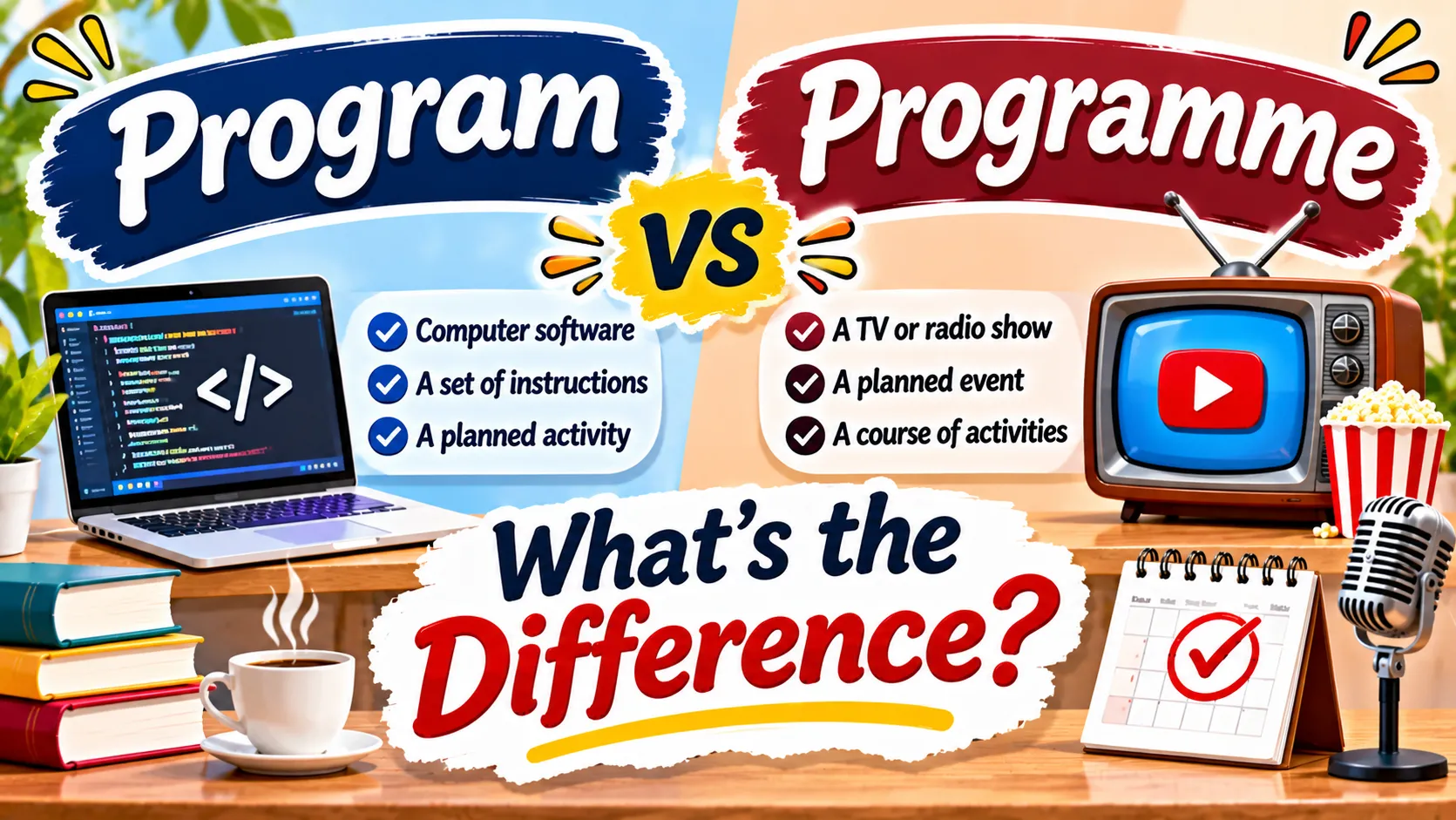
The words “program” and “programme” represent one of the most persistent spelling variations in English. Both refer to the same thing—a plan of action, a series of events, or a set of coded instructions for a computer. Yet the program vs programme distinction comes down to regional preference rather than grammatical correctness.
“Program” is the standard spelling in American and Canadian English for all meanings. “Programme” is the traditional British spelling for most meanings, though British English uses “program” for computer software. The confusion arises because the two spellings coexist across regions, and the computer exception creates further uncertainty. This comprehensive guide explains the regional differences, explores the origins of both forms, provides practical examples, and helps you choose the right spelling for your audience.
Quick Answer
Both “program” and “programme” are correct. Use “program” in American and Canadian English for all meanings, including computer software. Use “programme” in British English for television shows, events, and plans, but use “program” for computer software. The meaning is identical; only the regional spelling preference differs.
Meaning Overview Table
| Aspect | Meaning |
|---|---|
| Definition | A plan of action, a scheduled series of events, or a set of coded computer instructions |
| Pronunciation | Both: /ˈproʊɡræm/ (US) or /ˈprəʊɡræm/ (UK) |
| Part of Speech | Nouns and verbs |
| Usage | “A TV program” (US) vs. “a TV programme” (UK) |
| Context | Broadcasting, education, computing, events, business |
Main Meaning
Definition
Program and programme are spelling variants of the same word. As a noun, the word refers to a planned series of events, a broadcast show, a course of study, or a set of instructions that tells a computer what to do. As a verb, it means to schedule something or to write computer code. The two spellings differ only by region.
Origin
The word comes from the Late Latin programma, meaning “a public notice” or “proclamation,” which traces to the Greek programma (“a written public notice”). It entered English in the 17th century as “programme,” following French spelling conventions. American English simplified the spelling to “program” in the 19th century as part of broader spelling reforms. British English retained “programme” for most uses but adopted “program” for computer software in the 20th century.
Context
The choice between the two forms depends on your audience:
- American English: Always use “program”
- Canadian English: Prefer “program,” though “programme” appears occasionally
- British English: Use “programme” for television, events, and plans; use “program” for computer software
- Australian English: Follow British conventions, using “programme” for most meanings and “program” for software
- Computing: Use “program” universally, even in British English
Modern Usage
Today, “program” dominates in North America across all contexts. In the UK, “programme” remains standard for broadcasting and events, while “program” rules in computing. The computer exception exists because the technology industry developed largely in the United States, and the American spelling traveled with the software.
Detailed Explanation
Literal Meaning
Literally, both words mean a written public notice or a plan. The meaning has expanded over centuries to cover television shows, educational courses, and computer code.
Common Meaning
Commonly, people use “program” (American) or “programme” (British) to describe a television show, a schedule of events, or a course of study. “I watched a program about wildlife” or “The conference programme is online.”
Broadcasting Meaning
In broadcasting, British English uses “programme” for television and radio shows. American English uses “program.” A “TV programme” in London is a “TV program” in New York.
Computing Meaning
In computing, “program” is universal. Even British publications use “program” for software, code, and applications. “I wrote a program to sort the data” appears in both American and British English.
Educational Meaning
In education, British English uses “programme” for a course of study. American English uses “program.” “She enrolled in a graduate programme” (UK) versus “She enrolled in a graduate program” (US).
Business Meaning
In business, “programme” (UK) or “program” (US) describes a planned initiative or series of projects. “The company launched a training programme” (UK) versus “The company launched a training program” (US).
Examples Table
| Example | Meaning |
|---|---|
| I watched a program about space. | American spelling for a TV show |
| The programme starts at 8 PM. | British spelling for a TV show |
| She wrote a computer program. | Universal spelling for software |
| The conference programme is available online. | British spelling for an event schedule |
| He enrolled in a degree program. | American spelling for a course of study |
| The training programme lasts six weeks. | British spelling for a business initiative |
| The program crashed unexpectedly. | Universal spelling for software |
| We need to program the thermostat. | Universal verb spelling |
| The theatre programme lists all the actors. | British spelling for a printed guide |
| The government launched a new program. | American spelling for an initiative |
Related Meanings Table
| Related Term | Meaning |
|---|---|
| Program | American and Canadian spelling; universal for computing |
| Programme | British spelling for most meanings |
| Programmer | A person who writes computer code (universal spelling) |
| Programming | The act of writing code (universal spelling) |
| Programmer | British English also uses “programmer” |
| Programme guide | British term for a TV schedule |
| Program of study | American term for an educational course |
| Programme of study | British term for an educational course |
| TV program | American spelling for a broadcast show |
| TV programme | British spelling for a broadcast show |
| Software program | Universal term for computer software |
| Application program | Universal term for an app |
| Program schedule | American term for a timetable |
| Programme schedule | British term for a timetable |
| Program manager | Universal term for a project leader |
Common Uses
People use “program” and “programme” across numerous contexts:
Television and Radio: British broadcasters list “programmes” in their schedules. American networks air “programs.” This is the most common point of confusion.
Education: Universities in the UK offer “programmes” of study. American universities offer “programs.” This distinction appears in brochures, websites, and academic documents.
Computing: Software developers worldwide write “programs.” The word “programme” never appears in code documentation, even in British English.
Business and Government: Companies launch “training programmes” in the UK and “training programs” in the US. Government initiatives follow the same pattern.
Theatre and Events: British theatres sell “programmes” at performances. American venues sell “programs.”
Common Mistakes
| Mistake | Correction |
|---|---|
| Using “programme” for computer software in British English | Use “program” for software in all varieties |
| Using “programme” in American publications | Use “program” in American English |
| Using “program” for a TV show in British formal writing | Use “programme” for television in British English |
| Mixing spellings within one document | Choose one convention and apply it consistently |
| Assuming “programme” is always British | British English uses “program” for computing |
| Writing “programer” instead of “programmer” | “Programmer” is universal; do not use “programmer” with a “me” ending |
| Writing “programme” in computer code | Use “program” in technical documentation |
| Forgetting the computing exception | British English uses “program” for software |
| Using “program” for a theatre guide in the UK | Use “programme” for printed theatre guides in British English |
| Believing one spelling is grammatically incorrect | Both are correct; the difference is regional |
Related Questions
Is it “program” or “programme”?
Both are correct. “Program” is standard in American and Canadian English for all meanings. “Programme” is standard in British English for television, events, and plans, while “program” is used for computer software.
What is the difference between program and programme?
The difference is regional spelling. “Program” is American and Canadian. “Programme” is British. The meaning is identical.
Which spelling is used in the UK?
British English uses “programme” for most meanings but “program” for computer software.
Is “programme” used in America?
Rarely. American English uses “program” for all meanings. “Programme” appears only in quoted British material or as a stylistic choice.
Why do British people say “programme”?
British English retained the French-influenced spelling “programme,” while American English adopted the simplified “program” during the 19th century.
Is “program” always used for computers?
Yes. Even in British English, “program” is the standard spelling for computer software.
FAQs
What does “program” mean?
“Program” refers to a plan of action, a scheduled series of events, a broadcast show, a course of study, or a set of coded computer instructions.
What does “programme” mean?
“Programme” has the same meanings as “program.” It is the traditional British spelling for television shows, events, and plans.
Is it “TV program” or “TV programme”?
Both are correct. “TV program” is standard in American English. “TV programme” is standard in British English.
Why is computer software spelled “program” in the UK?
The technology industry developed largely in the United States, and the American spelling traveled with the software. British English adopted “program” specifically for computing.
Can I use “programme” in American English?
Rarely. American English uses “program” for all meanings. “Programme” appears only in quoted British material.
What is the plural of program and programme?
The plural is “programs” in American English and “programmes” in British English for non-computing meanings. For software, “programs” is used universally.
How do you pronounce program and programme?
Both are pronounced /ˈproʊɡræm/ in American English and /ˈprəʊɡræm/ in British English. The spelling does not change the pronunciation.
Is “programme” a real word?
Yes. “Programme” is a standard spelling in British English and appears in all major dictionaries.
Conclusion
Mastering the program vs programme distinction comes down to regional conventions. American and Canadian English use “program” for everything. British English uses “programme” for television shows, events, and plans, but “program” for computer software. The computer exception exists because the technology industry developed in the United States. Neither spelling is wrong, and the choice depends entirely on your audience. Whether you write “TV program” or “TV programme,” “training program” or “training programme,” your meaning remains clear. Choose the spelling that matches your region and context, apply it consistently, and write with confidence knowing that both forms are standard English.

Natalie Brooks is a content researcher and writer with a strong interest in word meanings, dream interpretations, symbolism, and cultural insights. She is passionate about creating clear, informative, and easy-to-understand content that helps readers discover the deeper meanings behind words, names, dreams, and symbols. Through her work at Meanzly, Natalie aims to make knowledge accessible and valuable for readers around the world.









