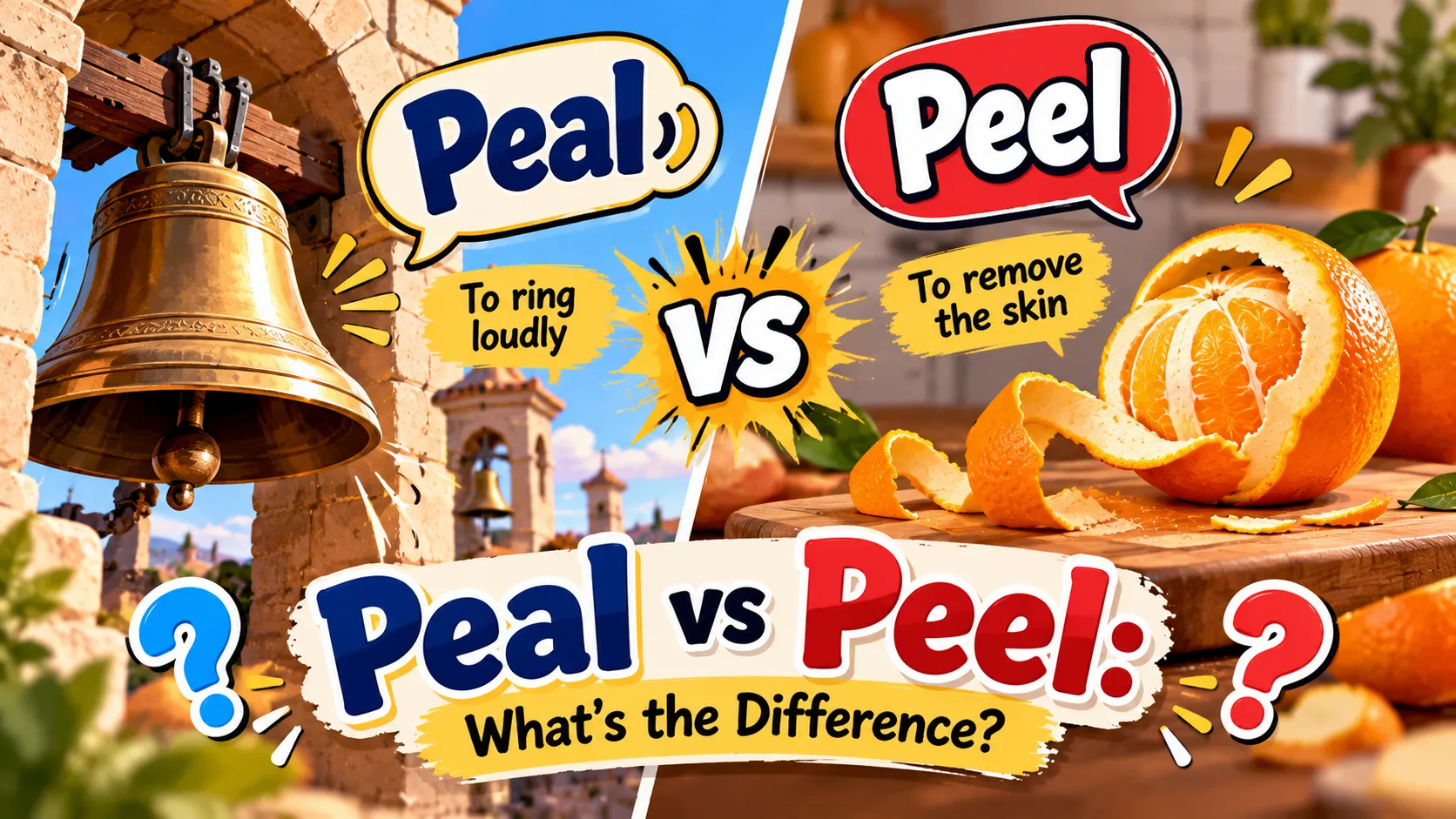
The words “peal” and “peel” sound exactly alike, yet they describe completely different things. One relates to sound—the ringing of bells or bursts of laughter. The other relates to removing a outer layer from fruit, vegetables, or skin. The peal vs peel confusion ranks among the most common homophone errors in English writing, appearing in everything from recipes to literary descriptions.
“Peal” is a noun and verb relating to loud sounds, especially bells or laughter. “Peel” is a noun and verb relating to skin, rind, or removing outer layers. These words share identical pronunciation but no shared meaning. This comprehensive guide explains the difference, explores their origins, provides practical examples, and helps you choose the correct word every time you write.
Quick Answer
“Peal” refers to a loud ringing of bells or a burst of laughter, as in “a peal of thunder” or “peals of laughter.” “Peel” refers to the outer skin of fruit or vegetables, or the act of removing it, as in “orange peel” or “peel the potatoes.” Remember: peal relates to sound; peel relates to skin or rind.
Meaning Overview Table
| Aspect | Meaning |
|---|---|
| Definition | Peal: a loud ringing sound or burst of laughter. Peel: the outer skin of fruit or the act of removing it |
| Pronunciation | Both: /piːl/ |
| Part of Speech | Peal: noun and verb. Peel: noun and verb |
| Usage | “A peal of thunder” vs. “Peel the apple” |
| Context | Peal: sound, music, weather, laughter. Peel: cooking, biology, skincare |
Main Meaning
Definition
Peal functions as both a noun and a verb. As a noun, it refers to a loud, prolonged ringing of bells, a burst of thunder, or a lively outburst of laughter. As a verb, it means to ring loudly or to sound in a peal. Peel functions as both a noun and a verb. As a noun, it refers to the outer skin or rind of a fruit or vegetable. As a verb, it means to remove that outer layer.
Origin
“Peal” comes from the Middle English pele, meaning a ringing of bells, which likely derives from the Old French apel (“a call”). The word has always been associated with sound, particularly the ringing of church bells.
“Peel” comes from the Old English pil or pyl, meaning the skin or rind of fruit. It relates to the Latin pellis (“skin”), which also gives us “pellicle” and “pelt.” The word has always referred to outer coverings.
Context
The distinction matters across several contexts:
- Cooking and Recipes: “Peel” appears in instructions for preparing fruits and vegetables
- Weather and Literature: “Peal” appears in descriptions of thunder, bells, and laughter
- Skincare: “Peel” refers to chemical or physical exfoliation
- Everyday Writing: Confusing the two creates embarrassing errors in emails, essays, and social media posts
Modern Usage
Today, “peel” appears frequently in cooking content, nutrition discussions, and skincare. “Peal” appears less often but remains common in literary descriptions, weather reporting, and discussions of bells. The confusion between the two persists because they sound identical and spell-check often fails to catch the error.
Detailed Explanation
Literal Meaning
Literally, “peal” means a loud ringing sound. “Peel” literally means the outer skin of something. These literal meanings remain the primary definitions of both words.
Common Meaning
Commonly, people use “peel” when discussing fruit, vegetables, or skincare. A recipe might instruct you to “peel the potatoes.” People use “peal” when describing loud sounds. “A peal of thunder” means a loud rumble. “Peals of laughter” means bursts of laughter.
Sound Meaning
“Peal” describes loud, prolonged sounds. Church bells peal on special occasions. Thunder peals across the sky. Laughter peals through a room. The word suggests resonance, volume, and duration.
Culinary Meaning
In cooking, “peel” refers to the outer layer of fruits and vegetables. Orange peel, lemon peel, and potato peel are common terms. The verb form describes removing this layer: “Peel the carrots before chopping them.”
Skincare Meaning
In skincare, “peel” refers to chemical or physical exfoliation. A “chemical peel” removes dead skin cells using acids. A “fruit peel” mask uses natural enzymes. The term draws on the idea of removing an outer layer.
Literary Meaning
In literature, “peal” appears in poetic descriptions of bells, thunder, and laughter. Writers use it to evoke atmosphere and sound. “Peel” appears in descriptions of food preparation and physical transformation.
Examples Table
| Example | Meaning |
|---|---|
| A peal of thunder shook the house. | A loud rumble |
| Peel the apples before baking. | Remove the outer skin |
| The bells pealed across the valley. | Rang loudly |
| Orange peel adds flavor to the recipe. | The outer rind |
| Peals of laughter filled the room. | Bursts of laughter |
| She peeled the label off the bottle. | Removed the outer layer |
| A peal of bells announced the wedding. | A loud ringing |
| Potato peel can be composted. | The outer skin |
| The storm pealed through the night. | Thundered loudly |
| He peeled back the curtain to look outside. | Pulled back a layer |
Related Meanings Table
| Related Term | Meaning |
|---|---|
| Peal | A loud ringing sound or burst of laughter |
| Peel | The outer skin of fruit or the act of removing it |
| Bells | Instruments that peal |
| Thunder | Weather phenomenon that peals |
| Laughter | Sounds that can come in peals |
| Rind | The outer skin of citrus or cheese |
| Zest | The outer colored part of citrus peel |
| Skin | The outer covering of fruit or animals |
| Paring | Removing the outer layer of food |
| Exfoliation | Removing dead skin cells |
| Chime | A ringing sound similar to a peal |
| Toll | The slow ringing of a bell |
| Knell | The sound of a bell rung slowly |
| Pellicle | A thin skin or film |
| Pelt | The skin of an animal |
Common Uses
People use “peal” and “peel” across numerous contexts:
Cooking and Baking: “Peel” appears constantly in recipes. Cooks peel potatoes, apples, carrots, and citrus fruits. Recipes list “orange peel” and “lemon peel” as ingredients.
Weather Reporting: “Peal” appears in descriptions of thunder and storms. “Peals of thunder” describe loud, rolling thunder.
Literature and Poetry: Writers use “peal” to describe bells, laughter, and natural sounds. The word adds musicality and resonance to prose.
Skincare and Beauty: “Peel” appears in discussions of chemical peels, exfoliation, and skincare treatments.
Music and Celebration: Church bells peal on holidays and weddings. The sound signals celebration and community.
Common Mistakes
| Mistake | Correction |
|---|---|
| Writing “peel of thunder” | Write “peal of thunder” (a loud sound) |
| Writing “peal the potatoes” | Write “peel the potatoes” (remove skin) |
| Writing “peals of laughter” as “peels of laughter” | Write “peals of laughter” (bursts of sound) |
| Writing “orange peal” | Write “orange peel” (the outer rind) |
| Writing “the bells peeled” | Write “the bells pealed” (rang loudly) |
| Writing “peal the label” | Write “peel the label” (remove a layer) |
| Assuming spell-check will catch the error | Spell-check often misses homophones; proofread manually |
| Confusing the two in recipes | Precision matters; “peel” refers to removing skin |
| Writing “chemical peal” | Write “chemical peel” (skincare treatment) |
| Using “peel” for loud sounds | Use “peal” for bells, thunder, and laughter |
Related Questions
Is it “peal” or “peel”?
It depends on meaning. Use “peal” for loud sounds like bells, thunder, or laughter. Use “peel” for the outer skin of fruit or removing it.
What does “peal of thunder” mean?
“Peal of thunder” describes a loud, rolling rumble of thunder. “Peal” refers to the prolonged, resonant sound.
What is orange peel?
Orange peel is the outer rind of an orange. It is used in cooking, baking, and cocktails for its flavor and aroma.
What does “peals of laughter” mean?
“Peals of laughter” means loud, prolonged bursts of laughter. The phrase suggests joyful, unrestrained sound.
What is a chemical peel?
A chemical peel is a skincare treatment that removes dead skin cells using acids. It is called a “peel” because it removes the outer layer of skin.
Why do people confuse “peal” and “peel”?
They sound identical and differ by only one letter. Spell-check often misses homophones, so the error persists in written communication.
FAQs
What does “peal” mean?
“Peal” is a noun and verb relating to loud sounds. It means a ringing of bells, a burst of thunder, or a peal of laughter.
What does “peel” mean?
“Peel” is a noun and verb relating to outer layers. It means the skin of fruit or vegetables, or the act of removing that skin.
Is it “peal the apple” or “peel the apple”?
The correct phrase is “peel the apple.” “Peel” means to remove the outer skin.
Is it “a peal of thunder” or “a peel of thunder”?
The correct phrase is “a peal of thunder.” “Peal” refers to the loud sound.
Can “peel” be used for sounds?
No. “Peel” only refers to skin, rind, or removing layers. Sounds use “peal.”
Can “peal” be used for fruit?
No. “Peal” only refers to sounds. Fruit skin uses “peel.”
How can I remember the difference?
Remember: “peal” contains “ea,” like “ear” (hearing sound). “Peel” contains “ee,” like “see” the skin you remove. If it’s a sound, use “peal.” If it’s skin, use “peel.”
What is the origin of “peal”?
“Peal” comes from Middle English pele, meaning a ringing of bells, likely from Old French apel (“a call”).
Conclusion
Mastering the peal vs peel distinction protects your writing from embarrassing homophone errors. “Peal” refers to loud sounds—the ringing of bells, the rumble of thunder, or bursts of laughter. “Peel” refers to the outer skin of fruit and vegetables or the act of removing it. Remember the simple rule: peal is for sound; peel is for skin. Whether you’re writing a recipe, a weather report, or a literary description, choosing the correct word ensures your meaning is clear. Practice using “peal” for sounds and “peel” for layers, and your readers will understand exactly what you intend. Small distinctions like this separate careful writers from careless ones.

Natalie Brooks is a content researcher and writer with a strong interest in word meanings, dream interpretations, symbolism, and cultural insights. She is passionate about creating clear, informative, and easy-to-understand content that helps readers discover the deeper meanings behind words, names, dreams, and symbols. Through her work at Meanzly, Natalie aims to make knowledge accessible and valuable for readers around the world.