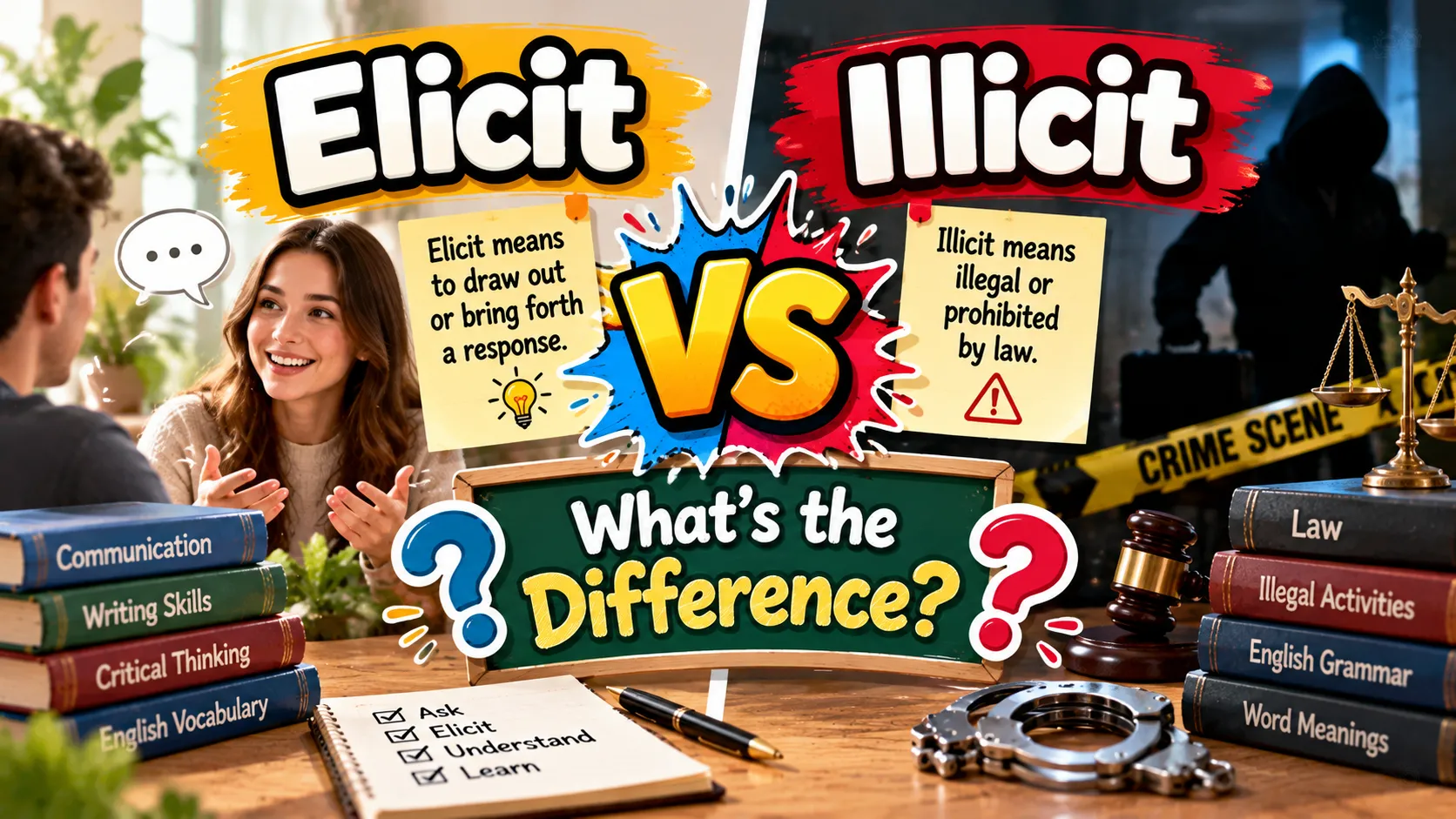
The words “elicit” and “illicit” sound similar enough to trip up even careful writers, yet they belong to completely different areas of language. One is a verb about drawing out information or responses; the other is an adjective describing something illegal or forbidden. The elicit vs illicit confusion ranks among the most common word-choice errors in professional writing, appearing in news reports, academic papers, and business documents.
“Elicit” means to bring out, draw forth, or evoke a response. “Illicit” means illegal, unlawful, or forbidden by law or custom. These words share similar pronunciation but no shared meaning. This comprehensive guide explains the difference, explores their origins, provides practical examples, and helps you choose the correct word every time you write.
Quick Answer
“Elicit” is a verb meaning to draw out or evoke a response, as in “The question elicited a strong reaction.” “Illicit” is an adjective meaning illegal or forbidden, as in “illicit drugs.” Remember: elicit is an action you perform; illicit describes something unlawful. They sound similar but mean completely different things.
Meaning Overview Table
| Aspect | Meaning |
|---|---|
| Definition | Elicit: to draw out or evoke a response. Illicit: illegal, unlawful, or forbidden |
| Pronunciation | Elicit: /ɪˈlɪsɪt/; Illicit: /ɪˈlɪsɪt/ (nearly identical) |
| Part of Speech | Elicit: verb. Illicit: adjective |
| Usage | “The teacher elicited answers from students” vs. “The police seized illicit goods” |
| Context | Elicit: communication, psychology, education. Illicit: law, ethics, security |
Main Meaning
Definition
Elicit is a transitive verb meaning to bring out, draw forth, or call forth a response, answer, or reaction. It describes the act of prompting someone to provide information, express emotion, or take action. Illicit is an adjective meaning not permitted by law, rule, or custom; illegal or forbidden.
Origin
“Elicit” comes from the Latin verb elicere, meaning “to draw out,” combining ex- (“out”) and lacere (“to entice” or “to lure”). The word entered English in the 17th century. “Illicit” comes from the Latin adjective illicitus, meaning “not allowed,” combining in- (“not”) and licitus (“permitted,” from licere, “to be allowed”). It also entered English in the 17th century. Despite their similar sounds, the words have entirely different roots.
Context
The distinction matters across several contexts:
- Law and Security: “Illicit” appears in discussions of illegal activities, contraband, and forbidden substances
- Education and Psychology: “Elicit” appears in discussions of questioning techniques, behavioral responses, and therapeutic methods
- Journalism: Reporters describe how questions “elicit” responses; they describe “illicit” activities in crime reporting
- Everyday Writing: Confusing the two creates embarrassing errors in emails, essays, and social media posts
Modern Usage
Today, “elicit” appears frequently in academic, therapeutic, and professional contexts where drawing out information matters. “Illicit” appears constantly in legal, security, and news contexts. The confusion between the two persists because they sound nearly identical and spell-check often fails to catch the error.
Detailed Explanation
Literal Meaning
Literally, “elicit” means to draw out something hidden or potential. “Illicit” literally means not permitted—outside the bounds of law or accepted rules.
Common Meaning
Commonly, people use “elicit” to describe getting a response. A joke elicits laughter. A question elicits an answer. A performance elicits applause. People use “illicit” to describe illegal or forbidden things: illicit drugs, illicit affairs, illicit trade.
Communication Meaning
In communication, “elicit” describes the process of prompting a response. Interviewers elicit information. Teachers elicit answers. Therapists elicit feelings. The word emphasizes drawing out rather than simply receiving.
Legal Meaning
In legal contexts, “illicit” describes actions, goods, or relationships that violate law or accepted standards. Illicit drugs, illicit trade, and illicit relationships all involve prohibition or taboo.
Psychological Meaning
In psychology, “elicit” describes evoking a response or behavior. Stimuli elicit reactions. Questions elicit memories. The word appears frequently in behavioral research and therapeutic practice.
Examples Table
| Example | Meaning |
|---|---|
| The question elicited a thoughtful response. | Drew out a response |
| Police seized illicit drugs at the border. | Illegal drugs |
| The comedian elicited laughter from the crowd. | Evoked laughter |
| The company engaged in illicit trading practices. | Illegal trading |
| The survey elicited honest answers from participants. | Drew out honest answers |
| He had an illicit affair with a coworker. | Forbidden relationship |
| The teacher elicited the correct answer from the student. | Drew out the answer |
| The government cracked down on illicit gambling. | Illegal gambling |
| The documentary elicited strong emotions from viewers. | Evoked emotions |
| The investigation uncovered illicit financial transactions. | Illegal transactions |
Related Meanings Table
| Related Term | Meaning |
|---|---|
| Elicit | To draw out or evoke a response |
| Illicit | Illegal or forbidden |
| Evoke | To bring to mind or memory; similar to elicit |
| Provoke | To stimulate or incite a reaction |
| Extract | To draw out information or substance |
| Elicitation | The act of drawing out information |
| Illegitimate | Not authorized by law; similar to illicit |
| Unlawful | Contrary to law |
| Illegal | Forbidden by law |
| Prohibited | Forbidden by rule or law |
| Contraband | Goods forbidden by law |
| Taboo | Forbidden by social custom |
| Eliciting | The present participle of elicit |
| Illicitly | In an illegal manner |
| Elicited | Past tense of elicit |
Common Uses
People use “elicit” and “illicit” across numerous contexts:
Law Enforcement: Police describe “illicit” activities, substances, and trade. They “elicit” information from witnesses and suspects through questioning.
Education: Teachers “elicit” answers from students through questioning techniques. The word describes the art of drawing out knowledge rather than simply delivering it.
Psychology and Therapy: Therapists “elicit” feelings, memories, and responses from clients. The word emphasizes the active process of bringing hidden material to the surface.
Journalism: Reporters “elicit” quotes and reactions. They report on “illicit” affairs, trades, and activities.
Everyday Conversation: People “elicit” opinions and reactions through questions. They discuss “illicit” activities in news and gossip.
Common Mistakes
| Mistake | Correction |
|---|---|
| Writing “illicit a response” | Write “elicit a response” (draw out) |
| Writing “elicit drugs” | Write “illicit drugs” (illegal drugs) |
| Writing “the question illicit ed an answer” | Write “the question elicited an answer” (drew out) |
| Writing “elicit affairs” | Write “illicit affairs” (forbidden relationships) |
| Writing “elicit trade” | Write “illicit trade” (illegal trade) |
| Writing “elicited goods” when meaning illegal goods | Write “illicit goods” (illegal goods) |
| Assuming spell-check will catch the error | Spell-check often misses similar-sounding words; proofread manually |
| Writing “elicitly” | “Illicitly” is the adverb form of “illicit”; “elicit” has no standard adverb form |
| Confusing the two in legal writing | Precision matters; “illicit” describes illegality, “elicit” describes drawing out |
| Writing “illicit information from someone” | Write “elicit information from someone” (draw out) |
Related Questions
Is it “elicit” or “illicit”?
It depends on meaning. Use “elicit” as a verb meaning to draw out a response. Use “illicit” as an adjective meaning illegal or forbidden.
What does “elicit” mean?
“Elicit” means to bring out, draw forth, or evoke a response, answer, or reaction.
What does “illicit” mean?
“Illicit” means illegal, unlawful, or forbidden by law or custom.
Can “illicit” be a verb?
No. “Illicit” is only an adjective. “Elicit” is the verb.
Can “elicit” be an adjective?
No. “Elicit” is a verb. The adjective form would be “elicited” as a participle.
What is the difference between “elicit” and “evoke”?
“Elicit” often implies drawing out a response through questioning or prompting. “Evoke” often implies bringing something to mind or memory.
Why do people confuse “elicit” and “illicit”?
They sound nearly identical and differ by only one letter. Spell-check often misses similar-sounding words, so the error persists in written communication.
FAQs
What does “elicit” mean?
“Elicit” is a verb meaning to draw out, bring forth, or evoke a response, answer, or reaction.
What does “illicit” mean?
“Illicit” is an adjective meaning illegal, unlawful, or forbidden by law or custom.
Is it “elicit a response” or “illicit a response”?
The correct phrase is “elicit a response.” “Elicit” means to draw out. “Illicit” is an adjective meaning illegal.
Is it “illicit drugs” or “elicit drugs”?
The correct phrase is “illicit drugs.” “Illicit” means illegal. “Elicit” is a verb meaning to draw out.
Can “elicit” be used as an adjective?
No. “Elicit” is a verb. Use “elicited” as a participle or “eliciting” as a present participle.
What is the noun form of “elicit”?
The noun form is “elicitation,” meaning the act of drawing out information or responses.
What is the difference between “illicit” and “illegal”?
“Illicit” often carries a broader meaning, including things forbidden by custom or morality as well as law. “Illegal” specifically means forbidden by law.
How can I remember the difference?
Remember: “elicit” starts with “e” like “evoke” or “extract” (drawing out). “Illicit” starts with “ill” like “illegal” (forbidden).
Conclusion
Mastering the elicit vs illicit distinction protects your writing from embarrassing word-choice errors. “Elicit” is a verb meaning to draw out or evoke a response. “Illicit” is an adjective meaning illegal or forbidden. Remember the simple rule: elicit is an action; illicit is a description of something unlawful. Whether you’re writing a news report, a business document, or a social media post, choosing the correct word ensures your meaning is clear. Practice using “elicit” for drawing out responses and “illicit” for describing illegal activities, and your readers will understand exactly what you intend. Small distinctions like this separate careful writers from careless ones.

Natalie Brooks is a content researcher and writer with a strong interest in word meanings, dream interpretations, symbolism, and cultural insights. She is passionate about creating clear, informative, and easy-to-understand content that helps readers discover the deeper meanings behind words, names, dreams, and symbols. Through her work at Meanzly, Natalie aims to make knowledge accessible and valuable for readers around the world.









