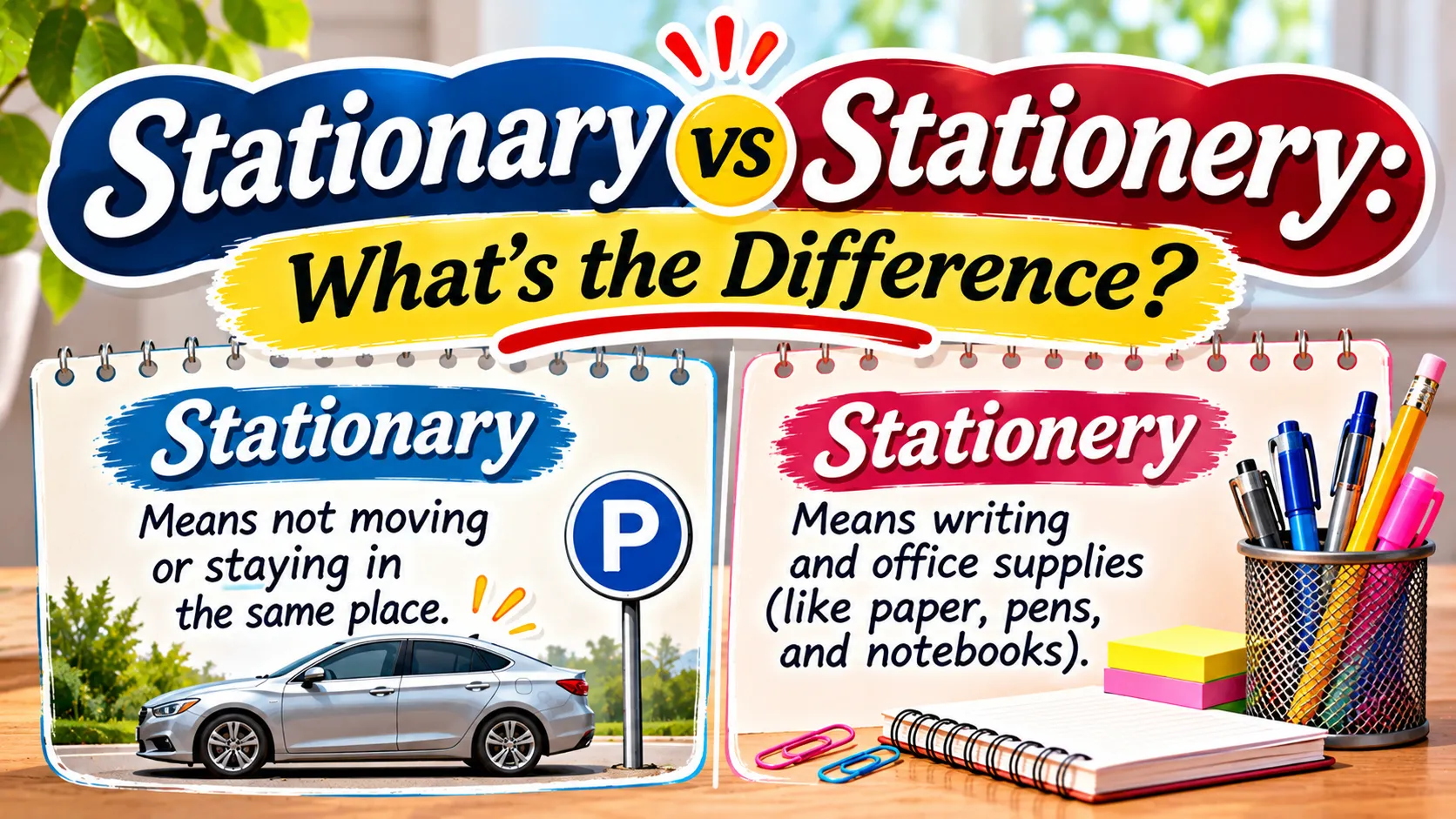
The words “stationary” and “stationery” differ by just one letter, sound nearly identical, and rank among the most commonly confused word pairs in English. The stationary vs stationery distinction trips up even experienced writers, appearing incorrectly in business emails, academic papers, and published articles.
“Stationary” is an adjective meaning not moving or fixed in place. “Stationery” is a noun referring to writing materials like paper, envelopes, and pens. The confusion arises because the words share the same Latin root and differ only in their final syllable. This comprehensive guide explains the difference, explores their origins, provides practical examples, and helps you choose the correct word every time you write.
Quick Answer
“Stationary” means not moving or fixed in place, as in “the car remained stationary.” “Stationery” refers to writing materials like paper, envelopes, and pens, as in “she bought stationery for her letters.” Remember: stationAry has an “A” for “At rest”; stationEry has an “E” for “Envelopes.” They sound the same but mean completely different things.
Meaning Overview Table
| Aspect | Meaning |
|---|---|
| Definition | Stationary: not moving, fixed in place. Stationery: writing materials like paper and envelopes |
| Pronunciation | Both: /ˈsteɪʃəneri/ |
| Part of Speech | Stationary: adjective. Stationery: noun |
| Usage | “The train was stationary” vs. “She ordered custom stationery” |
| Context | Stationary: physics, traffic, military, everyday descriptions. Stationery: office supplies, correspondence, branding |
Main Meaning
Definition
Stationary is an adjective meaning not moving, not changing, or fixed in a particular position. It describes objects, people, or conditions that remain still or stable. Stationery is a noun referring to writing materials such as paper, envelopes, pens, and other office supplies used for correspondence or record-keeping.
Origin
Both words share a common ancestor: the Latin noun stationarius, meaning “a seller of books” or “one who has a fixed station.” In medieval Latin, stationarius referred to a bookseller or publisher attached to a university. The adjective “stationary” developed from the Latin stationarius meaning “pertaining to a station” or “fixed.” The noun “stationery” emerged from the same root, referring to the goods sold by a stationer—originally a bookseller or publisher, later a seller of writing materials.
Context
The distinction matters across several contexts:
- Physics and Engineering: “Stationary” describes objects at rest or conditions that do not change
- Office and Business: “Stationery” describes branded paper, envelopes, and business supplies
- Everyday Writing: Confusing the two creates embarrassing errors in emails, essays, and business correspondence
- Military and Security: “Stationary” describes troops or vehicles not in motion
Modern Usage
Today, “stationary” appears frequently in descriptions of traffic, exercise bikes, and physics experiments. “Stationery” appears in discussions of office supplies, wedding invitations, and corporate branding. The confusion between the two persists because they sound identical and spell-check often fails to catch the error.
Detailed Explanation
Literal Meaning
Literally, “stationary” means remaining in one place or not moving. “Stationery” literally refers to the goods sold by a stationer—writing materials for correspondence and record-keeping.
Common Meaning
Commonly, people use “stationary” to describe things that are not moving. “The bus was stationary at the traffic light.” They use “stationery” when discussing paper, envelopes, and pens. “She bought new stationery for her desk.”
Physics Meaning
In physics, “stationary” describes an object at rest relative to a given frame of reference. A stationary bike stays in place while the rider pedals. A stationary front in meteorology describes a weather boundary that is not moving.
Business Meaning
In business, “stationery” refers to branded paper, envelopes, letterheads, and business cards. Corporate stationery carries a company’s logo, address, and contact information. Wedding stationery includes invitations, save-the-dates, and thank-you cards.
Spelling Meaning
The key to remembering the difference lies in the endings. “StationAry” ends with “ary,” relating to “at rest.” “StationEry” ends with “ery,” relating to “envelopes” or “paper.”
Examples Table
| Example | Meaning |
|---|---|
| The car remained stationary at the red light. | Not moving |
| She ordered custom stationery for her wedding. | Writing materials |
| The exercise bike is stationary. | Fixed in place |
| The office manager ordered new stationery. | Paper and envelopes |
| The train was stationary for twenty minutes. | Not moving |
| He wrote a letter on his personal stationery. | Writing paper |
| The satellite appears stationary from Earth. | Fixed in position |
| The company logo appears on all stationery. | Office supplies |
| Keep the ladder stationary while I climb. | Not moving |
| The stationery store sells pens and paper. | Writing materials |
Related Meanings Table
| Related Term | Meaning |
|---|---|
| Stationary | Not moving; fixed in place |
| Stationery | Writing materials like paper and envelopes |
| Stationer | A person who sells stationery |
| Stationary bike | An exercise bike that stays in place |
| Stationary front | A weather boundary that is not moving |
| Stationary phase | A phase in chromatography where the material is fixed |
| Stationery store | A shop selling writing materials |
| Letterhead | The printed heading on stationery |
| Envelope | A paper container for letters, part of stationery |
| Writing paper | Paper used for writing letters, part of stationery |
| Stationary object | An object at rest |
| Stationary waves | Waves that appear to stand still |
| Stationary engine | An engine that stays in one place |
| Stationery set | A collection of writing materials |
| Stationery cabinet | A storage unit for writing supplies |
Common Uses
People use “stationary” and “stationery” across numerous contexts:
Traffic and Transportation: Drivers describe vehicles as stationary when they are not moving. Traffic reports note stationary traffic during rush hour.
Office and Business: Businesses order stationery with their logo and address. Office managers track stationery supplies. Corporate branding includes stationery design.
Education: Students use stationery for note-taking and assignments. Teachers may provide stationery lists for the school year.
Weddings and Events: Couples order wedding stationery including invitations, menus, and thank-you cards. Event planners coordinate stationery design.
Physics and Science: Scientists describe stationary objects, stationary phases in chromatography, and stationary fronts in meteorology.
Common Mistakes
| Mistake | Correction |
|---|---|
| Writing “stationery bike” | Write “stationary bike” (not moving) |
| Writing “stationary store” | Write “stationery store” (selling writing materials) |
| Writing “the car was stationery” | Write “the car was stationary” (not moving) |
| Writing “she bought stationary” | Write “she bought stationery” (writing materials) |
| Writing “stationary supplies” | Write “stationery supplies” (writing materials) |
| Writing “stationery traffic” | Write “stationary traffic” (not moving) |
| Writing “wedding stationary” | Write “wedding stationery” (invitations and cards) |
| Writing “stationery object” | Write “stationary object” (not moving) |
| Assuming spell-check will catch the error | Spell-check often misses homophones; proofread manually |
| Writing “business stationary” | Write “business stationery” (letterheads and cards) |
Related Questions
Is it “stationary” or “stationery”?
It depends on meaning. Use “stationary” for something not moving or fixed in place. Use “stationery” for writing materials like paper and envelopes.
What does “stationary” mean?
“Stationary” is an adjective meaning not moving, not changing, or fixed in a particular position.
What does “stationery” mean?
“Stationery” is a noun referring to writing materials such as paper, envelopes, pens, and other office supplies.
What is the difference between “stationary” and “stationery” in a sentence?
“Stationary” describes something that is not moving. “Stationery” refers to writing materials.
Why do people confuse “stationary” and “stationery”?
They sound identical and differ by only one letter. Spell-check often misses homophones, so the error persists in written communication.
How can I remember the difference?
Remember: stationAry has an “A” for “At rest.” StationEry has an “E” for “Envelopes.”
Is “stationery” always paper?
No. Stationery includes pens, pencils, envelopes, notebooks, and other writing supplies, though paper products are the most common.
FAQs
What does “stationary” mean?
“Stationary” is an adjective meaning not moving, fixed in place, or unchanging. It describes objects, people, or conditions that remain still.
What does “stationery” mean?
“Stationery” is a noun referring to writing materials such as paper, envelopes, pens, and other office supplies used for correspondence.
Is it “stationary bike” or “stationery bike”?
The correct phrase is “stationary bike.” A stationary bike is an exercise bike that stays in place.
Is it “stationery store” or “stationary store”?
The correct phrase is “stationery store.” A stationery store sells writing materials.
Can “stationary” be a noun?
No. “Stationary” is only an adjective. The noun form is “stationariness,” meaning the quality of being stationary.
Can “stationery” be an adjective?
No. “Stationery” is only a noun. The adjective form is “stationary,” though it has a different meaning.
How can I remember the difference?
Remember: stationAry has an “A” for “At rest.” StationEry has an “E” for “Envelopes.”
What is the origin of “stationery”?
“Stationery” comes from the medieval Latin stationarius, meaning a bookseller or publisher. Over time, it came to refer to the goods sold by stationers—writing materials.
Conclusion
Mastering the stationary vs stationery distinction protects your writing from embarrassing homophone errors. “Stationary” is an adjective meaning not moving or fixed in place. “Stationery” is a noun referring to writing materials like paper, envelopes, and pens. Remember the simple rule: stationAry has an “A” for “At rest”; stationEry has an “E” for “Envelopes.” Whether you’re writing a business email, a wedding invitation, or a traffic report, choosing the correct word ensures your meaning is clear. Practice using “stationary” for things that stay still and “stationery” for writing supplies, and your readers will understand exactly what you intend. Small distinctions like this separate careful writers from careless ones.

Natalie Brooks is a content researcher and writer with a strong interest in word meanings, dream interpretations, symbolism, and cultural insights. She is passionate about creating clear, informative, and easy-to-understand content that helps readers discover the deeper meanings behind words, names, dreams, and symbols. Through her work at Meanzly, Natalie aims to make knowledge accessible and valuable for readers around the world.