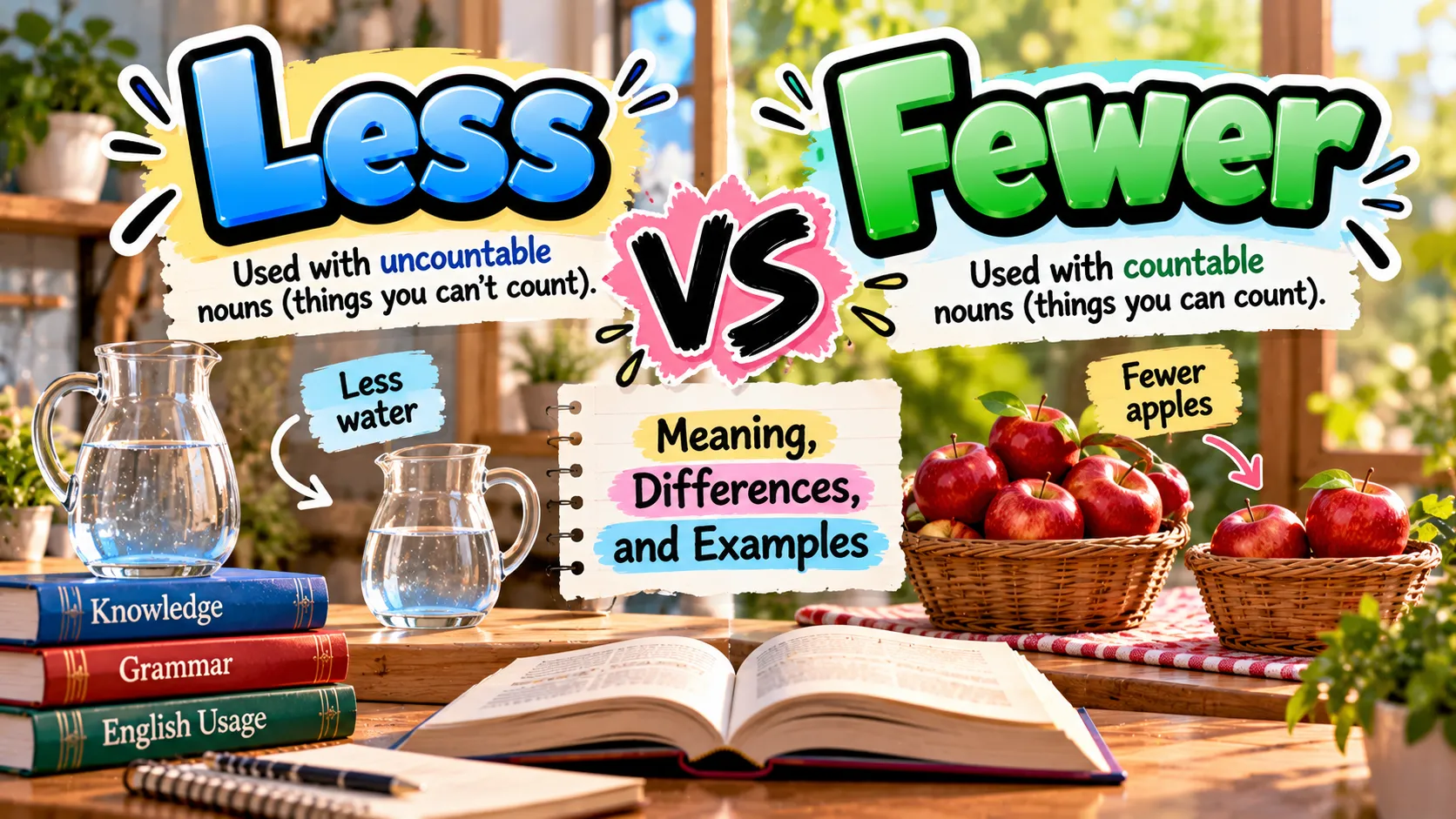
Understanding less vs fewer is essential for clear and grammatically correct English. These two words both describe a smaller amount or number, but they are generally used with different types of nouns. Choosing the correct word can improve your writing, help you avoid common grammar mistakes, and make your sentences sound more natural.
The basic rule is simple: use less with uncountable nouns and fewer with countable plural nouns. For example, you would say “less water” because water is not usually counted as individual units, but “fewer bottles” because bottles can be counted separately. Although this rule works in most situations, some expressions involving time, money, distance, and measurement follow different patterns.
In this guide, you will learn what less and fewer mean, how to use them correctly, and when the traditional grammar rule has exceptions. You will also find practical examples, comparison tables, common mistakes, and easy memory tips to help you choose the right word with confidence.
📖 What Does Less Mean?
Less means a smaller amount, degree, quantity, or extent. It is generally used with uncountable nouns, which are nouns that people do not ordinarily count as separate individual items.
Common uncountable nouns include water, sugar, money, information, time, traffic, patience, and furniture. You can measure or describe the amount of these things, but you do not normally count them directly without using units.
For example, you can have less water, less information, or less patience. You could also say that someone spends less money or experiences less stress.
Less can also compare degrees or qualities. In sentences such as “This route is less expensive” and “The second explanation is less complicated,” the word compares characteristics rather than the number of objects.
Examples of Less in Sentences
- I need less sugar in my coffee.
- We have less time to finish the project.
- She spends less money on unnecessary purchases.
- There is less traffic on the road this morning.
- He has less experience than his colleague.
- This recipe requires less oil.
- I would like less information on the first page and more detail on the second.
- The new system creates less confusion for users.
- We experienced less stress after organizing our schedule.
- This option is less expensive than the alternative.
These examples show that less commonly describes quantities, amounts, and degrees. When you cannot naturally count a noun as individual items, less is usually the appropriate choice.
🔢 What Does Fewer Mean?
Fewer means a smaller number of individual people, animals, objects, or other countable things. It is generally used with plural countable nouns, which can be counted one by one.
For example, you can count books, chairs, students, cars, and apples. If the number of these items decreases, you can use fewer to describe the difference.
You would say “fewer books,” “fewer students,” or “fewer mistakes” because each noun refers to individual items or instances that can be counted.
Fewer is especially useful in professional writing, reports, academic work, and everyday conversations when you need to compare numbers clearly.
Examples of Fewer in Sentences
- Fewer students attended the meeting this week.
- I made fewer mistakes on my second attempt.
- We need fewer chairs for the smaller room.
- The store received fewer customers than expected.
- She bought fewer apples than she planned.
- Fewer cars were on the road after midnight.
- The team completed the project with fewer delays.
- This year, the company hired fewer employees.
- He answered fewer questions than his classmates.
- We received fewer complaints after updating the service.
In each example, the noun refers to something that can be counted. You can count students, mistakes, chairs, customers, apples, cars, delays, employees, questions, and complaints.
⚖️ Less vs Fewer: Key Differences
The main difference between less and fewer is the type of noun they describe. Less generally refers to an amount, while fewer generally refers to a number of countable items.
| Feature | Less | Fewer |
|---|---|---|
| Main meaning | A smaller amount or degree | A smaller number |
| Common noun type | Uncountable nouns | Countable plural nouns |
| Examples | Less water, less time, less stress | Fewer bottles, fewer hours, fewer problems |
| Common question | How much? | How many? |
| Example sentence | We need less equipment. | We need fewer tools. |
The easiest way to apply this distinction is to examine the noun that follows the word.
If the noun answers the question “How much?” use less in most ordinary contexts. If it answers “How many?” use fewer.
For example, “How much milk do we have?” calls for a quantity, so you would say “We have less milk.” However, “How many cartons do we have?” asks about countable items, so “We have fewer cartons” is correct.
📝 When to Use Less in a Sentence
Use less when discussing an amount of something that is not normally counted individually. This includes liquids, substances, abstract concepts, and many general quantities.
1. With Uncountable Nouns
Uncountable nouns usually refer to substances, concepts, or categories that do not have separate units unless you specify a measurement.
Examples include:
- Less water
- Less milk
- Less information
- Less furniture
- Less traffic
- Less noise
- Less patience
- Less energy
Example: “The updated instructions contain less unnecessary information.”
2. With Comparisons of Degree
Less can also describe a lower degree of a characteristic or quality. In these sentences, it does not directly compare the number of objects.
Examples:
- Less difficult
- Less interesting
- Less reliable
- Less comfortable
- Less expensive
- Less complicated
Example: “The revised process is less complicated than the original one.”
3. With Time, Money, and Measurement
Less is common with amounts of time, money, distance, weight, and other measurements, particularly when the quantity is treated as a single total.
Examples:
- Less than ten minutes
- Less than five dollars
- Less than two miles
- Less than three kilograms
Example: “The package weighs less than two kilograms.”
Although these expressions may involve numbers or countable units, English often treats the measurement as a single quantity.
📚 When to Use Fewer in a Sentence
Use fewer when you are comparing the number of separate items, people, events, or other countable things.
1. With Countable Plural Nouns
Countable nouns can be counted individually. Their plural forms commonly follow fewer.
Examples:
- Fewer books
- Fewer people
- Fewer appointments
- Fewer questions
- Fewer opportunities
- Fewer emails
- Fewer mistakes
- Fewer visitors
Example: “We received fewer emails after updating the notification settings.”
2. With Countable Units of Time
When you count separate units, such as minutes, days, weeks, or appointments, fewer is often appropriate.
Examples:
- Fewer than ten minutes remain before the meeting.
- She missed fewer days of work this month.
- We scheduled fewer appointments this week.
- The revised process requires fewer working days.
The choice depends on what you are emphasizing. “Less time” treats time as an overall amount, while “fewer hours” counts separate units.
3. With Numbers of People or Events
Fewer is also suitable when comparing the number of people, incidents, or occasions.
Examples:
- Fewer employees joined the training session.
- The report recorded fewer accidents this year.
- Fewer customers visited the store on Monday.
- We encountered fewer problems during testing.
Using fewer makes it clear that you are comparing a count rather than an uncountable amount.
⏰ Less vs Fewer With Time, Money, and Distance
Time, money, and distance can create confusion because they may be described as either amounts or countable units. In these cases, the meaning of the sentence determines which word sounds most natural.
| Expression | Typical usage | Why |
|---|---|---|
| Less time | Correct | Time is treated as an overall amount. |
| Fewer minutes | Correct | Minutes are counted as separate units. |
| Less money | Correct | Money is treated as an amount. |
| Fewer coins | Correct | Coins are individual countable objects. |
| Less distance | Correct | Distance is treated as a measurement. |
| Fewer miles | Often appropriate when counting miles | Miles are expressed as countable units. |
| Less than $20 | Correct | The total monetary amount is being compared. |
| Fewer than 20 dollars in coins | Possible, depending on context | The sentence counts individual dollar coins. |
For example, “The trip took less time than expected” emphasizes the total duration. “The trip took fewer minutes than expected” counts the minutes, though the first version is generally more natural in everyday English.
Similarly, “We spent less money” compares the total amount spent, while “We used fewer bills” compares the number of individual banknotes.
🚦 Exceptions to the Less vs Fewer Rule
The traditional rule is helpful, but real English usage includes several exceptions and established expressions. Knowing these patterns will help you understand both formal grammar and everyday communication.
1. Less Than With Numbers and Measurements
English commonly uses less than before amounts, prices, weights, distances, and periods of time.
Examples:
- The repair cost less than $100.
- The drive takes less than an hour.
- The bag weighs less than five pounds.
- The office is less than ten miles away.
These expressions treat the number as a measurement or total amount.
2. Less Than With Time Periods
In some contexts, time expressions use less than even when the noun is countable.
For example, “The meeting lasted less than two hours” is standard and natural. Here, the speaker focuses on the total duration rather than counting individual hours.
However, “Fewer than two hours remain before the deadline” is also possible when the sentence emphasizes the number of hours remaining. Both constructions can be correct, depending on the intended meaning and context.
3. Established Expressions With Less
Some fixed expressions use less even when a countable noun appears.
For example, “one less problem” is standard English. The phrase refers to a reduction in the number of problems, but one less is the established construction.
You will also hear expressions such as “less than 100 people” in everyday speech. Some style guides prefer “fewer than 100 people” because people are countable. In formal edited writing, fewer is generally the safer choice for a direct count of individuals.
4. Less in Informal Conversation
In everyday speech, people sometimes use less with plural countable nouns. This usage is common in signs, advertisements, and casual conversation.
For example, a sign might say “10 items or less.” Many formal style guides recommend “10 items or fewer” because items can be counted. Both forms are widely encountered, but “10 items or fewer” follows the traditional rule more closely.
❌ Common Mistakes With Less and Fewer
Even fluent English speakers sometimes confuse these words. The following examples demonstrate how to correct common errors.
Mistake 1: Using less with countable items
Incorrect: There are less cars on the road today.
Correct: There are fewer cars on the road today.
Cars are countable objects, so fewer is preferred.
Mistake 2: Using fewer with an uncountable noun
Incorrect: We need fewer information about the product.
Correct: We need less information about the product.
Information is generally uncountable in English.
Mistake 3: Confusing money with individual coins
Incorrect: I have fewer money than before.
Correct: I have less money than before.
The sentence refers to the total amount of money, not the number of coins or banknotes.
Mistake 4: Choosing the wrong expression for time
Less time and fewer minutes can both be correct, but they emphasize different things.
- Correct: We have less time to prepare.
- Correct: We have fewer minutes available than yesterday.
The first describes the overall amount of time; the second counts units of time.
Mistake 5: Writing “less mistakes” in formal content
Incorrect: The new process produced less mistakes.
Preferred: The new process produced fewer mistakes.
Mistakes are countable individual occurrences, so fewer mistakes is generally preferred in formal writing.
🧠 Easy Ways to Remember Less vs Fewer
A simple memory trick can help you choose the correct word quickly.
Less = how much? Use it for amounts that are not normally counted as separate items.
- Less water
- Less sugar
- Less stress
- Less information
- Less money
Fewer = how many? Use it for things you can count individually.
- Fewer books
- Fewer students
- Fewer cars
- Fewer questions
- Fewer mistakes
You can also try a quick test: if you can naturally place a number directly before the plural noun—such as five books or three students—fewer is usually the better choice when you want to describe a smaller number.
If the noun normally refers to a general amount, such as water, advice, or equipment, less is usually appropriate.
Remember that context still matters. Time, distance, money, and measurements may use less when the speaker treats them as a total quantity.
❓ Frequently Asked Questions
Is it less or fewer?
Both words are correct, but they are used differently. Use less for amounts and uncountable nouns, such as less water or less information. Use fewer for countable plural nouns, such as fewer books or fewer people.
What is the main difference between less and fewer?
The main difference is that less generally describes a smaller amount, while fewer describes a smaller number of countable items. For example, you need less milk but fewer bottles.
Is “less people” grammatically correct?
In formal edited English, “fewer people” is generally preferred because people are countable. However, “less people” appears in informal speech and everyday writing.
Should I say “less than 10 items” or “fewer than 10 items”?
“Fewer than 10 items” follows the traditional rule because items are countable. You may encounter “less than 10 items” in informal usage and on signs, but fewer is the safer option for formal writing.
Is it less time or fewer time?
The correct expression is less time because time is generally treated as an uncountable quantity. You can say “fewer minutes” when counting individual minutes.
Is it less money or fewer money?
The correct expression is less money when you are talking about the total amount of money. Use fewer when counting individual monetary items, such as fewer coins or fewer banknotes.
Can less and fewer be used interchangeably?
Not in most formal contexts. Although casual speech sometimes uses less with countable nouns, the traditional distinction remains useful: less for amounts and fewer for countable numbers.
✅ Conclusion
The difference between less vs fewer depends mainly on whether you are describing an amount or a number. Use less with uncountable nouns such as water, money, information, and time. Use fewer with countable plural nouns such as books, students, cars, and mistakes.
The easiest way to remember the rule is to ask yourself two questions: How much? usually points to less, while How many? usually points to fewer. Keep in mind that expressions involving time, distance, money, and measurements can depend on whether you are emphasizing an overall quantity or counting separate units.
By understanding this distinction and practicing with real examples, you can write more clearly, avoid common grammar errors, and use both words confidently in everyday and professional English.

Natalie Brooks is a content researcher and writer with a strong interest in word meanings, dream interpretations, symbolism, and cultural insights. She is passionate about creating clear, informative, and easy-to-understand content that helps readers discover the deeper meanings behind words, names, dreams, and symbols. Through her work at Meanzly, Natalie aims to make knowledge accessible and valuable for readers around the world.