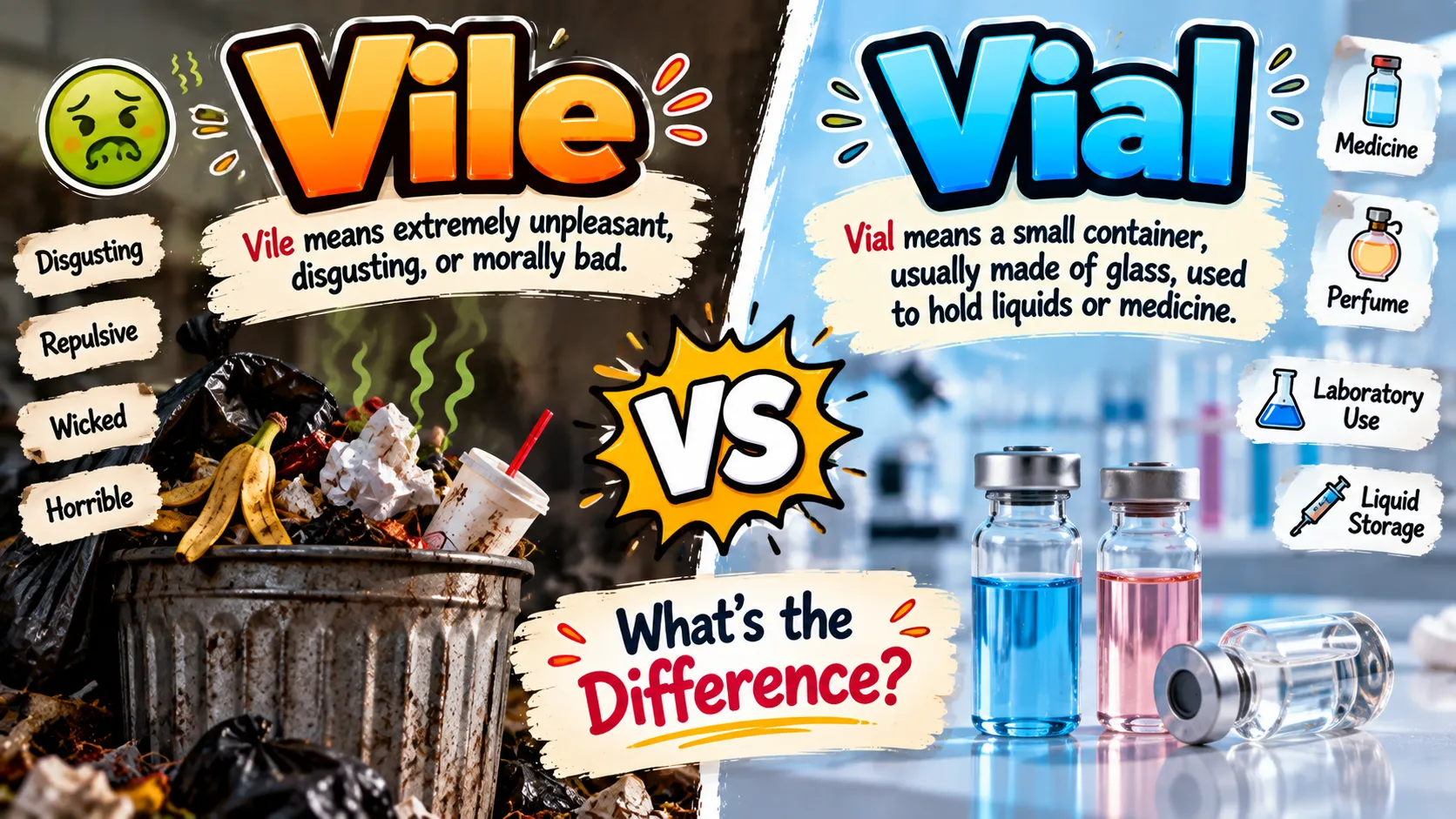
The words “vile” and “vial” look almost identical on the page, differ by just one letter, and occasionally cause writers to pause and double-check their spelling. The vile vs vial confusion ranks among the less common homophone errors, but it still appears in everything from medical notes to book reviews. Getting it right matters because the two words belong to completely different worlds.
“Vile” is an adjective meaning extremely unpleasant, morally repulsive, or disgusting. “Vial” is a noun referring to a small glass container used for holding liquids, especially medicines or chemicals. These words sound similar but mean completely different things. This comprehensive guide explains the difference, explores their origins, provides practical examples, and helps you choose the correct word every time you write.
Quick Answer
“Vile” is an adjective meaning extremely unpleasant, disgusting, or morally repulsive, as in “a vile smell” or “a vile act.” “Vial” is a noun referring to a small glass container for liquids, as in “a vial of medicine.” Remember: vile describes something awful; a vial holds something. They sound similar but mean completely different things.
Meaning Overview Table
| Aspect | Meaning |
|---|---|
| Definition | Vile: extremely unpleasant or morally repulsive. Vial: a small glass container for liquids |
| Pronunciation | Vile: /vaɪl/; Vial: /ˈvaɪəl/ |
| Part of Speech | Vile: adjective. Vial: noun |
| Usage | “The vile odor made us leave” vs. “The nurse filled a vial with medicine” |
| Context | Vile: descriptive writing, moral judgments. Vial: medicine, chemistry, laboratories |
Main Meaning
Definition
Vile is an adjective meaning extremely unpleasant, repulsive, disgusting, or morally base. It describes something that offends the senses or the moral sense. It can describe physical qualities (a vile smell) or moral qualities (a vile act).
Vial is a noun referring to a small glass or plastic container, usually with a narrow neck, used for holding liquids such as medicines, chemicals, or samples. The word appears frequently in medical, pharmaceutical, and laboratory contexts.
Origin
“Vile” comes from the Latin adjective vilis, meaning “cheap,” “worthless,” or “base.” It entered English through Old French vil in the 13th century. The meaning evolved from “cheap or lowly” to “morally reprehensible” and “physically disgusting.”
“Vial” comes from the Old French fiole, meaning a small container, which traces to the Latin phiala and Greek phialē, meaning a broad, flat vessel or bowl. The word has always referred to a small container for liquids.
Context
The distinction matters across several contexts:
- Medical and Laboratory Writing: “Vial” appears constantly in discussions of medications, vaccines, and samples
- Descriptive and Moral Writing: “Vile” appears in descriptions of unpleasant sensations or immoral actions
- Everyday Writing: Confusing the two creates embarrassing errors in emails, essays, and social media posts
- Creative Writing: Authors use “vile” for vivid descriptions of disgust or villainy
Modern Usage
Today, “vial” appears frequently in healthcare and scientific contexts, especially since the COVID-19 pandemic brought vaccine vials into daily news coverage. “Vile” appears in descriptive writing, moral commentary, and casual expressions of disgust. The confusion between the two persists because they look similar and spell-check often fails to catch the error.
Detailed Explanation
Literal Meaning
Literally, “vile” means “cheap” or “worthless” in its oldest sense, but modern usage emphasizes “disgusting” or “morally repulsive.” “Vial” literally means a small container for liquids.
Common Meaning
Commonly, people use “vile” to describe something extremely unpleasant. “That’s a vile smell” or “What a vile thing to say.” They use “vial” when discussing medicines, vaccines, or laboratory samples stored in small glass containers.
Medical Meaning
In medicine, a “vial” is a small glass or plastic container that holds liquid medication, vaccine doses, or blood samples. Nurses draw medicine from vials with syringes. Pharmacies store vaccines in vials. Laboratory technicians handle vials of chemicals and samples.
Moral Meaning
“Vile” carries strong moral weight. A “vile act” is not just unpleasant but morally reprehensible. The word appears in discussions of cruelty, corruption, and ethical failures.
Sensory Meaning
“Vile” also describes physical sensations. A “vile taste,” a “vile smell,” or a “vile sight” all convey intense disgust. The word intensifies negative sensory experiences beyond mere unpleasantness.
Examples Table
| Example | Meaning |
|---|---|
| The vile smell came from the dumpster. | Extremely unpleasant odor |
| The nurse drew medicine from the vial. | Small glass container for liquid |
| That was a vile thing to say. | Morally repulsive statement |
| The vaccine vial was stored in the refrigerator. | Container holding vaccine doses |
| He had a vile temper. | Extremely unpleasant or cruel temper |
| She filled a vial with the chemical sample. | Small container for laboratory use |
| The food tasted vile. | Extremely unpleasant taste |
| The pharmacist counted the vials on the shelf. | Small glass containers |
| The villain’s vile deeds shocked the town. | Morally reprehensible actions |
| The blood sample was placed in a vial. | Small container for medical testing |
Related Meanings Table
| Related Term | Meaning |
|---|---|
| Vile | Extremely unpleasant or morally repulsive |
| Vial | A small glass container for liquids |
| Disgusting | Extremely unpleasant; similar to vile |
| Repulsive | Causing strong dislike; similar to vile |
| Despicable | Morally reprehensible; similar to vile |
| Abhorrent | Inspiring disgust; similar to vile |
| Vilely | In a vile manner (adverb) |
| Vileness | The quality of being vile (noun) |
| Ampoule | A sealed glass container for medicine; similar to vial |
| Ampule | Alternative spelling of ampoule |
| Phial | An older word for vial |
| Bottle | A container for liquids; larger than a vial |
| Test tube | A cylindrical container for laboratory use |
| Syringe | A device for injecting or withdrawing liquids from a vial |
| Vaccine vial | A vial containing vaccine doses |
| Vial cap | The seal on top of a vial |
Common Uses
People use “vile” and “vial” across numerous contexts:
Healthcare and Medicine: “Vial” appears constantly in discussions of vaccines, medications, and blood samples. Nurses draw doses from vials. Pharmacies store medications in vials.
Laboratory Science: “Vial” refers to small containers for chemical samples, reagents, and specimens. Laboratories use vials for storage and analysis.
Descriptive Writing: “Vile” appears in vivid descriptions of unpleasant smells, tastes, and sights. Novelists use it to convey strong disgust.
Moral Commentary: “Vile” appears in discussions of immoral actions, cruel behavior, and ethical failures. Journalists and commentators use it to condemn reprehensible conduct.
Everyday Speech: People use “vile” informally to express disgust. “That’s vile” appears constantly on social media.
Common Mistakes
| Mistake | Correction |
|---|---|
| Writing “vial smell” | Write “vile smell” (extremely unpleasant) |
| Writing “vile of medicine” | Write “vial of medicine” (small container) |
| Writing “vile of blood” | Write “vial of blood” (small container) |
| Writing “the vile was stored in the fridge” | Write “the vial was stored in the fridge” (container) |
| Writing “a vile act” as “a vial act” | Write “a vile act” (morally repulsive) |
| Writing “vial language” | Write “vile language” (disgusting language) |
| Assuming spell-check will catch the error | Spell-check often misses homophones; proofread manually |
| Writing “the vaccine vile” | Write “the vaccine vial” (container) |
| Writing “vial taste” | Write “vile taste” (unpleasant taste) |
| Using “vial” as an adjective | “Vial” is a noun; “vile” is the adjective |
Related Questions
Is it “vile” or “vial”?
It depends on meaning. Use “vile” for something extremely unpleasant or morally repulsive. Use “vial” for a small glass container for liquids.
What does “vile” mean?
“Vile” is an adjective meaning extremely unpleasant, disgusting, or morally repulsive. It describes something that offends the senses or the moral sense.
What does “vial” mean?
“Vial” is a noun referring to a small glass or plastic container used for holding liquids like medicines, chemicals, or samples.
What is the difference between “vial” and “ampoule”?
A vial is a small container with a cap or stopper that can be opened and resealed. An ampoule is a sealed glass container that must be broken open for use.
Can “vile” describe a person?
Yes. “Vile” can describe a person as morally repulsive or extremely unpleasant. “A vile person” means someone morally reprehensible.
Why do people confuse “vile” and “vial”?
They look similar and differ by only one letter. Spell-check often misses homophones, so the error persists in written communication.
FAQs
What does “vile” mean?
“Vile” is an adjective meaning extremely unpleasant, disgusting, or morally repulsive. It describes something that offends the senses or the moral sense.
What does “vial” mean?
“Vial” is a noun referring to a small glass or plastic container used for holding liquids, especially medicines, chemicals, or samples.
Is it “vile of medicine” or “vial of medicine”?
The correct phrase is “vial of medicine.” A vial is the container that holds the medicine.
Is it “vile smell” or “vial smell”?
The correct phrase is “vile smell.” Vile means extremely unpleasant.
Can “vial” be used as an adjective?
No. “Vial” is a noun. The adjective form is “vile.”
What is the difference between “vile” and “vial” in a sentence?
“Vile” describes something extremely unpleasant or morally repulsive. “Vial” refers to a small container for liquids.
How can I remember the difference?
Remember: “vile” has an “e” like “evil” — both mean bad. “Vial” has an “a” like “container” — both hold things.
Is “vial” related to “phial”?
Yes. “Phial” is an older spelling of “vial.” Both refer to a small container for liquids.
Conclusion
Mastering the vile vs vial distinction protects your writing from embarrassing homophone errors. “Vile” is an adjective meaning extremely unpleasant or morally repulsive. “Vial” is a noun referring to a small glass container for liquids, especially medicines and samples. Remember the simple rule: vile describes something awful; a vial holds something. Whether you’re writing a medical report, a book review, or a social media post, choosing the correct word ensures your meaning is clear. Practice using “vile” for disgust and “vial” for containers, and your readers will understand exactly what you intend. Small distinctions like this separate careful writers from careless ones.

Natalie Brooks is a content researcher and writer with a strong interest in word meanings, dream interpretations, symbolism, and cultural insights. She is passionate about creating clear, informative, and easy-to-understand content that helps readers discover the deeper meanings behind words, names, dreams, and symbols. Through her work at Meanzly, Natalie aims to make knowledge accessible and valuable for readers around the world.