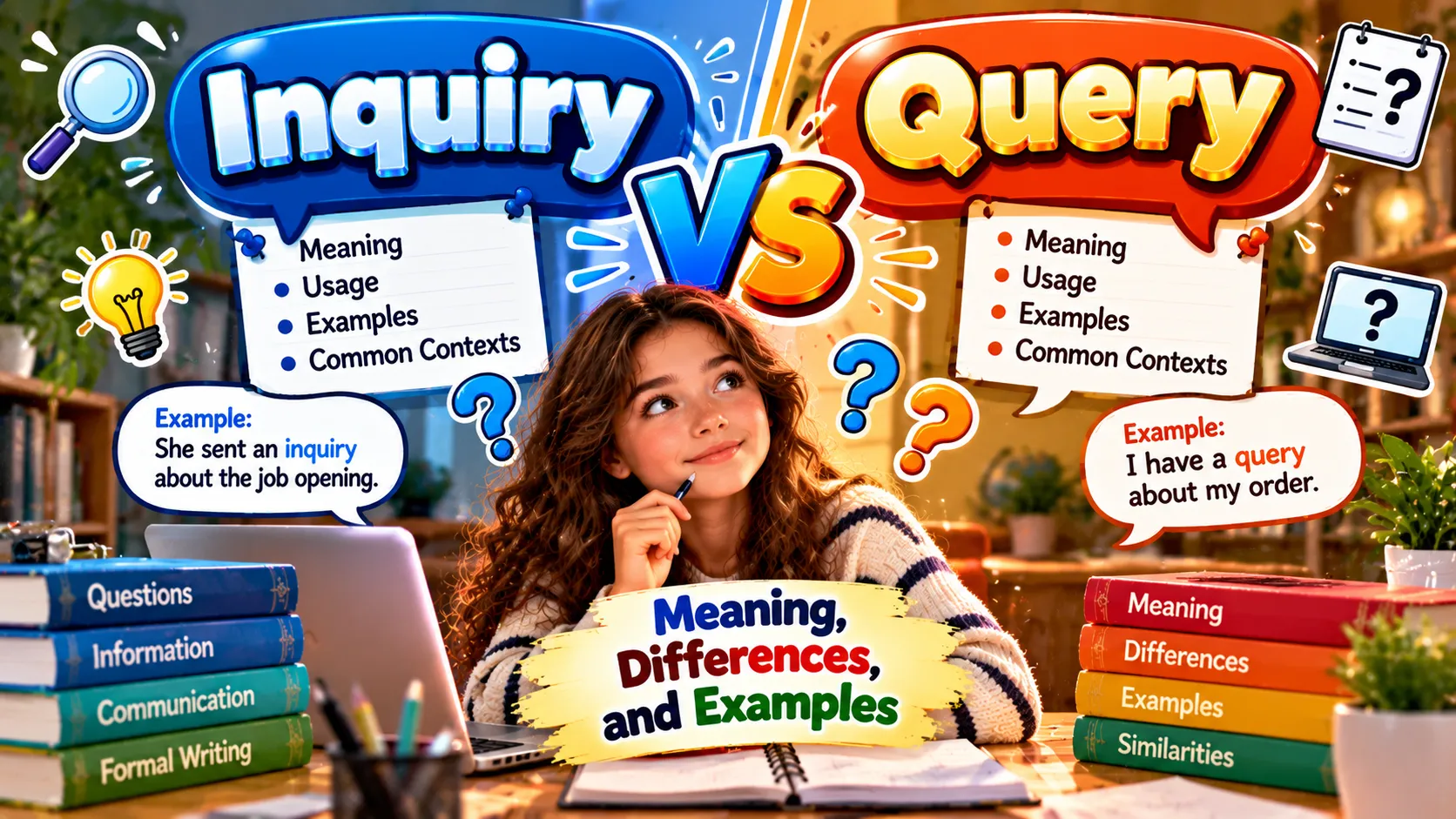
Understanding the difference between inquiry vs query can help you choose the right word in professional writing, academic work, emails, and everyday conversations. Both words involve asking for information, but they are not always interchangeable. Their meanings can vary depending on the situation, industry, and regional English usage.
An inquiry usually refers to a request for information, an investigation, or an attempt to learn more about a subject. A query generally refers to a question or a specific request for information, clarification, or data. For example, you might send an inquiry about a job opening, while a customer might submit a query about an unexpected charge.
In this guide, you will learn what inquiry and query mean, how they differ, when to use each word, and which examples are most appropriate for everyday and professional communication.
What Does Inquiry Mean? 🔎
An inquiry is a request for information or an investigation into a particular subject. People commonly use the word when contacting a business, asking about a service, seeking details about an opportunity, or examining an issue.
In American English, inquiry is widely used in formal and professional contexts. For example, a person might make an inquiry about university admission requirements or submit an inquiry regarding a product’s availability.
The word can also describe a more extensive investigation. A government agency may conduct an inquiry into a public concern, while a school may begin an inquiry into an incident.
Examples of Inquiry in Sentences
- I sent an inquiry about the job opening.
- The customer made an inquiry about the refund policy.
- She submitted an inquiry regarding university admission.
- We received an inquiry about our consulting services.
- The company launched an inquiry into the complaint.
- He called the hotel to make an inquiry about room availability.
- The committee conducted an inquiry into the incident.
- Please direct your inquiry to the customer service department.
When to use inquiry: Choose inquiry when you want to emphasize a request for information, a formal question, or an investigation.
What Does Query Mean? 💬
A query is a question or a request for specific information, clarification, or data. It is common in business communication, customer support, publishing, research, computing, and database management.
For example, a customer may send a query asking why a payment was processed twice. A researcher may raise a query about a result, while a computer user may run a database query to retrieve specific records.
In everyday English, query can sound more focused or specific than inquiry, although their meanings overlap. It is particularly useful when referring to a particular question that needs an answer.
Examples of Query in Sentences
- I have a query about my latest bill.
- She sent a query to the support team.
- The editor reviewed the writer’s publishing query.
- Please answer the client’s query by tomorrow.
- The researcher raised a query about the results.
- I entered a database query to find the records.
- He submitted a query about the application process.
- The teacher answered every student’s query.
When to use query: Choose query when referring to a specific question, clarification request, or technical request for information.
Inquiry vs Query: Key Differences 📊
Inquiry and query have similar meanings, but their typical uses can differ. The following table highlights their main distinctions.
| Feature | Inquiry | Query |
|---|---|---|
| Main meaning | Request for information or investigation | Question or specific information request |
| Common use | Formal requests, customer contact, investigations | Specific questions, clarification, technical searches |
| Tone | Often formal | Neutral, professional, or technical |
| Business example | An inquiry about available services | A query about an invoice |
| Investigation meaning | Can refer to a formal investigation | Usually refers to a question, though usage varies |
| Computing | Less common in this sense | Common for database searches and data retrieval |
The distinction is not absolute. A customer can make an inquiry or submit a query about the same service. The best choice depends on whether you want to emphasize a broader request for information or a particular question.
When to Use Inquiry vs Query at Work 💼
Choosing the right word can make professional emails and business messages sound more natural. Both words are appropriate in the workplace, but some situations favor one over the other.
Use Inquiry For:
- Asking about a company’s services.
- Requesting information about job vacancies.
- Contacting a university about admission requirements.
- Asking a hotel about reservations.
- Referring to a formal investigation.
- Making a general request for product information.
Example: I am writing to make an inquiry about your available marketing services.
Use Query For:
- Asking about a specific invoice or transaction.
- Requesting clarification about a policy.
- Following up on a particular issue.
- Asking a technical support team about an error.
- Submitting a question about a document.
- Requesting particular information from a database.
Example: I have a query about the additional fee listed on my invoice.
These are useful guidelines rather than strict rules. In many workplaces, either word can work when the context is clear.
Inquiry vs Query in American and British English 🇺🇸
Both inquiry and query are used in American and British English. However, inquiry is particularly common in formal requests for information and investigations, while query is frequently used for individual questions and technical requests.
In American English, inquiry is a natural choice for contacting a business or asking about a service. Query is also common, especially in technology, research, and professional communication.
British English also uses both words. In some contexts, enquiry is used for a general request for information, while inquiry may be associated with a formal investigation. This distinction is not consistently applied by every writer or organization.
For a US-focused article or business email, inquiry is a dependable choice for general information requests, while query works well for specific questions.
Inquiry vs Query: Real-Life Examples ✍️
The easiest way to understand these words is to compare them in similar situations.
| Situation | Example with inquiry | Example with query |
|---|---|---|
| Business | I made an inquiry about your services. | I have a query about your service fee. |
| Education | She sent an inquiry about enrollment. | He raised a query about his grade. |
| Customer support | We received an inquiry about product availability. | The customer submitted a query about a payment. |
| Employment | I made an inquiry about the vacant position. | I have a query about the job description. |
| Technology | The team began an inquiry into the system failure. | The developer ran a database query. |
Notice that inquiry often fits a broader request or investigation, whereas query often focuses on a specific question or information need. Nevertheless, context matters more than the word alone.
Common Mistakes When Using Inquiry and Query ⚠️
Although these words overlap, using them without considering context can make a sentence less precise.
Mistake 1: Treating every inquiry as an investigation
An inquiry does not always involve a formal investigation. It can simply be a request for information.
- Natural: I made an inquiry about the course fees.
- Also natural: The agency conducted an inquiry into the incident.
Mistake 2: Assuming query is only a computer term
A query can refer to an ordinary question as well as a technical database request.
- Natural: I have a query about the contract.
- Natural: The analyst ran a database query.
Mistake 3: Assuming the words are never interchangeable
Both can describe requests for information. For instance, a company may receive an inquiry or a query about its services. The choice often depends on the organization’s preferred wording.
Mistake 4: Using an unnecessarily formal word
In casual conversation, question may be clearer than either inquiry or query.
- Simple: I have a question about the meeting.
- More formal: I have a query about the meeting agenda.
Choose the word that fits your audience and purpose.
Synonyms for Inquiry and Query 📝
Although inquiry and query share some synonyms, their alternatives depend on the intended meaning.
| Synonyms for inquiry | Synonyms for query |
|---|---|
| Request | Question |
| Investigation | Clarification request |
| Examination | Information request |
| Appeal for information | Doubt |
| Search for answers | Technical request |
Some alternatives, such as question and request for information, can replace either word in many contexts. Others are more specific. For example, investigation fits an inquiry into wrongdoing but usually does not replace a simple query about an invoice.
Frequently Asked Questions ❓
Is inquiry the same as query?
Not exactly, but their meanings overlap. An inquiry often emphasizes a request for information or an investigation, while a query often refers to a specific question or request for clarification.
Which is more formal: inquiry or query?
Both can be formal. Inquiry is common in official requests and investigations, while query is common in professional communication and technical contexts. Neither is universally more formal.
Should I use inquiry or query in an email?
Use inquiry when asking generally about a service, opportunity, or process. Use query when asking about a specific detail, issue, or charge. Either can be appropriate if the meaning is clear.
Is a query a question?
Yes. A query can be a question or a request for information. In computing, it can also mean an instruction used to retrieve or manipulate data.
Is inquiry American or British English?
Inquiry is used in both American and British English. British English also commonly uses enquiry for general requests for information, although spelling preferences vary.
What is the difference between inquiry and investigation?
An inquiry can be a request for information or a formal examination of an issue. An investigation specifically involves examining facts or evidence to establish what happened or determine the truth.
Conclusion
The difference between inquiry vs query is mainly a matter of emphasis and context. An inquiry often involves requesting information or examining an issue, while a query usually refers to a specific question or request for clarification.
Use inquiry when contacting a business, asking about an opportunity, or describing an investigation. Use query when asking about a particular detail, seeking clarification, or working with databases. Since the meanings overlap, choose the word that communicates your intended meaning most clearly.

Natalie Brooks is a content researcher and writer with a strong interest in word meanings, dream interpretations, symbolism, and cultural insights. She is passionate about creating clear, informative, and easy-to-understand content that helps readers discover the deeper meanings behind words, names, dreams, and symbols. Through her work at Meanzly, Natalie aims to make knowledge accessible and valuable for readers around the world.