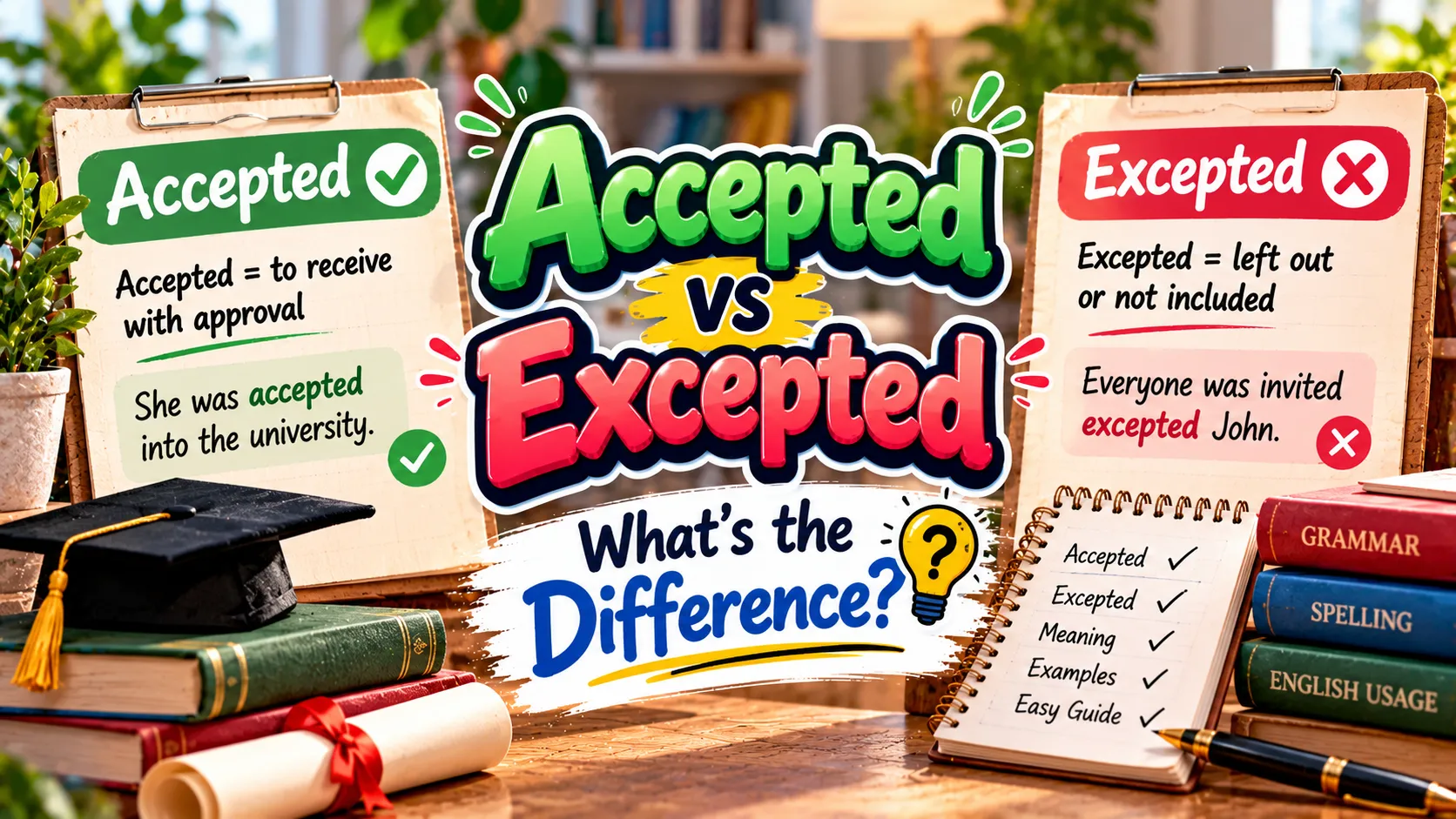
The words “accepted” and “excepted” look nearly identical, sound almost the same, and appear in similar contexts. Yet they carry opposite meanings. Understanding the accepted vs excepted distinction is essential for anyone who wants to communicate clearly in writing, whether in business, academics, or everyday correspondence.
“Accepted” means received, approved, or generally agreed upon. “Excepted” means excluded, left out, or not included. The confusion arises because both words share the same Latin root and differ by only one letter, but their functions in English are completely different . This guide breaks down the difference with clear definitions, practical examples, and memory tricks to help you use each word correctly every time.
Quick Answer
“Accepted” means received with approval or generally agreed upon, as in “an accepted theory.” “Excepted” means excluded or left out, as in “present company excepted.”
Meaning Overview Table
| Aspect | Meaning |
|---|---|
| Definition | Accepted: received or approved. Excepted: excluded or left out |
| Pronunciation | Both: /ɪkˈsɛptɪd/ or /əkˈsɛptɪd/ |
| Part of Speech | Accepted: adjective and past tense verb. Excepted: adjective and past tense verb |
| Usage | “The proposal was accepted” vs. “All days are open excepted Sundays” |
| Context | Business, academics, legal writing, everyday communication |
Main Meaning
Definition
Accepted functions as both an adjective and the past tense of the verb “accept.” As an adjective, it means “regarded favorably,” “generally approved,” or “widely used” . As a verb form, it means “received willingly” or “agreed to.”
Excepted functions as an adjective and the past tense of the verb “except.” As an adjective, it means “not included” or “excluded from a statement” . As a verb form, it means “left out” or “excluded.”
Origin
Both words trace back to the Latin verb capere, meaning “to take.” “Accept” derives from accipere (“to receive”), combining ad- (“toward”) and capere. “Except” derives from excipere (“to take out”), combining ex- (“out of”) and capere . The prefixes tell the story: ad- suggests taking something in, while ex- suggests taking something out. This etymological difference explains the modern meanings perfectly.
Modern Usage
Today, “accepted” appears constantly in both formal and casual writing. It describes everything from job offers to scientific theories. “Excepted” appears less frequently but carries important legal and formal weight. The phrase “present company excepted” remains a common courtesy, and legal documents frequently use “excepted” to carve out exclusions .
Detailed Explanation
Literal Meaning
Literally, “accepted” means “taken in” or “received.” It describes something that has been welcomed, approved, or agreed to. “Excepted” literally means “taken out” or “excluded.”
Common Meaning
An “accepted practice” is a standard way of doing things. A “widely accepted theory” is one most experts believe. People use “excepted” to carve out exceptions. “Present company excepted” means “excluding everyone here.” “Sundays excepted” means “not including Sundays” .
Text Meaning
In written communication, the distinction carries weight. Mixing the two can create confusion or legal ambiguity.
Legal Meaning
In legal contexts, “excepted” appears frequently to describe exclusions. The phrase “errors and omissions excepted” (E&OE) appears on invoices to protect against mistakes .
Academic Meaning
In academic writing, “accepted” describes ideas that have gained widespread approval. “The accepted interpretation” or “the generally accepted view” refers to scholarly consensus. “Excepted” appears less often, usually to describe specific cases excluded from a general rule.
Examples Table
| Example | Meaning |
|---|---|
| The job offer was accepted. | The offer was received and agreed to |
| Present company excepted, the team performed poorly. | Excluding the people present, the team did poorly |
| The theory is widely accepted. | The theory is generally approved |
| All items are on sale, batteries excepted. | Batteries are excluded from the sale |
| She accepted the apology. | She received the apology willingly |
| The rule applies to everyone, minors excepted. | Minors are excluded from the rule |
| The accepted standard for measurement is the metric system. | The approved, normal standard |
| Sundays excepted, the office is open daily. | Not including Sundays |
| He was accepted into the program. | He was admitted into the program |
| Errors and omissions excepted. | Excluding errors and omissions (legal disclaimer) |
Related Meanings Table
| Related Term | Meaning |
|---|---|
| Accept | To receive or agree to |
| Except | To exclude or leave out |
| Acceptance | The act of receiving or approving |
| Exception | Something excluded from a rule |
| Accepted | Approved, received, agreed upon |
| Excepted | Excluded, left out |
| Acceptable | Good enough to be accepted |
| Exceptional | Unusually good; forming an exception |
| Unaccepted | Not received or approved |
| Unexcepted | Not excluded (rare usage) |
| Generally accepted | Widely approved or believed |
| Present company excepted | Excluding the people present |
| Errors and omissions excepted | Legal disclaimer excluding mistakes |
| Accepted practice | Standard, normal way of doing things |
| Excepted items | Items specifically excluded |
Common Uses
People use “accepted” and “excepted” across numerous contexts:
Business Communication: Invoices often carry the phrase “errors and omissions excepted” to protect against mistakes . Policies may except certain items from coverage.
Academic Writing: Researchers describe “accepted theories” and “accepted practices.”
Legal Documents: Clauses may except specific situations, as in “notwithstanding the foregoing, Clause 5 excepted” .
Everyday Speech: People say “present company excepted” as a courtesy when making a critical remark. They accept invitations, apologies, and gifts.
Social Media: “Accepted” appears in posts about college admissions, job offers, and relationship statuses. “Excepted” appears less often but carries the same meaning online.
Common Mistakes
| Mistake | Correction |
|---|---|
| Using “excepted” when meaning “received” | Use “accepted” for receiving or approving |
| Using “accepted” when meaning “excluded” | Use “excepted” for excluding or leaving out |
| Writing “present company accepted” | Write “present company excepted” (excluding those present) |
| Confusing the two in legal documents | Precision matters; “excepted” means excluded, “accepted” means agreed |
| Saying “the offer was excepted” | Say “the offer was accepted” (received) |
| Saying “all days are accepted Sundays” | Say “all days are excepted Sundays” (excluding Sundays) |
| Misspelling “excepted” as “accepted” in formal writing | Check the meaning: exclusion requires “excepted” |
| Assuming they are interchangeable | They have opposite meanings and cannot be swapped |
| Forgetting the “ex-” prefix means “out” | Remember: except = exclude |
| Using “accepted” in the phrase “errors and omissions _“ | Use “excepted” in this legal disclaimer |
Related Questions
Should you write “accepted” or “excepted”?
It depends on meaning. Pick “accepted” when you receive or approve something. Pick “excepted” when you exclude or leave something out.
What does “present company excepted” mean?
It means “excluding the people who are present.” People say it as a courtesy before making a critical remark about a group .
What does “errors and omissions excepted” mean?
It is a legal disclaimer meaning “excluding errors and omissions.” It appears on invoices and documents to protect against mistakes .
How can I remember the difference?
Remember the prefixes. “Accept” starts with “ac-” like “acquire” (take in). “Except” starts with “ex-” like “exclude” (take out) .
Can you use “excepted” as a verb?
Yes. “Excepted” is the past tense of “except,” meaning “excluded.” For example, “The company excepted the item from the warranty.”
What is the opposite of accepted?
“Rejected” or “unaccepted” directly oppose “accepted,” while “included” directly opposes “excepted.”
FAQs
What does accepted mean?
Accepted means received, approved, or generally agreed upon. It is the past tense of “accept” and an adjective meaning “regarded favorably” .
What does excepted mean?
Excepted means excluded, left out, or not included. It is the past tense of “except” and an adjective meaning “not included in a statement” .
Which phrase should you choose: “present company accepted” or “present company excepted”?
The correct phrase is “present company excepted.” It means “excluding the people present” .
Is it “errors and omissions accepted” or “errors and omissions excepted”?
The correct phrase is “errors and omissions excepted” (E&OE). It is a legal disclaimer excluding errors and omissions .
Can I use “accepted” to mean “excluded”?
No. “Accepted” means received or approved. Using it to mean “excluded” changes the meaning entirely.
Can I use “excepted” to mean “received”?
No. “Excepted” means excluded. Using it to mean “received” creates confusion .
What is the difference between accept and except?
“Accept” means to receive or agree to. “Except” means to exclude or leave out. “Accepted” and “excepted” are their past tense and adjective forms .
Why do people confuse accepted and excepted?
They sound nearly identical and differ by only one letter. Both can function as adjectives and past tense verbs. The meanings, however, are opposite .
Conclusion
Mastering the accepted vs excepted distinction protects your writing from embarrassing errors. “Accepted” means received, approved, or agreed upon—it describes things taken in. “Excepted” means excluded or left out—it describes things taken out. Remember the simple rule: “ac-” means acquire (take in), “ex-” means exclude (take out). Whether you’re writing a business proposal, a legal document, or a casual email, choosing the correct word ensures your meaning is clear. Practice using “accepted” for approval and “excepted” for exclusion, and your readers will understand exactly what you intend.

Natalie Brooks is a content researcher and writer with a strong interest in word meanings, dream interpretations, symbolism, and cultural insights. She is passionate about creating clear, informative, and easy-to-understand content that helps readers discover the deeper meanings behind words, names, dreams, and symbols. Through her work at Meanzly, Natalie aims to make knowledge accessible and valuable for readers around the world.









