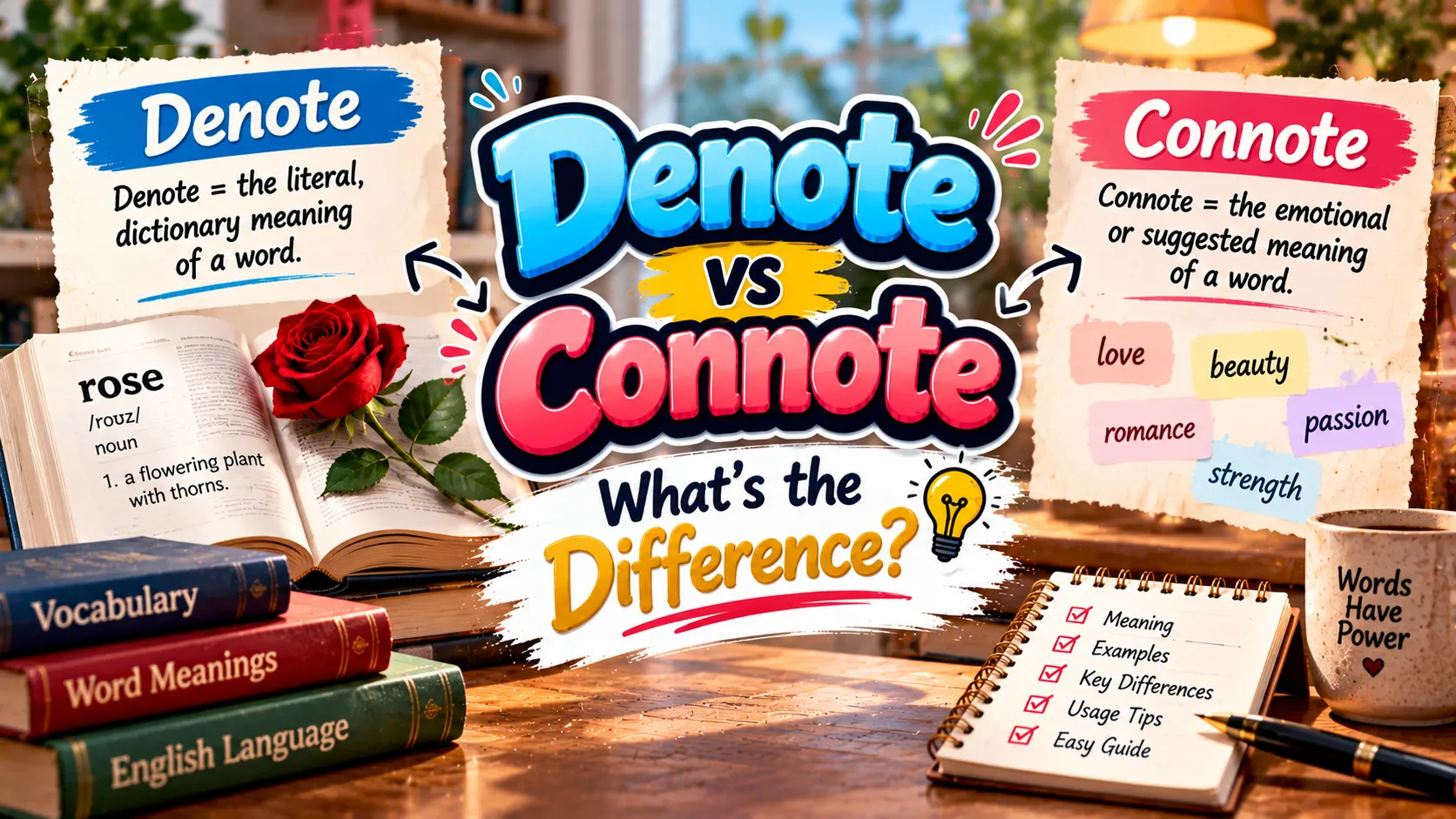
Words carry multiple layers of meaning, and understanding the denote vs connote distinction helps you communicate with greater precision. Denote refers to a word’s literal, dictionary definition—the explicit meaning you find in a dictionary. Connote refers to the associations, emotions, or cultural ideas a word suggests beyond its literal meaning. The difference matters in everyday conversation, professional writing, and creative work.
For example, the word “home” denotes a place where someone lives. But it connotes warmth, safety, and belonging. The literal meaning stays fixed; the connotation shifts depending on personal experience and culture. Confusing the two leads to imprecise language and misread intentions. This guide explains the difference, explores their origins, and provides practical examples to help you use each word correctly.
Quick Answer
Denote means to indicate the literal, primary meaning of a word—the definition you find in a dictionary. Connote means to suggest additional meanings, emotions, or cultural associations beyond the literal definition . Denotation is explicit and fixed; connotation is implicit and varies by context.
Meaning Overview Table
| Aspect | Meaning |
|---|---|
| Definition | Denote: literal meaning. Connote: suggested or associated meaning |
| Pronunciation | Denote: /dɪˈnoʊt/; Connote: /kəˈnoʊt/ |
| Part of Speech | Both are verbs |
| Usage | “The word ‘rose’ denotes a flower but connotes romance” |
| Context | Linguistics, writing, communication, literary analysis |
Main Meaning
Definition
Denote means to be a sign of something, to indicate directly, or to have a specific meaning. It points to the explicit, literal definition of a word or symbol . Connote means to suggest or imply additional meanings, ideas, or feelings beyond the primary definition. It captures the emotional and cultural associations a word carries .
Origin
Both words share Latin roots. Denote comes from denotare, meaning “to mark out” or “to designate.” Connote comes from connotare, meaning “to mark along with.” The prefix “con-” means “together” or “with,” reflecting how connotation works alongside denotation . Both entered English in the 17th century, with meanings that have remained relatively stable.
Context
The distinction operates across several fields:
- Linguistics: Denotation is a word’s core meaning; connotation is its associative meaning
- Writing and Editing: Precise writing requires awareness of both layers
- Literary Analysis: Poetry and fiction rely heavily on connotation
- Marketing and Branding: Word choices carry emotional weight beyond definitions
- Everyday Communication: Misunderstanding connotation leads to offense or confusion
Modern Usage
Today, both words appear in academic writing, communication guides, and everyday discussions about language. Writers use “denote” when discussing literal meanings and “connote” when discussing emotional or cultural associations. The rise of social media has made connotation more visible, as words and symbols carry different meanings across communities.
Detailed Explanation
Literal Meaning
Literally, denote means “to mark” or “to indicate.” It points to the direct, explicit meaning of something. Connote literally means “to mark along with,” suggesting a secondary meaning that accompanies the primary one.
Common Meaning
Commonly, people use “denote” to describe what something literally means or represents. “The red sign denotes danger” means the sign indicates danger directly. People use “connote” to describe what something suggests or implies. “The red sign connotes warning” means the sign carries associations of caution beyond its literal function.
Linguistic Meaning
In linguistics, denotation is the core, dictionary meaning of a word. Connotation is the network of associations that surround it. The word “snake” denotes a reptile. It connotes danger, deceit, or, in some cultures, wisdom. The denotation stays constant; the connotation shifts across cultures and individuals .
Literary Meaning
In literature, writers exploit connotation to create mood and meaning. A poet might choose “slender” instead of “thin” because “slender” connotes elegance while “thin” connotes frailty. The denotation remains similar, but the connotation changes the emotional impact.
Cultural Meaning
Cultural context shapes connotation dramatically. The color white denotes the same wavelength of light everywhere, but it connotes purity in Western cultures and mourning in some Eastern cultures. Denotation crosses cultural boundaries more easily than connotation.
Examples Table
| Example | Meaning |
|---|---|
| “H” denotes hydrogen | The symbol literally means hydrogen |
| “Home” connotes warmth and safety | The word suggests comfort beyond its literal meaning |
| The red hexagon denotes “stop” | The sign literally indicates stopping |
| “Childlike” connotes innocence | The word suggests positive qualities |
| “Bachelor” denotes an unmarried man | The word has a specific dictionary definition |
| “Thrifty” connotes prudence or stinginess | The word carries mixed associations |
| A fever denotes infection | The symptom indicates illness |
| “Fireplace” connotes hospitality | The word suggests cozy comfort |
| Blue denotes a color | The word has a literal meaning |
| “Family” connotes love and comfort | The word carries emotional associations |
Related Meanings Table
| Related Term | Meaning |
|---|---|
| Denotation | The literal meaning of a word |
| Connotation | The suggested or associated meaning |
| Imply | To suggest indirectly (similar to connote) |
| Indicate | To point out directly (similar to denote) |
| Signify | To be a sign of; can mean either depending on context |
| Literal | The exact, primary meaning |
| Figurative | Meaning beyond the literal |
| Nuance | A subtle difference in meaning or expression |
| Association | A mental connection between ideas |
| Symbolism | The use of symbols to represent ideas |
| Semantics | The study of meaning in language |
| Pragmatics | The study of how context affects meaning |
| Ambiguity | Uncertainty of meaning |
| Explicit | Clearly stated, direct |
| Implicit | Suggested but not directly stated |
Common Uses
People use denote and connote across numerous contexts:
Academic Writing: Scholars use “denote” to clarify definitions and “connote” to discuss cultural or emotional associations. Precision matters in research and analysis.
Literary Criticism: Critics analyze how writers use connotation to create layers of meaning. A single word choice can shift the entire tone of a passage.
Marketing and Advertising: Copywriters choose words for their connotations as much as their denotations. “Luxury” connotes status; “affordable” connotes value.
Everyday Communication: People navigate connotation constantly in conversation. Choosing the wrong word with a negative connotation can cause unintended offense.
Language Learning: Students learning English must master both denotation and connotation to communicate naturally and avoid embarrassing mistakes.
Common Mistakes
| Mistake | Correction |
|---|---|
| Using “connote” to mean “denote” | Use “denote” for literal meanings, “connote” for associations |
| Assuming a word’s connotation is universal | Connotation varies by culture and personal experience |
| Ignoring connotation in formal writing | Even technical writing benefits from awareness of associations |
| Using “denote” for emotional suggestions | “Connote” captures emotional and cultural layers |
| Treating connotation as fixed | Connotations shift over time and across communities |
| Confusing “imply” with “connote” | People imply; words connote |
| Using connotation without context | The same word can have different connotations in different settings |
| Assuming denotation is always simple | Some words have multiple denotations |
| Overlooking connotation in translation | Words with similar denotations may have different connotations across languages |
| Using the words interchangeably | They describe different aspects of meaning |
Related Questions
What is the main difference between denote and connote?
Denote refers to a word’s literal, explicit meaning. Connote refers to the associations, emotions, or cultural ideas a word suggests beyond its definition .
Can you give an example of denote and connote?
“Rose” denotes a type of flower. It connotes romance, love, and beauty. The denotation is the plant; the connotation is the emotional association .
Is denotation more important than connotation?
Both matter, depending on context. Technical writing prioritizes denotation for clarity. Creative writing and marketing leverage connotation for emotional impact.
How do children learn connotation?
Children absorb connotation through exposure to language in context. They learn that “cheap” carries negative associations while “affordable” sounds more positive, even though both denote low cost.
Can a word have multiple connotations?
Yes. The word “family” can connote warmth and love for some people, and pain or stress for others . Connotation varies by individual experience.
Is connotation always cultural?
Not always. Some connotations are personal, based on individual experiences. Others are widely shared within a culture or community.
FAQs
What does denote mean?
Denote means to indicate, signify, or have a specific literal meaning. It refers to the explicit, dictionary definition of a word or symbol .
What does connote mean?
Connote means to suggest or imply additional meanings, emotions, or associations beyond the literal definition .
What is the noun form of denote?
The noun form of denote is “denotation.” It refers to the literal meaning of a word .
What is the noun form of connote?
The noun form of connote is “connotation.” It refers to the suggested or associated meaning of a word .
Can denote and connote be used interchangeably?
No. They describe different aspects of meaning. Denote is about literal definition; connote is about suggestion and association .
Do people imply or connote?
People imply. Words and symbols connote. This distinction matters in precise writing .
Is connotation the same in every language?
No. Connotation varies significantly across languages and cultures. A word with positive connotations in one language may carry negative associations in another.
Why does the denote vs connote distinction matter?
It helps you choose words carefully, avoid unintended offense, and communicate with greater precision. Understanding both layers of meaning makes you a more effective writer and speaker.
Conclusion
The denote vs connote distinction separates the literal from the suggested, the dictionary definition from the emotional resonance. Denote points to what a word explicitly means. Connote captures what a word whispers, hints, or evokes. Both layers of meaning operate simultaneously in every act of communication. Mastering this distinction sharpens your writing, deepens your reading, and helps you navigate the subtle terrain of human language. Whether you are drafting a professional email, analyzing a poem, or choosing the right word for a difficult conversation, awareness of denotation and connotation will serve you well. Words are never just definitions—they carry histories, emotions, and cultural weight. Use them wisely.

Natalie Brooks is a content researcher and writer with a strong interest in word meanings, dream interpretations, symbolism, and cultural insights. She is passionate about creating clear, informative, and easy-to-understand content that helps readers discover the deeper meanings behind words, names, dreams, and symbols. Through her work at Meanzly, Natalie aims to make knowledge accessible and valuable for readers around the world.









