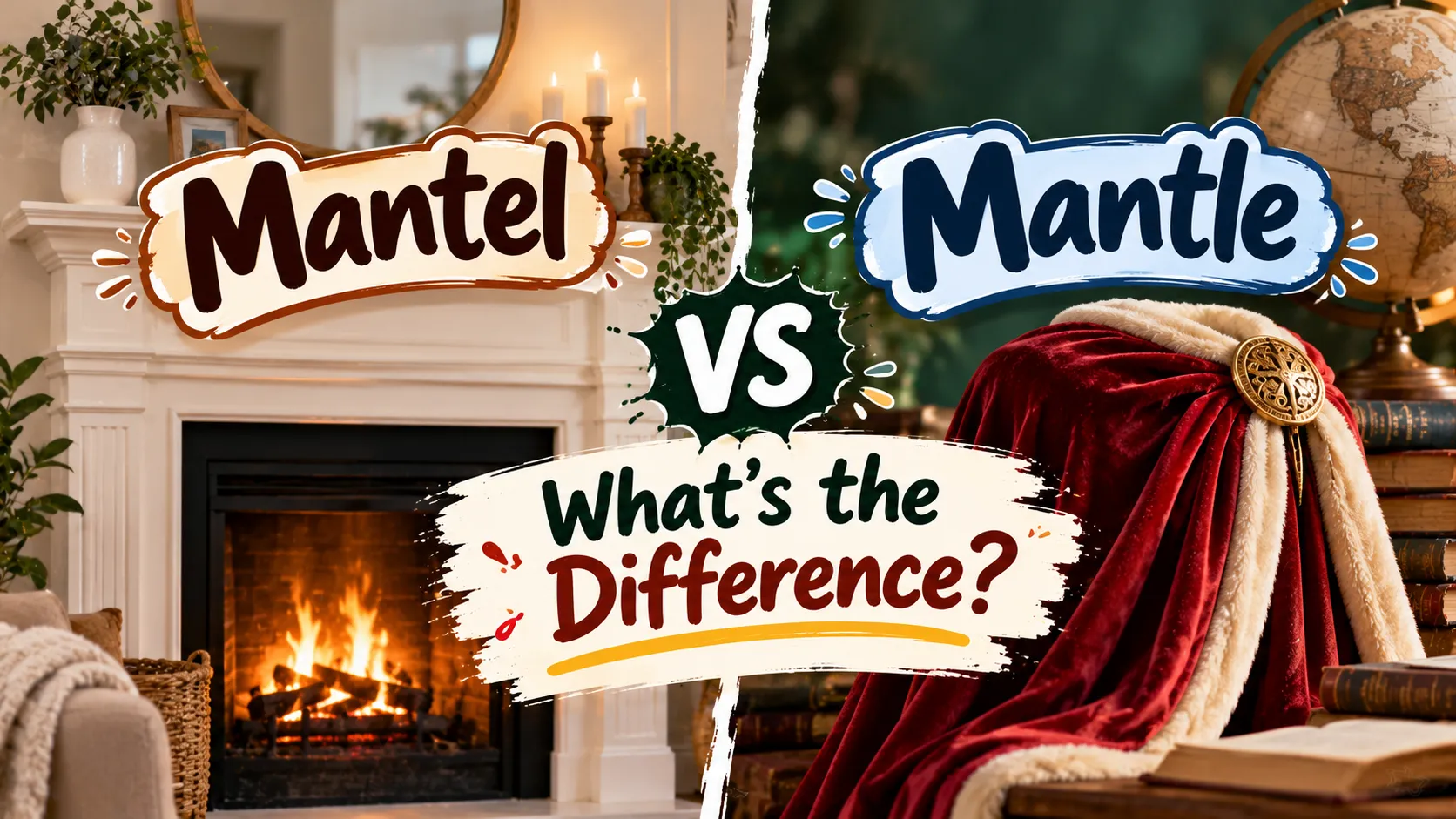
The words “mantel” and “mantle” sound identical and look almost the same, yet they refer to completely different things. One is a shelf above a fireplace; the other is a cloak, a layer of the Earth, or a metaphor for responsibility. The mantel vs mantle confusion ranks among the most common homophone errors in English writing, appearing in home décor descriptions, geology texts, and literary discussions.
“Mantel” has only one meaning: the shelf or structure above a fireplace. “Mantle” carries a wide range of meanings, from a sleeveless cloak to the layer of the Earth between the crust and core, and even a verb meaning “to cover.” These words share Latin roots but have diverged in modern usage. This comprehensive guide explains the difference, explores their origins, provides practical examples, and helps you choose the correct word every time you write.
Quick Answer
“Mantel” refers only to the shelf or structure above a fireplace, as in “she placed the vase on the mantel.” “Mantle” refers to a cloak or covering, the layer of the Earth between the crust and core, or metaphorically to a role or responsibility, as in “she took on the mantle of leadership.” Remember: mantel is for fireplaces; mantle is for everything else.
Meaning Overview Table
| Aspect | Meaning |
|---|---|
| Definition | Mantel: a shelf above a fireplace. Mantle: a cloak, covering, Earth layer, or metaphor for responsibility |
| Pronunciation | Both: /ˈmæn.təl/ |
| Part of Speech | Mantel: noun. Mantle: noun and verb |
| Usage | “The clock sits on the mantel” vs. “She wore a velvet mantle” or “He assumed the mantle of leadership” |
| Context | Mantel: home décor, architecture. Mantle: clothing, geology, literature, metaphor |
Main Meaning
Definition
Mantel is a noun with a single meaning: a shelf or ornamental structure above a fireplace, or a beam or stone serving as a lintel to support the masonry above a fireplace . It is often used in the longer forms “mantelpiece” or “mantelshelf” .
Mantle functions as both a noun and a verb. As a noun, it refers to a loose, sleeveless cloak; something that covers or envelops; the layer of the Earth between the crust and the core; the soft body wall of a mollusk; or metaphorically, a position of authority or responsibility . As a verb, it means to cover or envelop something .
Origin
Both words derive from the Latin word mantellum, meaning “cloak,” which entered Old English as mentel . The word evolved into “mantle” under Anglo-French influence, referring to a loose cloak or protective garment . By the 14th century, the Latin term also referred to a beam or stone supporting masonry above a fireplace, and this sense was adopted into English through Anglo-French, with a tendency to use the French spelling “mantel” for these structures . Over time, “mantel” became fixed as the word for the fireplace shelf, while “mantle” retained its broader meanings .
Context
The distinction matters across several contexts:
- Home Décor and Architecture: “Mantel” appears in descriptions of fireplaces, interior design, and home listings
- Geology and Science: “Mantle” refers to the Earth’s interior layer, a key term in earth science
- Literature and Metaphor: “Mantle” appears in phrases like “the mantle of leadership” or “a mantle of snow”
- Clothing and Fashion: “Mantle” describes a cloak or covering garment
- Everyday Writing: Confusing the two creates errors in emails, essays, and social media posts
Modern Usage
Today, “mantel” appears primarily in home-related content: real estate listings, interior design articles, and holiday decorating guides. “Mantle” appears across a much wider range of contexts, from geology textbooks to political commentary to literary analysis. Some writers, particularly in American English, still use “mantle” as a variant spelling for the fireplace shelf, but most usage authorities recommend keeping the words separate . The distinction is clearer in British English, where “mantel” is strongly preferred for the shelf .
Detailed Explanation
Literal Meaning
Literally, “mantel” means a shelf above a fireplace. “Mantle” literally means a cloak or covering. These literal meanings remain the primary definitions of both words.
Common Meaning
Commonly, people use “mantel” when discussing fireplaces, home décor, and architecture. A clock, photo frame, or holiday stocking might sit on the mantel. People use “mantle” when discussing clothing, geology, or metaphorical burdens. “The mantle of leadership” describes taking on responsibility .
Geological Meaning
In geology, “mantle” refers to the layer of the Earth between the crust and the core. This layer makes up about 84% of the planet’s volume and is nearly 3,000 kilometers thick in most places . The mantle consists mainly of silicate minerals and has an upper, partially molten part and a lower, solid part .
Biological Meaning
In biology, “mantle” refers to the soft tissue that covers the body of a mollusk, such as a clam or oyster. This mantle secretes the material that forms the shell . The term also describes the back and folded wings of a bird .
Metaphorical Meaning
Metaphorically, “mantle” describes a role, duty, or responsibility passed from one person to another. The phrase “take on the mantle” draws on the biblical image of Elijah passing his mantle to Elisha . Politicians assume the mantle of leadership; successors take up the mantle of a predecessor .
Verb Meaning
As a verb, “mantle” means to cover or envelop something. “Snow mantled the trees” means snow covered the trees. “Fog mantled the fields” describes fog spreading over the landscape .
Examples Table
| Example | Meaning |
|---|---|
| She placed the clock on the mantel. | The shelf above a fireplace |
| He wore a velvet mantle over his suit. | A sleeveless cloak |
| The Earth’s mantle lies beneath the crust. | The geological layer between crust and core |
| She took on the mantle of leadership. | A metaphor for responsibility or authority |
| The mantel was decorated with candles. | The fireplace shelf |
| Snow mantled the quiet streets. | A verb meaning covered or enveloped |
| The photo frame sits on the mantelpiece. | The shelf above the fireplace |
| The mantle of secrecy surrounded the project. | A covering or enveloping quality |
| He assumed the mantle of director. | Took on a role or responsibility |
| The mollusk’s mantle secretes shell material. | The biological tissue in mollusks |
Related Meanings Table
| Related Term | Meaning |
|---|---|
| Mantelpiece | The shelf above a fireplace; same as mantel |
| Mantelshelf | Another term for the fireplace shelf |
| Mantle (geology) | The layer between Earth’s crust and core |
| Mantle (clothing) | A loose, sleeveless cloak |
| Mantle (metaphor) | A role, duty, or responsibility |
| Mantle (verb) | To cover or envelop |
| Dismantle | To take apart; derived from removing a mantle (fortification) |
| Mantling | In heraldry, decorative drapery |
| Cloak | A synonym for mantle in its clothing sense |
| Covering | A synonym for mantle in its enveloping sense |
| Earth’s interior | The region containing the mantle |
| Crust | The layer above the mantle |
| Core | The layer below the mantle |
| Mollusk | An animal with a mantle that secretes a shell |
| Mantilla | A woman’s veil; a diminutive of mantle |
Common Uses
People use “mantel” and “mantle” across numerous contexts:
Home Décor and Real Estate: “Mantel” appears in descriptions of fireplaces, interior design articles, and home listings. Homeowners decorate mantels for holidays and display treasured items on them.
Geology and Science Education: “Mantle” appears in earth science textbooks, geology discussions, and documentaries about the planet’s interior.
Literature and Political Commentary: “Mantle” appears in phrases like “the mantle of leadership,” “assume the mantle,” and “a mantle of secrecy.” These metaphors draw on the image of a cloak symbolizing authority.
Clothing and Fashion History: “Mantle” describes historical garments, particularly the sleeveless cloaks worn by royalty and clergy.
Biology and Marine Science: “Mantle” describes the tissue in mollusks that secretes shell material.
Common Mistakes
| Mistake | Correction |
|---|---|
| Writing “mantle” for the fireplace shelf | Use “mantel” for the shelf above a fireplace |
| Writing “mantel” for a cloak or covering | Use “mantle” for clothing, geology, or metaphor |
| Writing “mantel of leadership” | Use “mantle of leadership” (a role or responsibility) |
| Writing “Earth’s mantel” | Use “Earth’s mantle” (the geological layer) |
| Writing “mantlepiece” | The standard spelling is “mantelpiece” |
| Assuming the words are always interchangeable | They have distinct meanings; “mantel” has only one meaning |
| Using “mantle” as a verb for placing objects on a shelf | “Mantle” as a verb means to cover; it does not mean to place on a shelf |
| Confusing the two in home listings | Precision matters; “mantel” is the correct term for the fireplace shelf |
| Writing “dismantle” as “dismantel” | The correct spelling is “dismantle” |
| Using “mantel” in geological contexts | Use “mantle” for the Earth’s interior layer |
Related Questions
Is it “mantel” or “mantle” for a fireplace?
Use “mantel” for the shelf above a fireplace. “Mantle” is a different word referring to a cloak or covering .
What does “mantle” mean in geology?
In geology, “mantle” refers to the layer of the Earth between the crust and the core. It is the largest layer of the planet, making up about 84% of its volume .
What does “take on the mantle” mean?
“Take on the mantle” is a metaphor meaning to assume a role, responsibility, or position of authority. It draws on the image of a cloak symbolizing power .
Is “mantle” ever acceptable for the fireplace shelf?
In American English, “mantle” is sometimes used as a variant spelling for the fireplace shelf, and this usage is considered acceptable by some sources. However, most usage authorities recommend keeping the words separate .
What is the difference between “mantel” and “mantelpiece”?
They refer to the same thing: the shelf or structure above a fireplace. “Mantelpiece” is a longer form of “mantel” .
Can “mantle” be a verb?
Yes. “Mantle” as a verb means to cover or envelop something, as in “snow mantled the trees” .
FAQs
What does “mantel” mean?
“Mantel” is a noun that refers to the shelf or ornamental structure above a fireplace, or the beam supporting masonry above a fireplace .
What does “mantle” mean?
“Mantle” is a noun and verb. As a noun, it refers to a cloak, a covering, the Earth’s interior layer, or a metaphor for responsibility. As a verb, it means to cover or envelop .
Is it “mantel” or “mantle” above a fireplace?
The correct word is “mantel.” “Mantle” refers to a cloak or covering, not the fireplace shelf .
What is the “mantle of leadership”?
“The mantle of leadership” is a metaphor describing the role, responsibility, or authority of a leader. It draws on the image of a cloak passed from one person to another .
Why do people confuse “mantel” and “mantle”?
They are homophones with similar spellings and shared Latin roots. “Mantle” has multiple meanings, and some writers use it as a variant for the fireplace shelf, adding to the confusion .
Is “mantel” used in British English?
Yes. “Mantel” is the standard British spelling for the fireplace shelf. British English more strongly distinguishes between “mantel” and “mantle” than American English .
What is the Earth’s mantle made of?
The Earth’s mantle consists mainly of silicate minerals. It has an upper, partially molten part and a lower, solid part. The upper mantle is the source of magma and volcanic lava .
How can I remember the difference?
Remember: “mantel” contains “el,” like “shelf” (both have an “el” sound). If you’re talking about a fireplace shelf, use “mantel.” For everything else—cloaks, geology, metaphors—use “mantle.”
Conclusion
Mastering the mantel vs mantle distinction protects your writing from embarrassing homophone errors. “Mantel” has one meaning: the shelf or structure above a fireplace. “Mantle” carries many meanings: a cloak, a covering, the Earth’s interior layer, a metaphor for responsibility, and a verb meaning to cover. Remember the simple rule: mantel is for fireplaces; mantle is for everything else. Whether you’re writing a home listing, a geology essay, or a political commentary, choosing the correct word ensures your meaning is clear. Practice using “mantel” for the fireplace shelf and “mantle” for cloaks, geology, and metaphors, and your readers will understand exactly what you intend. Small distinctions like this separate careful writers from careless ones.

Natalie Brooks is a content researcher and writer with a strong interest in word meanings, dream interpretations, symbolism, and cultural insights. She is passionate about creating clear, informative, and easy-to-understand content that helps readers discover the deeper meanings behind words, names, dreams, and symbols. Through her work at Meanzly, Natalie aims to make knowledge accessible and valuable for readers around the world.