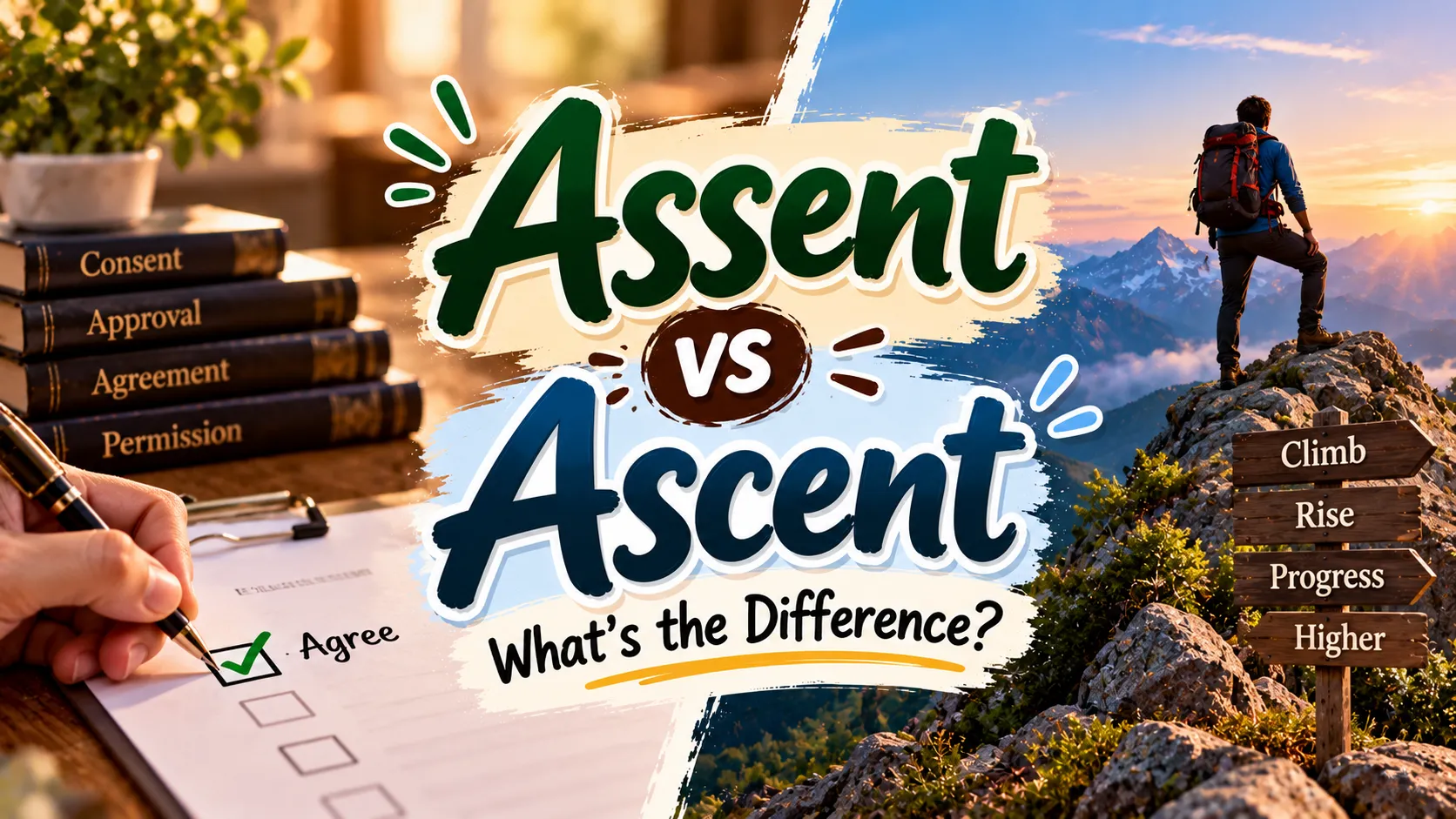
The words “assent” and “ascent” sound nearly identical, yet they describe completely different concepts. One relates to agreement and approval; the other relates to climbing or rising. The assent vs ascent confusion ranks among the most common homophone errors in English writing, appearing in legal documents, political commentary, and everyday correspondence.
“Assent” means agreement, approval, or consent. “Ascent” means the act of rising, climbing, or moving upward. These words share similar pronunciation but no shared meaning. This comprehensive guide explains the difference, explores their origins, provides practical examples, and helps you choose the correct word every time you write.
Quick Answer
“Assent” means agreement or approval, as in “The committee gave its assent to the proposal.” “Ascent” means the act of climbing or rising, as in “The mountain’s ascent took six hours.” Remember: assent relates to agreement (think “consent”); ascent relates to climbing (think “ascend”). They sound similar but mean completely different things.
Meaning Overview Table
| Aspect | Meaning |
|---|---|
| Definition | Assent: agreement, approval, or consent. Ascent: the act of climbing or rising |
| Pronunciation | Both: /əˈsɛnt/ |
| Part of Speech | Both are nouns; assent also functions as a verb |
| Usage | “The king gave his assent” vs. “The rocket’s ascent into space” |
| Context | Assent: legal, political, formal. Ascent: physical, metaphorical, aeronautical |
Main Meaning
Definition
Assent functions as both a noun and a verb. As a noun, it means agreement, approval, or consent, especially in formal or legal contexts. As a verb, it means to agree or approve. Ascent is a noun referring to the act of rising, climbing, or moving upward. It describes physical climbing, upward movement, or metaphorical progress.
Origin
“Assent” comes from the Latin verb assentire, meaning “to agree to,” combining ad- (“to”) and sentire (“to feel” or “think”). It entered English in the 14th century and has always carried the meaning of agreement or approval.
“Ascent” comes from the Latin verb ascendere, meaning “to climb up,” combining ad- (“up”) and scandere (“to climb”). It entered English in the 16th century and has always referred to upward movement.
Context
The distinction matters across several contexts:
- Legal and Political Writing: “Assent” appears in legislation, contracts, and formal approvals
- Physical and Metaphysical Writing: “Ascent” appears in mountaineering, aviation, and metaphorical discussions of progress
- Everyday Writing: Confusing the two creates embarrassing errors in emails, essays, and social media posts
- Historical Texts: “Royal assent” and “ascent to the throne” both appear frequently in historical writing
Modern Usage
Today, “assent” appears primarily in formal, legal, and political contexts. “Royal assent” remains a key step in British lawmaking. “Ascent” appears in physical contexts like mountain climbing, aviation, and space exploration, and in metaphors describing rising to power or success. The confusion between the two persists because they sound nearly identical.
Detailed Explanation
Literal Meaning
Literally, “assent” means agreement or approval. “Ascent” literally means the act of climbing or rising. These literal meanings remain the primary definitions of both words.
Common Meaning
Commonly, people use “assent” to describe formal agreement. “The board gave its assent” means the board approved. People use “ascent” to describe climbing or rising. “The ascent of Mount Everest” describes the climb.
Legal Meaning
In law, “assent” carries significant weight. “Royal assent” is the formal approval by a monarch that makes a bill into law. In contract law, “assent” means agreement to terms. The phrase “mutual assent” describes the meeting of minds essential to a valid contract.
Political Meaning
In politics, “assent” describes formal approval by a governing body. “The Senate gave its assent to the treaty” means the Senate approved it. “Ascent” appears in political writing when describing a politician’s rise to power: “His ascent to the presidency surprised many.”
Physical and Metaphorical Meaning
In physical contexts, “ascent” describes climbing mountains, rising in balloons or aircraft, and upward movement. Metaphorically, “ascent” describes rising to success, fame, or power. “The company’s ascent in the market” describes its growth and success.
Examples Table
| Example | Meaning |
|---|---|
| The king gave his assent to the new law. | Formal approval or agreement |
| The mountain’s ascent took six hours. | The act of climbing |
| The committee nodded in assent. | Agreement or approval |
| The rocket’s ascent into space was flawless. | Upward movement |
| The contract requires mutual assent. | Agreement between parties |
| His ascent to the presidency surprised many. | Rise to power |
| She gave her assent to the plan. | Approval or consent |
| The balloon’s ascent was slow and steady. | Upward movement |
| The board assented to the proposal. | Agreed or approved |
| The plane began its ascent after takeoff. | Upward movement |
Related Meanings Table
| Related Term | Meaning |
|---|---|
| Consent | Agreement or permission (similar to assent) |
| Approval | Favorable opinion or formal agreement |
| Agreement | Harmony or mutual understanding |
| Ascent | The act of climbing or rising |
| Ascend | To climb or rise |
| Ascension | The act of rising; also a religious holiday |
| Descent | The act of going down (opposite of ascent) |
| Dissent | Disagreement (opposite of assent) |
| Accent | Pronunciation or emphasis (a related homophone) |
| Assent | Agreement or approval (repeat for clarity) |
| Royal assent | Formal monarchical approval of legislation |
| Mutual assent | Agreement between contracting parties |
| Ascent rate | The speed of climbing or rising |
| Ascending order | Arrangement from smallest to largest |
| Assenting | Agreeing or approving |
Common Uses
People use “assent” and “ascent” across numerous contexts:
Legal and Political Writing: “Assent” appears in legislation, contracts, and formal approvals. “Royal assent” remains a standard term in British law. “Mutual assent” describes the basis of contract formation.
Mountaineering and Aviation: “Ascent” appears in descriptions of climbing routes, flight paths, and space missions. Climbers discuss the “ascent” of a mountain. Pilots describe the “ascent” after takeoff.
Metaphorical Writing: “Ascent” describes rising to success or power. Biographies describe a person’s “ascent” to fame. Business writing describes a company’s “ascent” in the market.
Formal Communication: “Assent” appears in formal letters and documents granting approval. “The board has given its assent” appears in corporate minutes and official correspondence.
Everyday Writing: Confusing the two creates errors. “The assent of the mountain” and “the king’s ascent to the proposal” both read awkwardly and confuse readers.
Common Mistakes
| Mistake | Correction |
|---|---|
| Writing “the king’s ascent to the proposal” | Write “the king’s assent to the proposal” (approval) |
| Writing “the mountain’s assent took six hours” | Write “the mountain’s ascent took six hours” (climb) |
| Writing “mutual ascent” in legal contexts | Write “mutual assent” (agreement) |
| Writing “royal ascent” | Write “royal assent” (monarchical approval) |
| Writing “his assent to power” | Write “his ascent to power” (rise) |
| Writing “the rocket’s assent into space” | Write “the rocket’s ascent into space” (upward movement) |
| Assuming spell-check will catch the error | Spell-check often misses homophones; proofread manually |
| Confusing with “accent” | “Accent” is a third homophone meaning pronunciation; context determines the word |
| Writing “nodded in ascent” | Write “nodded in assent” (agreement) |
| Writing “the plane began its assent” | Write “the plane began its ascent” (climb) |
Related Questions
Is it “assent” or “ascent”?
It depends on meaning. Use “assent” when referring to agreement or approval. Use “ascent” when referring to climbing or rising.
What does “royal assent” mean?
“Royal assent” is the formal approval by a monarch that makes a bill into law. It is a key step in the legislative process in constitutional monarchies.
What does “mutual assent” mean?
“Mutual assent” is a legal term describing the agreement between parties to a contract. Both parties must agree to the terms for the contract to be valid.
What is the difference between “ascent” and “ascension”?
“Ascent” refers to the act of climbing or rising. “Ascension” also means rising, but it carries religious connotations, particularly the Ascension of Jesus Christ in Christian tradition.
Can “assent” be a verb?
Yes. “Assent” functions as both a noun and a verb. As a verb, it means to agree or approve: “They assented to the proposal.”
Why do people confuse assent and ascent?
They sound nearly identical and differ by only one letter. Spell-check often misses homophones, so the error persists in written communication.
FAQs
What does “assent” mean?
“Assent” means agreement, approval, or consent, especially in formal or legal contexts. It functions as both a noun and a verb.
What does “ascent” mean?
“Ascent” means the act of climbing or rising. It describes physical climbing, upward movement, or metaphorical progress.
Is it “royal assent” or “royal ascent”?
The correct phrase is “royal assent.” It refers to formal monarchical approval of legislation.
Is it “his ascent to power” or “his assent to power”?
The correct phrase is “his ascent to power.” It describes rising to a position of authority.
What is the difference between “assent” and “consent”?
“Assent” and “consent” are close synonyms, but “assent” often implies formal or official approval, while “consent” implies permission or willingness.
Can “ascent” be used metaphorically?
Yes. “Ascent” describes rising to success, fame, or power. For example, “The company’s ascent in the market” describes its growth.
What is the opposite of “ascent”?
The opposite of “ascent” is “descent,” meaning the act of going down.
What is the opposite of “assent”?
The opposite of “assent” is “dissent,” meaning disagreement.
Conclusion
Mastering the assent vs ascent distinction protects your writing from embarrassing homophone errors. “Assent” means agreement or approval, especially in formal and legal contexts. “Ascent” means the act of climbing or rising, whether physically or metaphorically. Remember the simple rule: assent relates to agreement (think “consent”); ascent relates to climbing (think “ascend”). Whether you’re writing a legal document, a mountain climbing story, or a social media post, choosing the correct word ensures your meaning is clear. Practice using “assent” for approval and “ascent” for rising, and your readers will understand exactly what you intend. Small distinctions like this separate careful writers from careless ones.

Natalie Brooks is a content researcher and writer with a strong interest in word meanings, dream interpretations, symbolism, and cultural insights. She is passionate about creating clear, informative, and easy-to-understand content that helps readers discover the deeper meanings behind words, names, dreams, and symbols. Through her work at Meanzly, Natalie aims to make knowledge accessible and valuable for readers around the world.