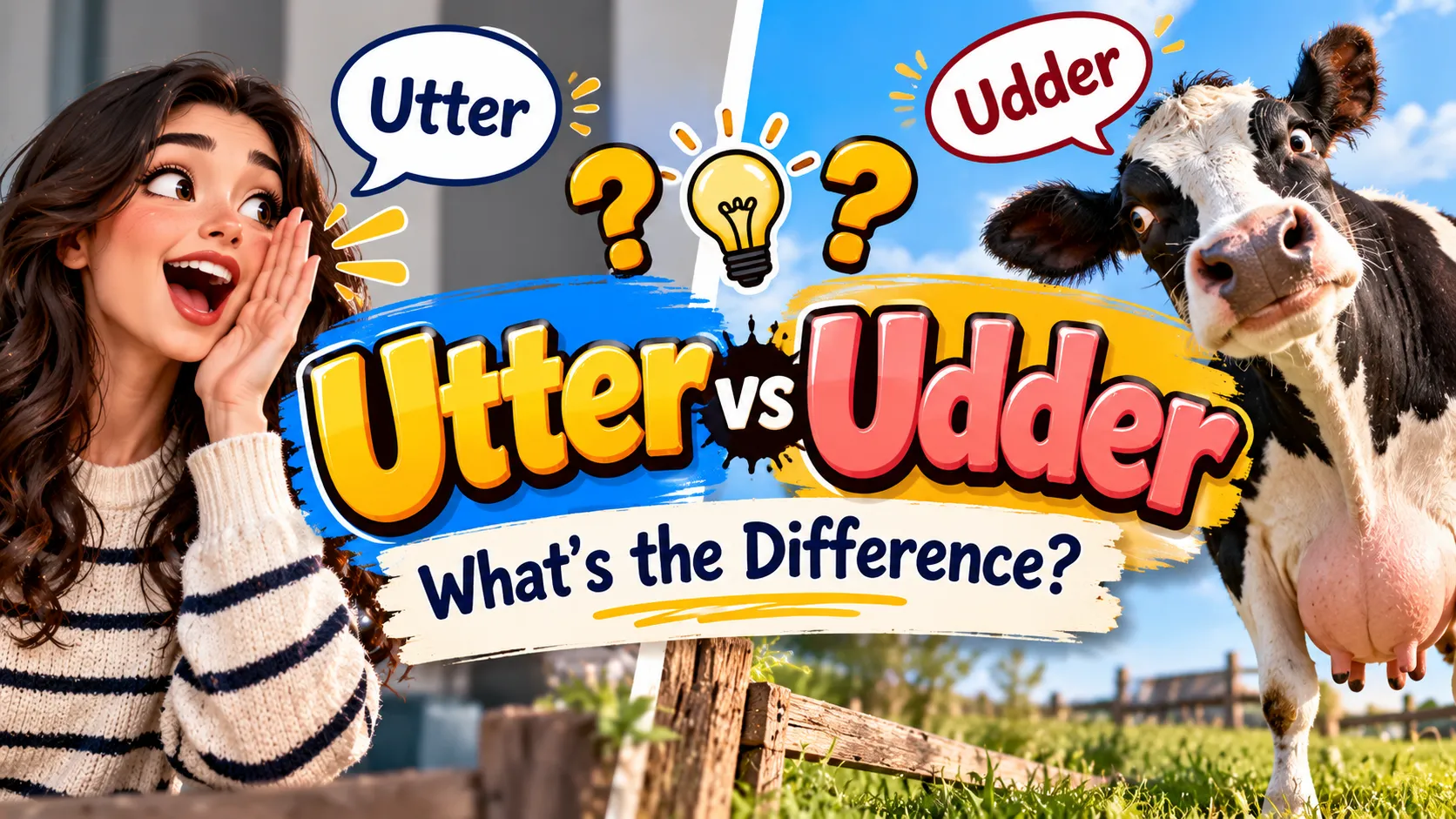
The words “utter” and “udder” sound nearly identical, yet they describe completely different things. One is a verb and adjective relating to speech and completeness; the other is a noun referring to a part of a cow. The utter vs udder confusion ranks among the most common homophone errors in English writing, appearing in everything from casual texts to published articles about farming or language.
“Utter” means to speak or express something aloud, or as an adjective, means complete or absolute. “Udder” refers to the mammary gland of a cow or other female mammal. These words share similar pronunciation but no shared meaning. This comprehensive guide explains the difference, explores their origins, provides practical examples, and helps you choose the correct word every time you write.
Quick Answer
“Utter” is a verb meaning to speak or express aloud, or an adjective meaning complete or absolute, as in “utter nonsense.” “Udder” is a noun referring to the milk-producing gland of a cow or other female mammal. Remember: utter relates to speech or completeness; udder relates to animals and milk. They sound similar but mean completely different things.
Meaning Overview Table
| Aspect | Meaning |
|---|---|
| Definition | Utter: to speak aloud; complete or absolute. Udder: the mammary gland of a cow or other mammal |
| Pronunciation | Utter: /ˈʌtər/; Udder: /ˈʌdər/ |
| Part of Speech | Utter: verb and adjective. Udder: noun |
| Usage | “She didn’t utter a word” vs. “The cow’s udder was full” |
| Context | Utter: speech, language, emphasis. Udder: farming, veterinary science, animal anatomy |
Main Meaning
Definition
Utter functions as both a verb and an adjective. As a verb, it means to speak, say, or express something aloud—often in a short or quiet manner. As an adjective, it means complete, absolute, or total, often used to emphasize a negative quality, as in “utter chaos” or “utter nonsense.”
Udder is a noun referring to the bag-like mammary gland of a cow, sheep, goat, or other female mammal, where milk is produced and stored. It is a distinct anatomical feature of ruminant mammals.
Origin
“Utter” comes from the Old English ūttrian, meaning “to put out” or “to send forth,” related to “out.” The verb sense of speaking aloud developed from the idea of sending words out. The adjective sense of “complete” comes from a different Old English word, ūttera, meaning “outer” or “extreme,” which later developed into the meaning of “absolute” .
“Udder” comes from the Old English ūder, with Germanic roots related to German Euter and Dutch uier. The word has remained remarkably stable for over a thousand years, always referring to the mammary gland of animals.
Context
The distinction matters across several contexts:
- Language and Writing: “Utter” appears in discussions of speech, silence, and emphasis
- Agriculture and Farming: “Udder” appears in discussions of dairy cattle, milking, and animal health
- Everyday Writing: Confusing the two creates embarrassing errors in emails, essays, and social media posts
- Veterinary Science: “Udder” appears in medical discussions of mastitis and milk production
Modern Usage
Today, “utter” appears frequently in both speech and writing, especially the adjective form meaning “complete.” The verb form remains common in literary contexts and formal writing. “Udder” appears less often, primarily in agricultural, veterinary, and culinary contexts. The confusion between the two persists because they sound similar and spell-check often fails to catch the error.
Detailed Explanation
Literal Meaning
Literally, “utter” means to send words out—to speak. “Udder” literally means the milk gland of an animal. These literal meanings remain the primary definitions of both words.
Common Meaning
Commonly, people use “utter” as an adjective meaning “complete” or “absolute.” “That’s utter nonsense” means the statement is completely nonsensical. They use “udder” when discussing cows, milk production, or farm animals.
Verb Meaning
As a verb, “utter” describes the act of speaking or making a sound. “She didn’t utter a word” means she remained silent. “He uttered a cry of pain” means he made a sound. The verb often appears in negative constructions (“didn’t utter”) or with sound words (“utter a sigh”).
Adjective Meaning
As an adjective, “utter” intensifies a negative quality. “Utter disaster,” “utter fool,” and “utter silence” all emphasize completeness. This usage is stronger than “very” or “extremely” and often carries a sense of finality or totality.
Agricultural Meaning
In farming, “udder” refers to the mammary gland of dairy animals. Farmers check udders for signs of mastitis, an infection that affects milk production. Cows with full udders need milking regularly. The health of the udder directly affects milk quality and yield.
Veterinary Meaning
Veterinarians treat udder infections and injuries. Mastitis, an inflammation of the udder, is one of the most common and costly diseases in dairy farming. Proper hygiene during milking prevents udder infections.
Examples Table
| Example | Meaning |
|---|---|
| She didn’t utter a single word. | She remained completely silent |
| The cow’s udder was full of milk. | The mammary gland was full |
| The movie was utter nonsense. | The movie was completely nonsensical |
| The farmer checked the udder for infection. | Examined the mammary gland |
| He uttered a sigh of relief. | He made a sound |
| The goat’s udder needed milking. | The mammary gland needed milking |
| The room was in utter darkness. | The room was completely dark |
| Mastitis affects the udder of dairy cows. | Inflammation affects the mammary gland |
| She uttered a warning before leaving. | She spoke a warning |
| The plan was an utter failure. | The plan completely failed |
Related Meanings Table
| Related Term | Meaning |
|---|---|
| Utterance | A spoken word or statement |
| Utterly | Completely; absolutely |
| Utter | To speak aloud; complete |
| Udder | The mammary gland of a cow or other mammal |
| Milk | The liquid produced by the udder |
| Lactation | The production and secretion of milk |
| Mastitis | Inflammation of the udder |
| Teat | The nipple of the udder |
| Dairy | Relating to milk production |
| Cattle | Cows and bulls, animals with udders |
| Ruminant | A mammal that chews cud, like cows and goats |
| Mammary gland | The organ that produces milk |
| Silence | The absence of uttered sound |
| Complete | Absolute; utter |
| Absolute | Total; utter |
Common Uses
People use “utter” and “udder” across numerous contexts:
Everyday Conversation: “Utter” appears frequently as an adjective. People say “utter nonsense,” “utter chaos,” and “utter disaster.” The verb form appears in phrases like “didn’t utter a word.”
Agriculture and Farming: Farmers and veterinarians use “udder” when discussing dairy animals. Milking procedures, udder health, and mastitis prevention are daily concerns on dairy farms.
Veterinary Medicine: “Udder” appears in clinical discussions of animal health. Veterinarians examine udders for swelling, heat, and signs of infection.
Literary and Formal Writing: “Utter” appears in formal writing, both as a verb describing speech and as an adjective emphasizing totality. Writers use it to create strong, emphatic statements.
Food and Culinary Writing: “Udder” occasionally appears in discussions of dairy products and traditional foods, such as udder-based dishes in some cuisines.
Common Mistakes
| Mistake | Correction |
|---|---|
| Writing “utter” when meaning the cow’s gland | Write “udder” for the mammary gland |
| Writing “udder” when meaning “complete” | Write “utter” for the adjective meaning complete |
| Writing “udder nonsense” | Write “utter nonsense” (complete nonsense) |
| Writing “the cow’s utter” | Write “the cow’s udder” (mammary gland) |
| Writing “she didn’t udder a word” | Write “she didn’t utter a word” (speak) |
| Writing “udder chaos” | Write “utter chaos” (complete chaos) |
| Assuming spell-check will catch the error | Spell-check often misses homophones; proofread manually |
| Confusing “udder” with “utter” in recipes | “Udder” refers to animal glands; “utter” does not belong in recipes |
| Writing “utterly” as “udderly” | “Utterly” means completely; “udderly” is not a word |
| Using “utter” as a noun for the gland | “Utter” is not a noun for the mammary gland |
Related Questions
Is it “utter” or “udder”?
It depends on meaning. Use “utter” for speaking or completeness. Use “udder” for the mammary gland of a cow or other mammal.
What does “utter nonsense” mean?
“Utter nonsense” means complete or absolute nonsense. “Utter” functions as an adjective meaning “complete” or “total.”
What is an udder?
An udder is the bag-like mammary gland of a cow, sheep, goat, or other female mammal, where milk is produced and stored.
Can “utter” be a verb?
Yes. “Utter” as a verb means to speak, say, or make a sound. For example, “She didn’t utter a word.”
What is mastitis?
Mastitis is an inflammation of the udder, common in dairy cows. It causes swelling, pain, and reduced milk production.
Why do people confuse “utter” and “udder”?
They sound similar and differ by only one letter. Spell-check often misses homophones, so the error persists in written communication.
FAQs
What does “utter” mean?
“Utter” is a verb meaning to speak or express aloud, and an adjective meaning complete or absolute, as in “utter chaos.”
What does “udder” mean?
“Udder” is a noun referring to the mammary gland of a cow or other female mammal, where milk is produced.
Is it “utter nonsense” or “udder nonsense”?
The correct phrase is “utter nonsense.” “Utter” means complete; “udder” refers to an animal gland.
What is the difference between “utter” and “udder” in a sentence?
“Utter” relates to speech or completeness. “Udder” relates to animal anatomy and milk production.
Can “udder” be used metaphorically?
Rarely. “Udder” almost always refers literally to the mammary gland. Metaphorical uses are uncommon and usually humorous.
What does “utterly” mean?
“Utterly” is an adverb meaning “completely” or “absolutely.” It comes from the adjective “utter.”
Is “udder” only used for cows?
No. “Udder” also refers to the mammary glands of sheep, goats, and other female mammals, though it is most commonly associated with dairy cattle.
How can I remember the difference?
Remember: “udder” contains the letter “d,” like “dairy” or “drink.” “Utter” relates to speech or completeness. If you’re talking about milk, use “udder.”
Conclusion
Mastering the utter vs udder distinction protects your writing from embarrassing homophone errors. “Utter” is a verb meaning to speak aloud or an adjective meaning complete or absolute. “Udder” is a noun referring to the mammary gland of a cow or other female mammal. Remember the simple rule: udder relates to animals and milk; utter relates to speech and completeness. Whether you’re writing an email, an essay, or a social media post, choosing the correct word ensures your meaning is clear. Practice using “utter” for speech and emphasis, and “udder” for animal anatomy, and your readers will understand exactly what you intend. Small distinctions like this separate careful writers from careless ones.

Natalie Brooks is a content researcher and writer with a strong interest in word meanings, dream interpretations, symbolism, and cultural insights. She is passionate about creating clear, informative, and easy-to-understand content that helps readers discover the deeper meanings behind words, names, dreams, and symbols. Through her work at Meanzly, Natalie aims to make knowledge accessible and valuable for readers around the world.









