The words “averse” and “adverse” look nearly identical, sound very similar, and both involve a sense of opposition. This combination makes the averse vs adverse distinction one of the most commonly confused word pairs in English. Writers frequently mix them up, and spell-check tools often fail to catch the error because both are real words.
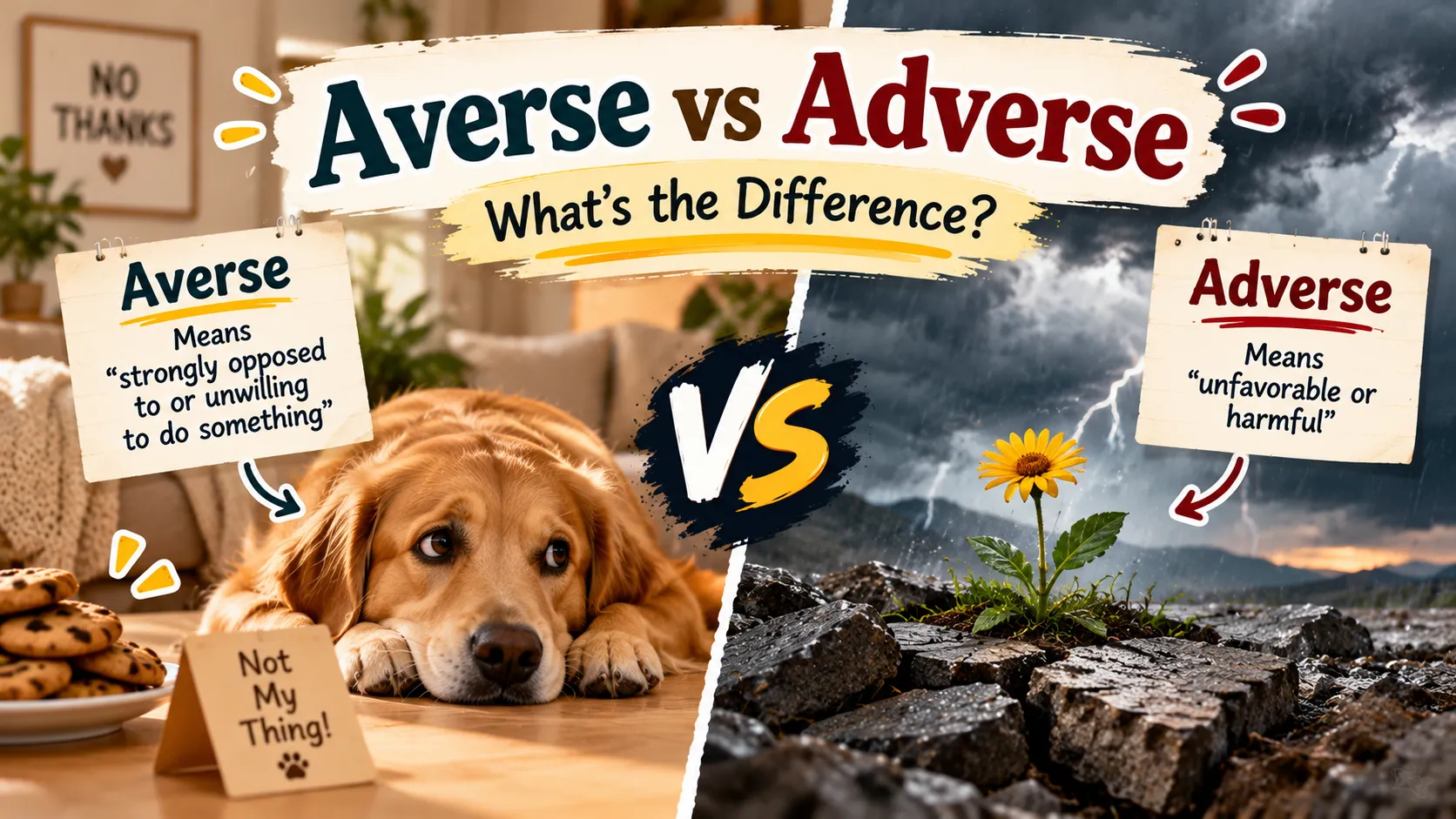
“Averse” describes a person’s feeling of dislike or opposition toward something. “Adverse” describes something harmful, unfavorable, or contrary to one’s interests. The key difference lies in who or what is doing the opposing. People feel averse; conditions and events are adverse. This comprehensive guide explains the distinction, explores their origins, provides practical examples, and helps you choose the correct word every time you write.
Quick Answer
“Averse” means having a strong dislike or opposition to something, and it applies to people, as in “She is averse to taking risks.” “Adverse” means harmful, unfavorable, or contrary, and it applies to things or conditions, as in “The drug has adverse side effects.” Remember: people are averse; things are adverse .
Meaning Overview Table
| Aspect | Meaning |
|---|---|
| Definition | Averse: a person’s feeling of dislike or opposition. Adverse: harmful, unfavorable, or contrary conditions |
| Pronunciation | Averse: /əˈvɜːrs/. Adverse: /ædˈvɜːrs/ or /ˈædˌvɜːrs/ |
| Part of Speech | Both are adjectives |
| Usage | “He is averse to change” vs. “The change had an adverse effect” |
| Context | Averse: personal feelings, preferences, attitudes. Adverse: medicine, weather, economics, conditions |
Main Meaning
Definition
Averse is an adjective meaning “having an active feeling of repugnance, dislike, or distaste” toward something . It describes a person’s attitude of opposition or unwillingness. The word typically appears with the preposition “to,” as in “averse to hard work” or “risk-averse” .
Adverse is an adjective meaning “harmful,” “unfavorable,” “acting against or in a contrary direction” . It describes external forces or conditions that work against someone’s interests. Common collocations include “adverse effects,” “adverse reaction,” “adverse weather,” and “adverse circumstances” .
Origin
Both words trace back to the Latin verb vertere, meaning “to turn” . “Averse” comes from the Latin aversus, the past participle of avertere, meaning “to turn away from” . “Adverse” comes from the Latin adversus, meaning “turned against” or “opposed.” The prefixes tell the story: a- (away from) versus ad- (toward, against). This etymological distinction mirrors the modern difference: averse involves turning away in dislike; adverse involves something turned against you.
Context
The distinction matters across several contexts:
- Medicine: “Adverse reactions” and “adverse side effects” describe harmful responses to drugs or treatments
- Psychology: “Averse” describes personal preferences, as in “risk-averse” or “averse to conflict”
- Weather and Conditions: “Adverse weather” or “adverse conditions” describe unfavorable circumstances
- Everyday Writing: Confusing the two creates embarrassing errors in emails, reports, and social media posts
Modern Usage
Today, “adverse” appears frequently in medical, legal, and financial writing. “Adverse effects” and “adverse impact” are standard phrases in these fields. “Averse” appears most often in discussions of personality, preferences, and risk tolerance. The phrase “risk-averse” has become common in investing and business writing. The confusion persists because the words differ by only one letter and both suggest opposition, but careful writers preserve the distinction.
Detailed Explanation
Literal Meaning
Literally, “averse” means “turned away from.” It describes a person’s inclination to turn away from something they dislike. “Adverse” literally means “turned against.” It describes something that opposes or works against a person or goal .
Common Meaning
Commonly, people use “averse” to describe someone who dislikes or opposes something. “She is averse to loud music” means she dislikes loud music. People use “adverse” to describe bad or harmful things. “Adverse weather” means bad weather that causes problems. “Adverse effects” means harmful results .
Medical Meaning
In medicine, “adverse” is the standard term for harmful reactions to drugs or treatments. “Adverse events” in clinical trials refer to negative health outcomes. “Adverse side effects” describes unintended harmful consequences of medication . “Averse” never appears in medical contexts because it describes personal feelings, not physical reactions.
Psychological Meaning
In psychology, “averse” describes personal attitudes and preferences. People can be “risk-averse” (avoiding risk), “change-averse” (resisting change), or “conflict-averse” (avoiding confrontation) . These compound forms have become standard in professional writing.
Legal and Financial Meaning
In law and finance, “adverse” describes unfavorable conditions or rulings. An “adverse possession” claim in property law, “adverse selection” in insurance, and “adverse market conditions” all use the term to mean harmful or contrary . “Averse” appears in financial writing through the phrase “risk-averse investors.”
Examples Table
| Example | Meaning |
|---|---|
| She is averse to taking risks. | She dislikes taking risks |
| The drug has adverse side effects. | The drug causes harmful effects |
| He is not averse to hard work. | He does not dislike hard work |
| Adverse weather delayed the flight. | Bad weather caused delays |
| They are risk-averse investors. | They avoid taking risks |
| The policy had an adverse impact on small businesses. | The policy harmed small businesses |
| I’m averse to change. | I dislike change |
| The medication caused an adverse reaction. | The medication caused a harmful reaction |
| She is averse to conflict. | She dislikes conflict |
| The court made an adverse ruling. | The court made an unfavorable ruling |
Related Meanings Table
| Related Term | Meaning |
|---|---|
| Aversion | A strong dislike or opposition; the noun form of averse |
| Adversity | Difficult or unfavorable conditions; the noun form of adverse |
| Risk-averse | Reluctant to take risks; avoiding risk |
| Adverse effect | A harmful or unfavorable result |
| Adverse reaction | A harmful response to a drug or treatment |
| Adverse weather | Bad or unfavorable weather conditions |
| Adverse conditions | Unfavorable circumstances |
| Averse to | The standard prepositional phrase for averse |
| Adverse to | Incorrect usage; “averse to” is correct for personal dislike |
| Unfavorable | A synonym for adverse |
| Harmful | A synonym for adverse |
| Disinclined | A synonym for averse |
| Reluctant | A synonym for averse |
| Opposed | A synonym for averse |
| Hostile | A stronger synonym for adverse |
Common Uses
People use “averse” and “adverse” across numerous contexts:
Healthcare and Medicine: Medical professionals use “adverse” constantly. “Adverse drug reactions,” “adverse events,” and “adverse outcomes” appear in clinical documentation and research . Patients might be “averse” to certain treatments, but the reactions themselves are “adverse.”
Business and Finance: Financial writers describe “risk-averse investors” who avoid volatility. They also discuss “adverse market conditions” that harm investments. Both terms appear frequently in financial reporting.
Psychology and Personality: “Averse” describes personality traits and preferences. People can be averse to change, conflict, risk, or novelty. These descriptions help explain behavior.
Weather and Travel: “Adverse weather” is a standard phrase in travel advisories and aviation. It describes conditions that make travel difficult or dangerous .
Legal Writing: Courts issue “adverse rulings” that go against a party’s interests. Attorneys file “adverse possession” claims. The term consistently means unfavorable or contrary.
Common Mistakes
| Mistake | Correction |
|---|---|
| Saying “adverse to” when describing a person’s dislike | Say “averse to” for personal feelings |
| Saying “averse effects” | Say “adverse effects” for harmful results |
| Saying “I am adverse to change” | Say “I am averse to change” |
| Saying “risk-adverse” | Say “risk-averse” (avoiding risk) |
| Using “averse” to describe weather or conditions | Use “adverse” for weather and conditions |
| Using “adverse” to describe a person’s feelings | Use “averse” for personal feelings |
| Assuming the two are interchangeable | They have different meanings and different applications |
| Writing “adverse to taking risks” | Write “averse to taking risks” |
| Writing “averse reaction to medicine” | Write “adverse reaction to medicine” |
| Forgetting the memory trick | Remember: adverse = bad; averse = a feeling |
Related Questions
Is it “averse” or “adverse”?
It depends on what you’re describing. Use “averse” for a person’s feeling of dislike or opposition. Use “adverse” for harmful or unfavorable conditions, effects, or events .
What does “averse to” mean?
“Averse to” means having a strong dislike or opposition to something. It describes a person’s attitude, as in “She is averse to change” .
What does “adverse effect” mean?
An “adverse effect” is a harmful or unfavorable result. It describes the negative consequences of something, like a drug or a policy .
What is the difference between “risk-averse” and “risk-adverse”?
“Risk-averse” is correct. It means avoiding risk. “Risk-adverse” is a misspelling and would mean something like “harmful to risk,” which makes no sense.
Can a person be “adverse”?
Technically, a person can have an “adverse effect” on others, but a person cannot be “adverse” in the sense of having a feeling of dislike. That feeling is “averse” .
Can weather be “averse”?
No. Weather cannot have feelings of dislike. Weather is “adverse” when it is bad or unfavorable .
FAQs
What does “averse” mean?
“Averse” is an adjective meaning having a strong dislike or opposition to something. It describes a person’s feeling or attitude and is usually followed by “to” .
What does “adverse” mean?
“Adverse” is an adjective meaning harmful, unfavorable, or contrary. It describes external conditions, effects, or events that work against someone’s interests .
Is it “adverse to” or “averse to”?
“Averse to” is correct when describing a person’s dislike. “Adverse to” is a common error. Use “adverse” without “to” when describing harmful things, as in “adverse effects” .
What is the noun form of each word?
The noun form of “averse” is “aversion,” meaning a strong dislike. The noun form of “adverse” is “adversity,” meaning difficult or unfavorable conditions .
Can I use “adverse” to describe a person?
You can say a person had an “adverse effect” on something, but you cannot say a person is “adverse” to mean they dislike something. That would be “averse” .
What is the difference between “averse” and “adverse” in a sentence?
“Averse” describes feelings: “She is averse to spicy food.” “Adverse” describes things: “The spicy food had an adverse effect on her stomach.”
Why do people confuse “averse” and “adverse”?
They differ by only one letter, sound similar, and both suggest opposition. Spell-check often misses the error because both are valid words .
How can I remember the difference?
Remember: “adverse” contains “ad” like “bad” (adverse = bad). “Averse” contains “a” like “a feeling” (averse = a person’s feeling). This simple trick helps many writers .
Conclusion
Mastering the averse vs adverse distinction protects your writing from a common and embarrassing error. “Averse” describes a person’s feeling of dislike or opposition—it requires a conscious attitude. “Adverse” describes harmful, unfavorable, or contrary conditions—it requires external circumstances. Remember the simple rule: people are averse; things are adverse. Whether you’re writing a medical report, a financial analysis, or a casual email, choosing the correct word ensures your meaning is clear. The one-letter difference matters more than it seems. Practice using “averse” for feelings and “adverse” for effects, and your readers will understand exactly what you intend.

Natalie Brooks is a content researcher and writer with a strong interest in word meanings, dream interpretations, symbolism, and cultural insights. She is passionate about creating clear, informative, and easy-to-understand content that helps readers discover the deeper meanings behind words, names, dreams, and symbols. Through her work at Meanzly, Natalie aims to make knowledge accessible and valuable for readers around the world.









