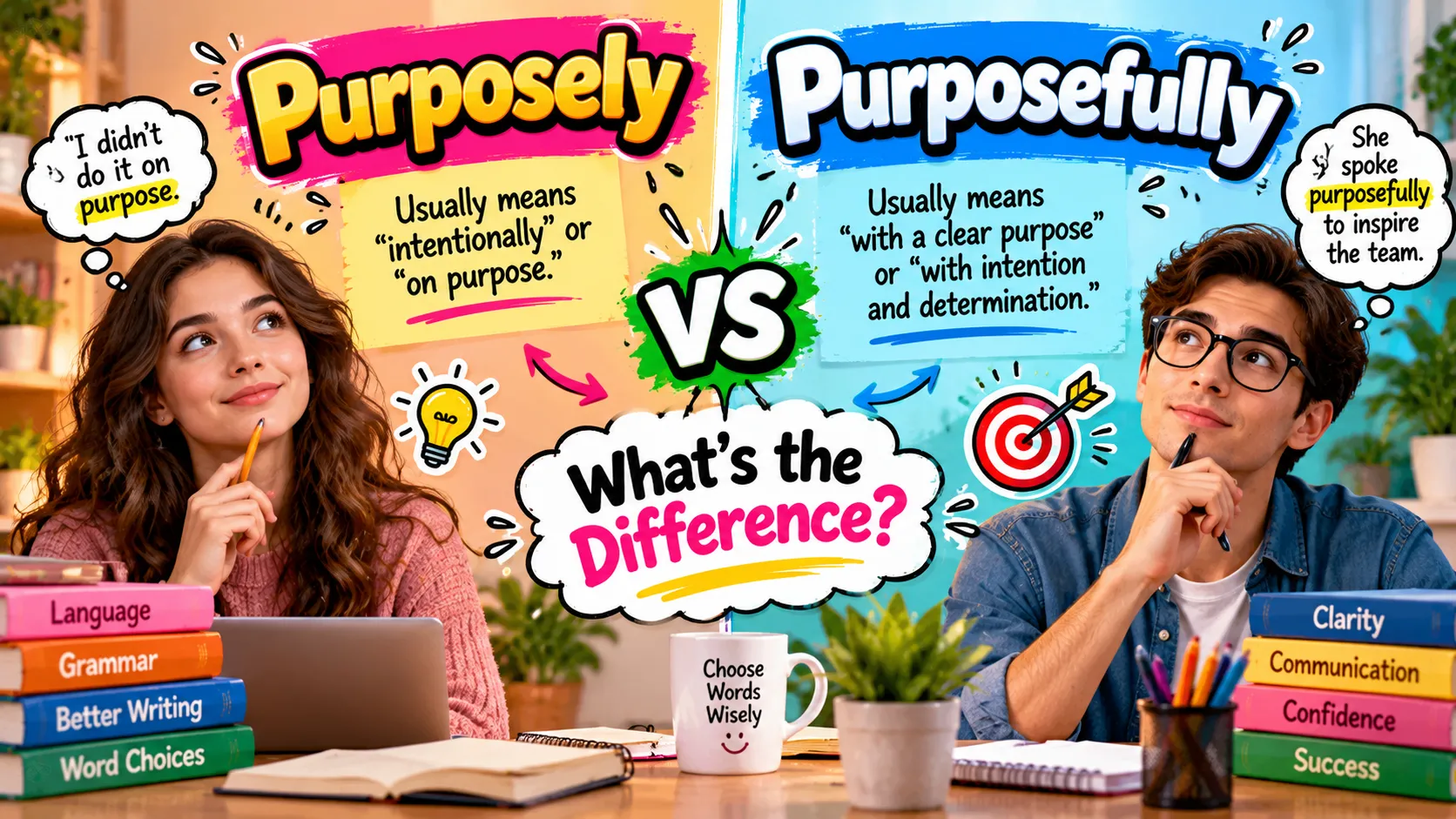
The words “purposely” and “purposefully” look almost identical, share the same root, and appear in similar contexts. Yet they carry distinct meanings that careful writers should understand. The purposely vs purposefully distinction trips up even experienced writers because the difference is subtle but meaningful.
“Purposely” means intentionally or on purpose—the opposite of accidentally. “Purposefully” means with determination, resolve, or a clear sense of purpose—the opposite of aimlessly. You might purposely ignore someone, but you would purposefully pursue a goal. This comprehensive guide explains the difference, explores their origins, provides practical examples, and helps you choose the correct word every time you write.
Quick Answer
“Purposely” means intentionally or deliberately—you did something on purpose rather than by accident. “Purposefully” means with determination, resolve, or a clear aim—you did something with purpose and focus. Use “purposely” to describe intent versus accident. Use “purposefully” to describe manner and determination.
Meaning Overview Table
| Aspect | Meaning |
|---|---|
| Definition | Purposely: intentionally, on purpose. Purposefully: with determination or a clear sense of purpose |
| Pronunciation | Purposely: /ˈpɜːrpəsli/; Purposefully: /ˈpɜːrpəsfəli/ |
| Part of Speech | Both are adverbs |
| Usage | “She purposely ignored him” vs. “She purposefully walked to the podium” |
| Context | Everyday writing, professional communication, academic writing |
Main Meaning
Definition
Purposely is an adverb meaning “intentionally,” “deliberately,” or “on purpose.” It describes an action done with conscious intent, as opposed to accidentally or unintentionally.
Purposefully is an adverb meaning “with determination,” “with resolve,” or “in a manner that shows a clear sense of purpose.” It describes the manner in which an action is performed—focused, deliberate, and directed toward a goal.
Origin
Both words derive from the noun “purpose,” which comes from Old French porpos, meaning “intention” or “aim.” “Purposely” developed as an adverb meaning “on purpose” or “intentionally.” “Purposefully” developed later, adding the suffix “-ful” (meaning “full of”) to “purpose,” creating an adjective “purposeful” and then the adverb “purposefully.” The distinction reflects the difference between having intent (purposely) and showing determination (purposefully).
Context
The distinction matters across several contexts:
- Everyday Writing: Choosing the wrong word can change the meaning of a sentence entirely
- Professional Communication: Precision matters in emails, reports, and legal documents
- Academic Writing: Clear distinctions demonstrate command of language
- Creative Writing: Writers use these words to convey character motivation and action
Modern Usage
Today, both words appear frequently, though “purposely” is more common in everyday speech. “Purposefully” appears more often in formal writing, business communication, and descriptions of deliberate action. The confusion persists because both words relate to “purpose” and sound similar.
Detailed Explanation
Literal Meaning
Literally, “purposely” means “with purpose” in the sense of intention—doing something on purpose. “Purposefully” means “with purpose” in the sense of determination—doing something with resolve and focus.
Common Meaning
Commonly, people use “purposely” to describe intentional actions, especially ones that might seem negative. “He purposely ignored my calls” means he did it on purpose. People use “purposefully” to describe actions performed with determination and clear intent. “She purposefully walked into the meeting” means she entered with confidence and resolve.
Intent vs. Manner
The core distinction is between intent and manner. “Purposely” describes why something was done—intentionally rather than accidentally. “Purposefully” describes how something was done—with determination and focus.
Legal Meaning
In legal contexts, “purposely” carries significant weight. It describes actions done with conscious intent, which can affect liability and culpability. “Purposefully” appears less often in legal writing, where the focus is on intent rather than manner.
Academic Meaning
In academic writing, the distinction demonstrates precision. Researchers describe actions “purposely” designed to test a hypothesis (intentional) and participants “purposefully” selected for a study (chosen with clear criteria and resolve).
Examples Table
| Example | Meaning |
|---|---|
| She purposely ignored his calls. | She did it intentionally |
| He purposefully walked to the front of the room. | He walked with determination |
| They purposely left the door unlocked. | They did it on purpose |
| She purposefully chose her words. | She spoke with care and resolve |
| I purposely avoided the topic. | I intentionally avoided it |
| He purposefully pursued his goal. | He pursued it with determination |
| The company purposely delayed the announcement. | The delay was intentional |
| She purposefully built her career. | She built it with clear purpose |
| He purposely made a mistake to test the system. | The mistake was intentional |
| They purposefully designed the program. | They designed it with clear intent |
Related Meanings Table
| Related Term | Meaning |
|---|---|
| Purpose | The reason for doing something; intention |
| Purposely | Intentionally; on purpose |
| Purposefully | With determination and resolve |
| Purposeful | Having a clear aim or determination |
| Intentionally | On purpose; deliberately |
| Deliberately | Consciously and intentionally |
| Accidentally | By mistake; unintentionally |
| Aimlessly | Without purpose or direction |
| Resolutely | With firm determination |
| Determinedly | With resolve |
| Willfully | Deliberately, often stubbornly |
| Knowingly | With awareness |
| Consciously | With awareness and intent |
| Spontaneously | Without planning or intent |
| Randomly | Without pattern or purpose |
Common Uses
People use “purposely” and “purposefully” across numerous contexts:
Everyday Conversation: People say “I purposely didn’t tell you” to explain intentional action. They say “She purposefully avoided the question” to describe determined evasion.
Professional Communication: Managers describe “purposely designed processes” (intentional) and “purposefully selected team members” (chosen with clear criteria).
Academic Writing: Researchers describe “purposely sampled participants” (intentionally selected) and “purposefully designed interventions” (created with clear goals).
Creative Writing: Authors use “purposely” to show character intent and “purposefully” to show character determination. “He purposely dropped the glass” versus “He purposefully strode across the room.”
Legal Writing: Attorneys describe “purposely committed acts” to establish intent. The word carries weight in criminal and civil cases.
Common Mistakes
| Mistake | Correction |
|---|---|
| Using “purposefully” to mean “intentionally” | Use “purposely” for intentional actions |
| Using “purposely” to mean “with determination” | Use “purposefully” for determined actions |
| Writing “She purposefully ignored him” when meaning intentional | Write “She purposely ignored him” |
| Writing “He purposely walked with confidence” | Write “He purposefully walked with confidence” |
| Assuming the words are interchangeable | They have different meanings and cannot be swapped |
| Overusing “purposefully” to sound sophisticated | “Purposely” is often clearer for intent |
| Confusing the two in legal writing | “Purposely” relates to intent; “purposefully” relates to manner |
| Writing “purposefully” when describing an accident | Use “purposely” for intentional acts |
| Forgetting the “-ful” suffix meaning | “Purposefully” contains “purposeful,” meaning full of purpose |
| Using “purposely” to describe determination | Use “purposefully” for resolve and focus |
Related Questions
What is the difference between purposely and purposefully?
“Purposely” means intentionally or on purpose. “Purposefully” means with determination or a clear sense of purpose.
Can I use them interchangeably?
No. They have different meanings. “Purposely” describes intent; “purposefully” describes manner.
Is “purposely” the opposite of accidentally?
Yes. “Purposely” means intentionally, which is the opposite of accidentally.
Is “purposefully” the opposite of aimlessly?
Yes. “Purposefully” means with determination and focus, which is the opposite of aimlessly.
Which word is more common?
“Purposely” is more common in everyday speech. “Purposefully” appears more often in formal and professional writing.
Can “purposefully” mean “intentionally”?
In some contexts, the meanings overlap, but “purposefully” emphasizes determination and focus rather than mere intent.
FAQs
What does “purposely” mean?
“Purposely” means intentionally, deliberately, or on purpose. It describes actions done with conscious intent.
What does “purposefully” mean?
“Purposefully” means with determination, resolve, or a clear sense of purpose. It describes the manner of an action.
Is it “purposely” or “purposefully” ignored?
Use “purposely ignored” to mean the ignoring was intentional. “Purposefully ignored” would emphasize the determination behind the ignoring.
Which word should I use in formal writing?
Both appear in formal writing, but “purposefully” is more common in professional and academic contexts. “Purposely” is clearer for intent.
Can “purposefully” mean “on purpose”?
Not exactly. “Purposefully” emphasizes determination and focus, not just intent. Use “purposely” for pure intent.
What is the noun form of each word?
The noun form of “purposely” is “purpose.” The noun form of “purposefully” is “purposefulness.”
Conclusion
Mastering the purposely vs purposefully distinction sharpens your writing and clarifies your meaning. “Purposely” means intentionally—the opposite of accidentally. “Purposefully” means with determination and resolve—the opposite of aimlessly. Remember the simple rule: purposely is about intent; purposefully is about manner. Whether you’re writing an email, an essay, or a story, choosing the correct word ensures your readers understand whether you mean deliberate action or determined action. Practice using “purposely” for intent and “purposefully” for determination, and your writing will gain precision and clarity. Small distinctions like this separate careful writers from careless ones.

Natalie Brooks is a content researcher and writer with a strong interest in word meanings, dream interpretations, symbolism, and cultural insights. She is passionate about creating clear, informative, and easy-to-understand content that helps readers discover the deeper meanings behind words, names, dreams, and symbols. Through her work at Meanzly, Natalie aims to make knowledge accessible and valuable for readers around the world.