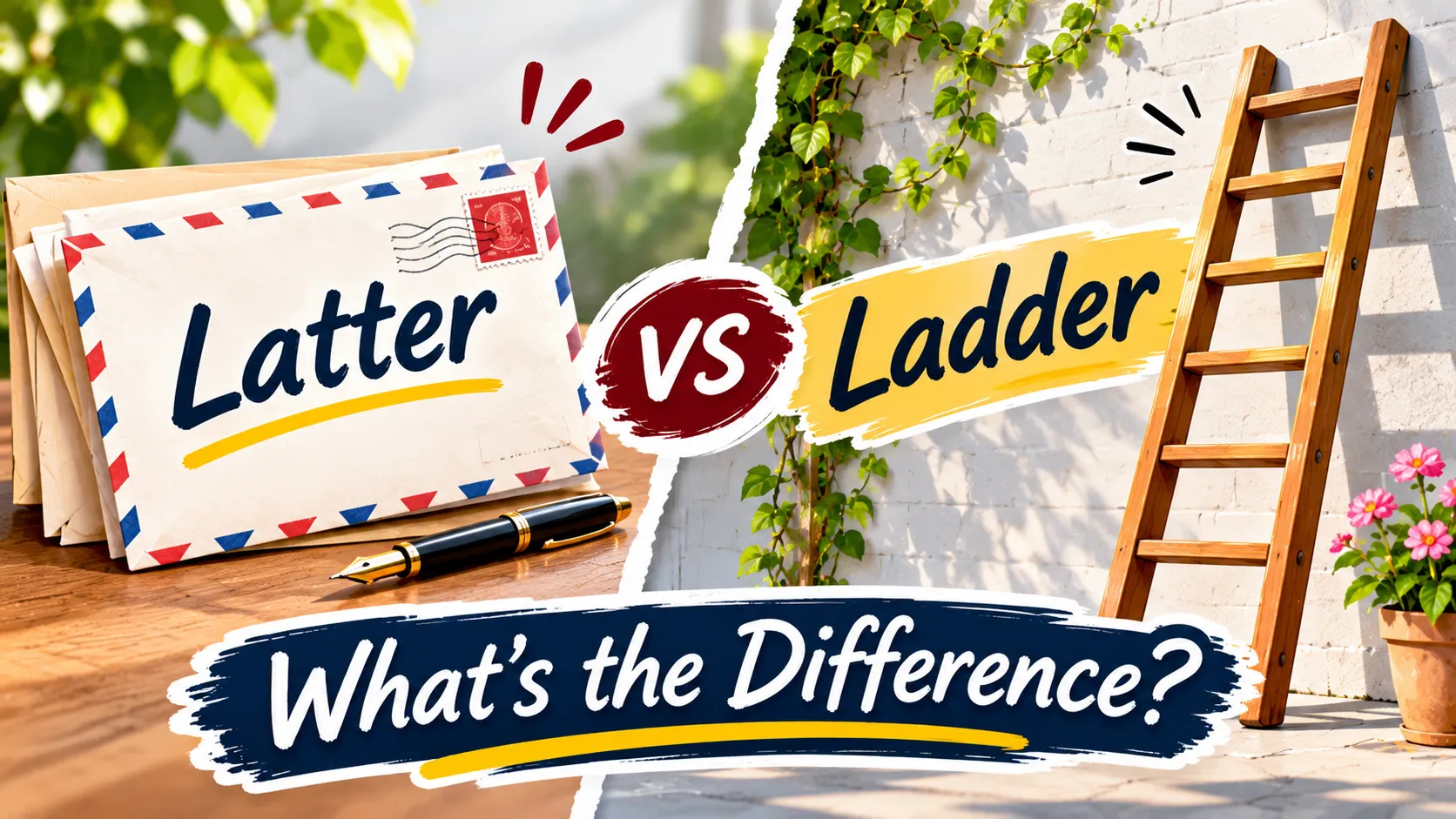
The words “latter” and “ladder” sound similar, differ by just one letter, and appear in completely different contexts. The latter vs ladder confusion ranks among the less common homophone errors in English writing, but it still appears in everything from academic essays to construction manuals.
“Latter” refers to the second of two things mentioned, or the later part of a period. “Ladder” refers to a structure with rungs used for climbing, or metaphorically to a hierarchy or progression. These words sound similar but mean completely different things. This comprehensive guide explains the difference, explores their origins, provides practical examples, and helps you choose the correct word every time you write.
Quick Answer
“Latter” refers to the second of two things just mentioned, as in “Of coffee and tea, I prefer the latter.” “Ladder” refers to a climbing structure with rungs, or a metaphorical hierarchy, as in “climb the corporate ladder.” Remember: latter means “the second one”; ladder is something you climb. They sound similar but mean completely different things.
Meaning Overview Table
| Aspect | Meaning |
|---|---|
| Definition | Latter: the second of two things mentioned. Ladder: a climbing structure with rungs, or a hierarchy |
| Pronunciation | Latter: /ˈlætər/; Ladder: /ˈlædər/ |
| Part of Speech | Latter: adjective or noun. Ladder: noun |
| Usage | “The latter option is better” vs. “He climbed the ladder” |
| Context | Latter: writing, comparisons, lists. Ladder: construction, sports, careers, metaphors |
Main Meaning
Definition
Latter functions as an adjective and a noun. As an adjective, it means “being the second of two things mentioned” or “belonging to the second part of a list.” As a noun, it refers to the second of two things. Ladder is a noun referring to a structure consisting of two side pieces connected by rungs, used for climbing. Metaphorically, it refers to a hierarchy or progression, as in “the corporate ladder.”
Origin
“Latter” comes from the Old English lætra, the comparative form of læt, meaning “late.” It originally meant “later” or “slower,” and its meaning evolved to refer to the second of two things mentioned.
“Ladder” comes from the Old English hlǣder, with Germanic roots related to German Leiter and Dutch ladder. The word has always referred to a climbing structure.
Context
The distinction matters across several contexts:
- Writing and Comparisons: “Latter” appears when comparing two things or referring to the second item
- Construction and Safety: “Ladder” appears in discussions of climbing equipment, safety, and building
- Career and Hierarchy: “Ladder” appears metaphorically in discussions of career advancement
- Sports: “Ladder” refers to rankings or tournament structures
- Everyday Writing: Confusing the two creates embarrassing errors in emails, essays, and social media posts
Modern Usage
Today, “latter” appears frequently in formal writing, especially when comparing two options. “Ladder” appears in construction, safety, sports, and career discussions. The confusion between the two persists because they sound similar and spell-check often fails to catch the error.
Detailed Explanation
Literal Meaning
Literally, “latter” means “the second of two.” “Ladder” literally means a climbing structure with rungs.
Common Meaning
Commonly, people use “latter” when presenting two options and referring to the second one. “Between hiking and swimming, I prefer the latter.” They use “ladder” when discussing climbing equipment or career advancement.
Comparative Meaning
In comparisons, “latter” refers to the second of two items mentioned. “Of the two candidates, Smith and Jones, the latter has more experience” means Jones has more experience. The word always refers to the most recently mentioned item.
Structural Meaning
In construction and safety, a “ladder” is a climbing structure with two side pieces and horizontal rungs. Ladders come in various types: step ladders, extension ladders, and fixed ladders.
Metaphorical Meaning
Metaphorically, “ladder” refers to a hierarchy or progression. “The corporate ladder” describes career advancement. “The social ladder” describes social status. “Climbing the ladder” means advancing in a hierarchy.
Sports Meaning
In sports, “ladder” refers to a ranking system or tournament structure. Tennis ladders, chess ladders, and athletic ladders show rankings and progress.
Examples Table
| Example | Meaning |
|---|---|
| Of tea and coffee, I prefer the latter. | The second option (coffee) |
| He climbed the ladder to reach the roof. | A climbing structure |
| The latter part of the book was slow. | The later part |
| She is climbing the corporate ladder. | Career advancement |
| Between the two plans, the latter is cheaper. | The second plan |
| The ladder was too short for the job. | A climbing tool |
| The latter half of the movie dragged. | The later portion |
| He fell off the ladder and hurt his arm. | A climbing structure |
| Of cats and dogs, the latter requires more care. | The second option (dogs) |
| The team moved up the league ladder. | Sports rankings |
Related Meanings Table
| Related Term | Meaning |
|---|---|
| Latter | The second of two things mentioned |
| Ladder | A climbing structure with rungs |
| Former | The first of two things mentioned (opposite of latter) |
| Latter-day | Modern or recent; belonging to recent times |
| Stepladder | A self-supporting folding ladder |
| Extension ladder | A ladder that can be lengthened |
| Corporate ladder | The hierarchy of career advancement |
| Social ladder | The hierarchy of social status |
| Career ladder | The progression of jobs in a profession |
| Ladder tournament | A competition using rankings |
| Rung | A step on a ladder |
| Latter half | The second half of something |
| Latter part | The later portion of something |
| Climb the ladder | Advance in a hierarchy |
| Ladder rack | A vehicle attachment for carrying ladders |
Common Uses
People use “latter” and “ladder” across numerous contexts:
Writing and Comparisons: Writers use “latter” to refer to the second of two items. This usage appears in academic writing, business reports, and formal correspondence.
Construction and Safety: Construction workers use ladders daily. Safety training covers proper ladder use and maintenance.
Career Advancement: Professionals discuss “climbing the corporate ladder.” Career development programs use the ladder metaphor.
Sports: Tournaments and leagues use ladders to rank competitors. Tennis and chess clubs maintain ladders for match scheduling.
Everyday Speech: People say “the latter” when comparing two options. They discuss ladders in home maintenance and repair.
Common Mistakes
| Mistake | Correction |
|---|---|
| Writing “the ladder option” | Write “the latter option” (the second option) |
| Writing “climb the latter” | Write “climb the ladder” (career advancement) |
| Writing “the latter was too short” | Write “the ladder was too short” (climbing structure) |
| Writing “of the two, the ladder is better” | Write “of the two, the latter is better” (the second option) |
| Writing “latter-day” as “ladder-day” | Write “latter-day” (modern or recent) |
| Writing “latter rack” | Write “ladder rack” (vehicle attachment) |
| Writing “latter tournament” | Write “ladder tournament” (ranking competition) |
| Writing “the latter half” as “the ladder half” | Write “the latter half” (the second half) |
| Assuming spell-check will catch the error | Spell-check often misses homophones; proofread manually |
| Writing “fall off the latter” | Write “fall off the ladder” (climbing structure) |
Related Questions
Is it “latter” or “ladder”?
It depends on meaning. Use “latter” for the second of two things mentioned. Use “ladder” for a climbing structure or hierarchy.
What does “latter” mean?
“Latter” refers to the second of two things mentioned. It can also refer to the later part of a period or the more recent of two items.
What does “ladder” mean?
“Ladder” refers to a climbing structure with rungs, or metaphorically to a hierarchy or progression.
What is the difference between “latter” and “ladder” in a sentence?
“Latter” refers to the second of two options. “Ladder” refers to a climbing tool or hierarchy.
What is the opposite of “latter”?
The opposite of “latter” is “former,” which refers to the first of two things mentioned.
Can “ladder” be used metaphorically?
Yes. “Corporate ladder,” “social ladder,” and “career ladder” all use the word metaphorically to describe hierarchies.
Why do people confuse “latter” and “ladder”?
They sound similar and differ by only one letter. Spell-check often misses homophones, so the error persists in written communication.
FAQs
What does “latter” mean?
“Latter” refers to the second of two things mentioned, or the later part of a period.
What does “ladder” mean?
“Ladder” refers to a climbing structure with rungs, or metaphorically to a hierarchy or progression.
Is it “the latter option” or “the ladder option”?
The correct phrase is “the latter option.” Latter refers to the second of two things mentioned.
Is it “climb the ladder” or “climb the latter”?
The correct phrase is “climb the ladder.” Ladder refers to the climbing structure or hierarchy.
Can “latter” be a noun?
Yes. “Latter” can function as a noun meaning “the second of two things mentioned.” For example, “Of the two, the latter is better.”
What is a “ladder tournament”?
A ladder tournament is a competition that uses rankings to determine matchups. Players challenge others above them on the ladder.
How can I remember the difference?
Remember: “latter” has “tt” like “two” — both relate to the second of two. “Ladder” has “dd” like “down” — you climb down or up a ladder.
What is the origin of “latter”?
“Latter” comes from the Old English lætra, the comparative form of læt, meaning “late.”
Conclusion
Mastering the latter vs ladder distinction protects your writing from embarrassing errors. “Latter” refers to the second of two things mentioned, or the later part of a period. “Ladder” refers to a climbing structure with rungs, or metaphorically to a hierarchy or progression. Remember the simple rule: latter means “the second one”; ladder is something you climb. Whether you’re writing an academic essay, a business report, or a social media post, choosing the correct word ensures your meaning is clear. Practice using “latter” for comparisons and “ladder” for climbing structures and hierarchies, and your readers will understand exactly what you intend. Small distinctions like this separate careful writers from careless ones.

Natalie Brooks is a content researcher and writer with a strong interest in word meanings, dream interpretations, symbolism, and cultural insights. She is passionate about creating clear, informative, and easy-to-understand content that helps readers discover the deeper meanings behind words, names, dreams, and symbols. Through her work at Meanzly, Natalie aims to make knowledge accessible and valuable for readers around the world.