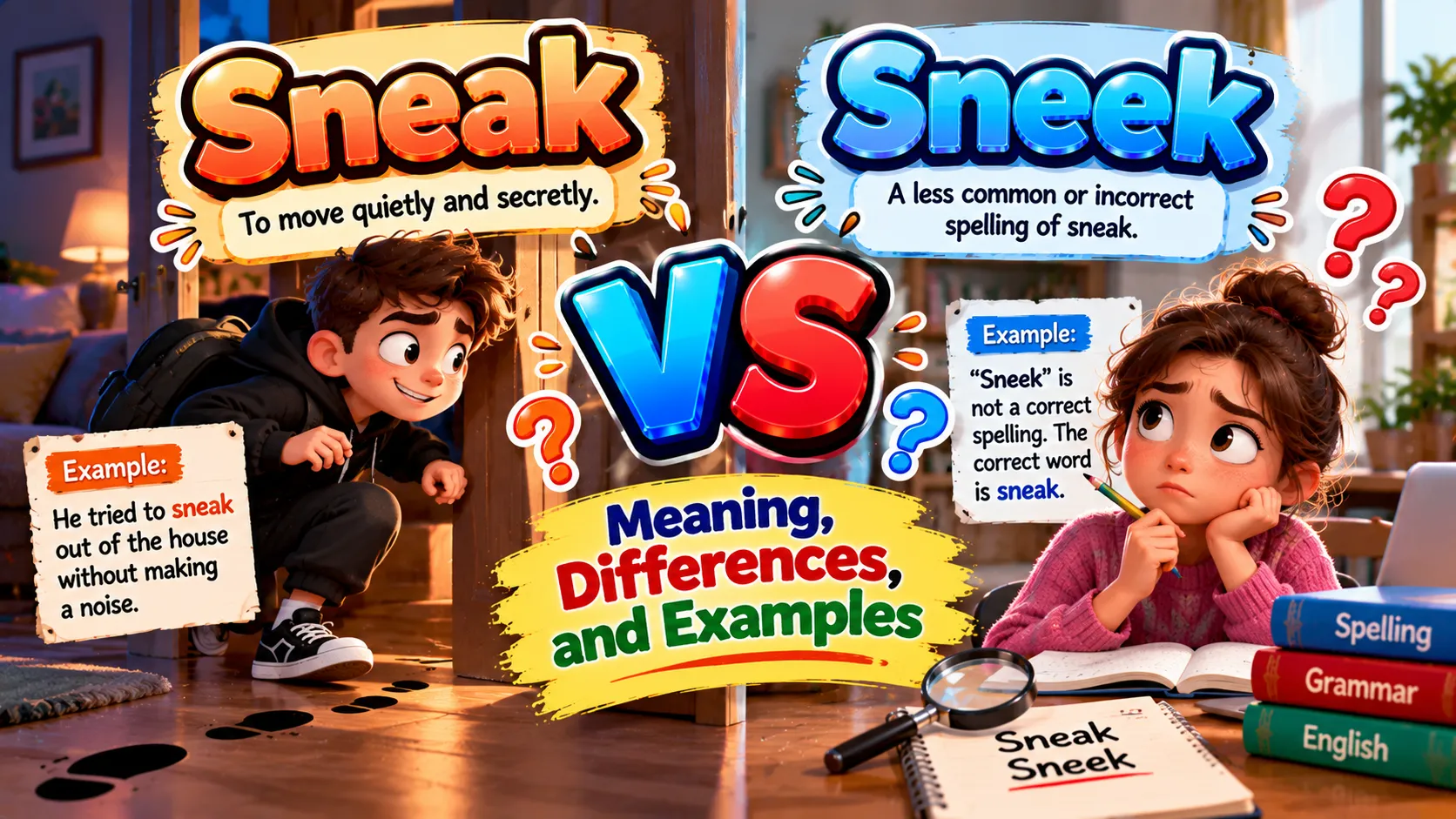
Understanding the difference between sneak vs sneek is simple once you know which spelling is correct. Both words may look similar, but sneak is the standard English spelling, while sneek is generally considered a misspelling.
The word sneak means to move quietly, secretly, or without being noticed. It can also describe doing something secretly, such as taking a sneak peek at a present before opening it. You might use this word when describing someone quietly entering a room or trying to avoid attention.
In this guide, you will learn the meaning of sneak, why sneek is incorrect in standard English, how to use sneak in sentences, and which related expressions can help you improve your vocabulary.
What Does Sneak Mean? 🤫
Sneak is a verb that means to move quietly or secretly to avoid being seen or heard. It can also describe doing something without permission or without attracting attention.
For example, a child might sneak into the kitchen to get a cookie after bedtime. Similarly, someone might sneak out of a meeting to answer an urgent phone call without interrupting everyone.
The word can also function as a noun in informal English. A sneak may refer to someone who behaves secretly or dishonestly, although this meaning can sound critical.
Examples of Sneak in Sentences
- The cat tried to sneak into the bedroom.
- He decided to sneak out of the house quietly.
- She took a sneak peek at the birthday present.
- The children tried to sneak extra cookies.
- I watched him sneak through the back door.
- They planned to sneak into the movie theater.
- My brother tried to sneak past our parents.
- We managed to sneak away before the rain started.
What Does Sneek Mean? ❌
Sneek is generally an incorrect spelling of sneak in standard modern English. If you want to describe moving quietly or secretly, you should write sneak, not sneek.
For example:
- Incorrect: He tried to sneek out of the room.
- Correct: He tried to sneak out of the room.
- Incorrect: The cat will sneek into the kitchen.
- Correct: The cat will sneak into the kitchen.
Although you might encounter sneek in usernames, creative writing, brand names, or informal online posts, those uses do not make it the standard spelling of the English word.
Sneak vs Sneek: Key Differences 📊
| Feature | Sneak | Sneek |
|---|---|---|
| Standard spelling | Yes | No |
| Meaning | To move or act secretly | Usually a misspelling of sneak |
| Dictionary usage | Standard English word | Not the standard spelling |
| Example | I tried to sneak outside. | I tried to sneek outside. |
| Correct for formal writing? | Yes | No |
The main difference is spelling. When writing an essay, email, school assignment, or professional document, always use sneak.
Different Forms of Sneak 📝
The word sneak changes form depending on the tense and grammatical structure of the sentence.
| Form | Example |
|---|---|
| Sneak | I sneak downstairs sometimes. |
| Sneaks | She sneaks out early. |
| Sneaked | He sneaked into the garden. |
| Snuck | He snuck into the garden. |
| Sneaking | They are sneaking past the door. |
Both sneaked and snuck are accepted past-tense forms in modern English. Snuck is especially common in American English, while sneaked is also correct.
Remember that the spelling does not change to sneeked or sneeking. The correct forms are sneaked and sneaking.
Common Expressions With Sneak 💬
The word sneak appears in several everyday expressions. Learning these phrases can help you understand how native English speakers use the word.
- Sneak peek: A quick or secret look at something before it is officially revealed.
- Sneak out: To leave a place quietly or without being noticed.
- Sneak in: To enter somewhere secretly.
- Sneak away: To leave quietly, often to avoid attention.
- Sneak up on: To approach someone or something quietly and unexpectedly.
- Sneak a look: To glance at something secretly.
- Sneak something in: To include or introduce something without attracting attention.
For example, a company might offer a sneak peek at a new product before its official launch. A child might sneak out of bed to get a glass of water, while a photographer might sneak a look at a beautiful sunset before taking a picture.
How to Remember Sneak vs Sneek 🧠
A simple way to remember the correct spelling is to associate sneak with the word peak, as in the expression sneak peek. Both words contain ea.
Try remembering this sentence:
“Take a sneak peek, not a sneek peek.”
You can also remember these spelling patterns:
- Correct: sneak
- Incorrect: sneek
- Correct: sneaked
- Incorrect: sneeked
- Correct: sneaking
- Incorrect: sneeking
When you are unsure, use a spell-checking tool or consult a reliable English dictionary. For standard writing, sneak is the correct choice.
Frequently Asked Questions ❓
Is sneek a real word?
Sneek is not the standard spelling of the English word meaning to move secretly. It may appear as a name, username, or creative spelling, but the standard spelling is sneak.
Is sneak or sneek correct?
Sneak is correct in standard English. Sneek is generally a misspelling.
What is the past tense of sneak?
Both sneaked and snuck are correct past-tense forms. For example, “She sneaked out” and “She snuck out” are both acceptable.
What does sneak mean in texting?
In texting, sneak usually means to do something quietly or secretly. For example, “I took a sneak peek” means you looked at something briefly, often before you were supposed to see it.
Is it sneak peek or sneek peek?
The correct expression is sneak peek. It means a preview or an early look at something.
Conclusion
The difference between sneak vs sneek is straightforward: sneak is the correct standard English spelling, while sneek is generally a spelling mistake. Use sneak when describing someone moving quietly, acting secretly, or taking an early look at something.
Remember the phrase sneak peek to help you keep the correct spelling in mind.

Natalie Brooks is a content researcher and writer with a strong interest in word meanings, dream interpretations, symbolism, and cultural insights. She is passionate about creating clear, informative, and easy-to-understand content that helps readers discover the deeper meanings behind words, names, dreams, and symbols. Through her work at Meanzly, Natalie aims to make knowledge accessible and valuable for readers around the world.