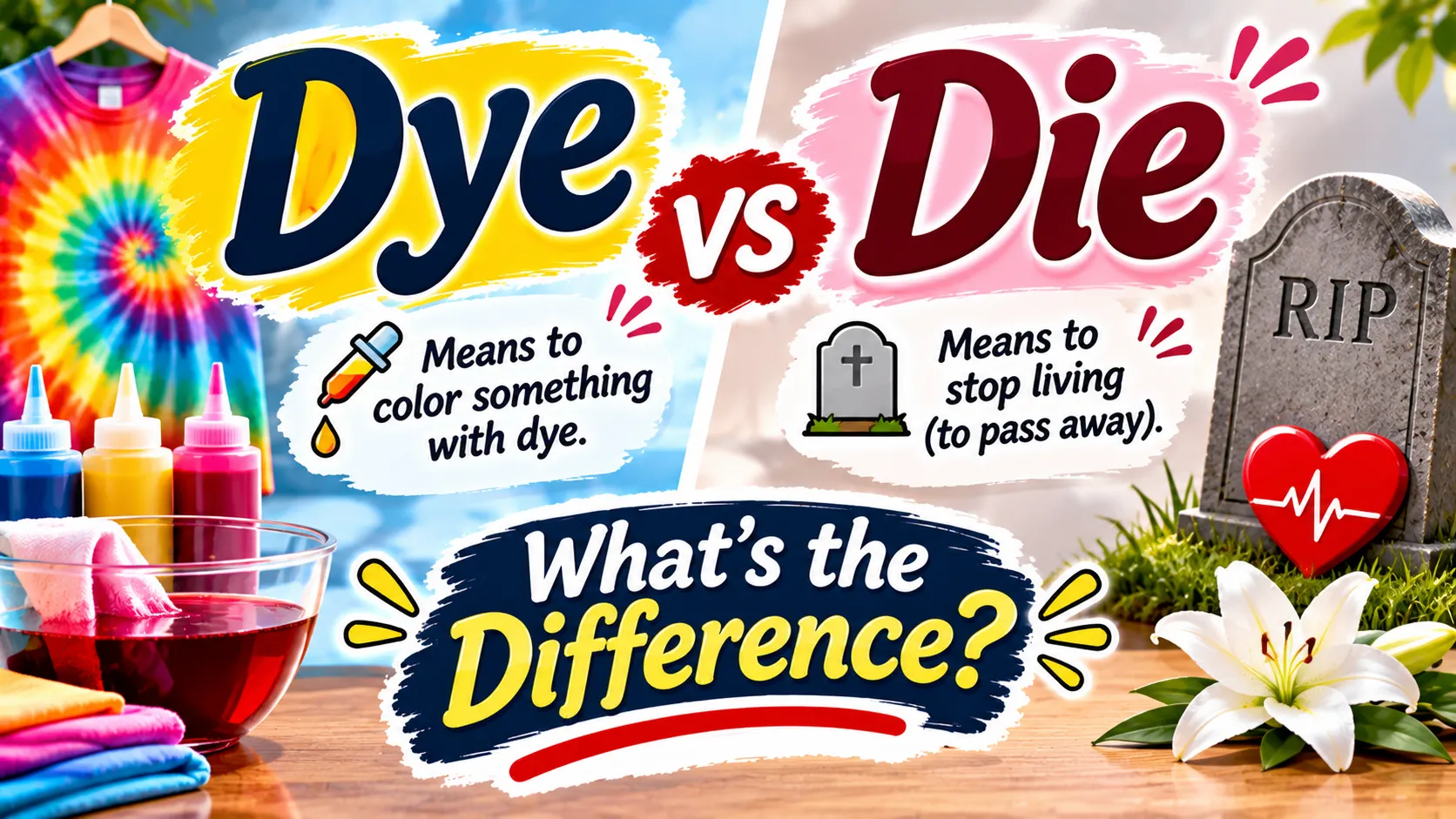
The words “dye” and “die” sound identical, differ by just one letter, and appear in completely different contexts. The dye vs die confusion ranks among the most common homophone errors in English writing, appearing in everything from craft instructions to news reports and gaming discussions.
“Dye” is a noun referring to a coloring substance and a verb meaning to color something. “Die” is a verb meaning to stop living, or a noun referring to a small cube used in games or a tool for shaping materials. These words share identical pronunciation but no shared meaning. This comprehensive guide explains the difference, explores their origins, provides practical examples, and helps you choose the correct word every time you write.
Quick Answer
“Dye” refers to a coloring substance or the act of coloring something, as in “dye your hair” or “fabric dye.” “Die” means to stop living, or refers to a game cube or a manufacturing tool, as in “the plants will die” or “roll the dice.” Remember: dye colors things; die ends life or refers to game pieces. They sound the same but mean completely different things.
Meaning Overview Table
| Aspect | Meaning |
|---|---|
| Definition | Dye: a coloring substance or the act of coloring. Die: to stop living; a game cube; a shaping tool |
| Pronunciation | Both: /daɪ/ |
| Part of Speech | Dye: noun and verb. Die: verb and noun |
| Usage | “Dye the fabric blue” vs. “The flowers will die without water” |
| Context | Dye: textiles, hair, crafts, chemistry. Die: biology, games, manufacturing |
Main Meaning
Definition
Dye functions as both a noun and a verb. As a noun, it refers to a natural or synthetic substance used to color materials such as fabric, hair, or food. As a verb, it means to color something using dye. Die functions as both a verb and a noun. As a verb, it means to stop living, to cease functioning, or to fade away. As a noun, it refers to a small cube used in games, or a tool used to shape or cut materials.
Origin
“Dye” comes from the Old English dēag or dēah, meaning “color” or “dye.” The word has Germanic roots and has been used for centuries in textile and craft contexts. “Die” comes from the Old Norse deyja, meaning “to die,” which replaced the Old English steorfan. The noun sense referring to a game cube comes from the Old French dé, from the Latin datum (“something given”). The tool sense comes from the idea of a shaped block.
Context
The distinction matters across several contexts:
- Textiles and Crafts: “Dye” appears in discussions of fabric coloring, tie-dye, and hair coloring
- Biology and Medicine: “Die” appears in discussions of life, death, and mortality
- Games and Gambling: “Die” (plural “dice”) refers to cubes used in board games and gambling
- Manufacturing: “Die” refers to tools used for cutting, shaping, or stamping materials
- Everyday Writing: Confusing the two creates embarrassing errors in emails, essays, and social media posts
Modern Usage
Today, “dye” appears frequently in fashion, beauty, and craft contexts. “Die” appears constantly in news reports, medical discussions, and gaming content. The phrase “die” also appears in idioms like “die hard” and “never say die.” The confusion between the two persists because they sound identical and spell-check often fails to catch the error.
Detailed Explanation
Literal Meaning
Literally, “dye” means a coloring substance or the act of coloring. “Die” literally means to stop living or to cease functioning.
Common Meaning
Commonly, people use “dye” when discussing hair color, fabric coloring, or Easter eggs. They use “die” when discussing death, game pieces, or manufacturing tools.
Textile Meaning
In textiles, “dye” refers to substances used to color fabric and yarn. Natural dyes come from plants, insects, and minerals. Synthetic dyes dominate modern textile production. Tie-dye, batik, and dip-dye are popular techniques.
Biological Meaning
In biology, “die” describes the end of life. Plants die without water. Animals die from illness or age. Cells die and are replaced. The word carries emotional weight in discussions of mortality.
Gaming Meaning
In gaming, “die” (plural “dice”) refers to small cubes with numbered faces used in board games, role-playing games, and gambling. “Roll the dice” means throw the cubes to generate random numbers. “The die is cast” is a famous phrase meaning a decision is final.
Manufacturing Meaning
In manufacturing, a “die” is a specialized tool used to cut, shape, or stamp materials. Dies are used in metalworking, plastic molding, and paper cutting. “Die casting” is a process for producing metal parts.
Examples Table
| Example | Meaning |
|---|---|
| She used blue dye to color the fabric. | A coloring substance |
| The plants will die without water. | Stop living |
| He dyed his hair blonde. | Colored his hair |
| Roll the dice to start the game. | Game cubes |
| The Easter eggs were dyed bright colors. | Colored with dye |
| The old tree died last winter. | Stopped living |
| The factory uses a die to cut metal sheets. | A shaping tool |
| She bought hair dye at the store. | A coloring product |
| The character will die in the final scene. | Stop living (fictional) |
| The die is cast; we must proceed. | The decision is final |
Related Meanings Table
| Related Term | Meaning |
|---|---|
| Dye | A coloring substance or the act of coloring |
| Die | To stop living; a game cube; a shaping tool |
| Dyeing | The process of coloring with dye |
| Dying | The process of losing life |
| Dyed | Past tense of dye; colored |
| Died | Past tense of die; stopped living |
| Dye job | A hair coloring treatment |
| Tie-dye | A fabric coloring technique |
| Dice | Plural of die (game cubes) |
| Die-cast | A manufacturing process using a die |
| Die-hard | Stubbornly resistant to change |
| Never say die | Never give up |
| The die is cast | The decision is final |
| Hair dye | A product for coloring hair |
| Fabric dye | A product for coloring fabric |
Common Uses
People use “dye” and “die” across numerous contexts:
Fashion and Beauty: Hair dye appears in salon discussions and beauty product marketing. Fabric dye appears in fashion design and home crafts.
Crafts and Hobbies: Tie-dye, Easter egg dyeing, and fabric dyeing are popular craft activities. Craft stores sell dyes in many colors.
Biology and Medicine: Doctors and scientists discuss cells dying, patients dying, and the dying process. These contexts require careful, respectful language.
Gaming and Gambling: Board games, role-playing games, and casinos use dice. “Roll the dice” and “the die is cast” are common phrases.
Manufacturing and Engineering: Dies are essential tools in metalworking, plastics, and paper production. “Die casting” produces complex metal parts.
Common Mistakes
| Mistake | Correction |
|---|---|
| Writing “die the fabric” | Write “dye the fabric” (color it) |
| Writing “dye without water” | Write “die without water” (stop living) |
| Writing “hair die” | Write “hair dye” (coloring product) |
| Writing “roll the dye” | Write “roll the die” (game cube) |
| Writing “the plant will dye” | Write “the plant will die” (stop living) |
| Writing “tie-die” | Write “tie-dye” (coloring technique) |
| Writing “dye cast” | Write “die cast” (manufacturing process) |
| Writing “dyed” when meaning “died” | “Dyed” means colored; “died” means stopped living |
| Assuming spell-check will catch the error | Spell-check often misses homophones; proofread manually |
| Writing “the die is dyed” | Write “the die is cast” (the decision is final) |
Related Questions
Is it “dye” or “die”?
It depends on meaning. Use “dye” for coloring substances or the act of coloring. Use “die” for stopping living, game cubes, or shaping tools.
What does “dye” mean?
“Dye” is a noun referring to a coloring substance and a verb meaning to color something.
What does “die” mean?
“Die” is a verb meaning to stop living, or a noun referring to a game cube or a shaping tool.
What is the difference between “dye” and “die” in a sentence?
“Dye” relates to coloring. “Die” relates to death, games, or manufacturing.
Why do people confuse “dye” and “die”?
They sound identical and differ by only one letter. Spell-check often misses homophones, so the error persists in written communication.
How can I remember the difference?
Remember: “dye” has “y” like “yellow” (a color). “Die” has “i” like “exit” (leaving life).
What is the plural of “die”?
The plural of “die” (game cube) is “dice.” The plural of “die” (tool) is “dies.”
FAQs
What does “dye” mean?
“Dye” is a noun referring to a coloring substance and a verb meaning to color something, such as fabric or hair.
What does “die” mean?
“Die” is a verb meaning to stop living, or a noun referring to a game cube or a shaping tool.
Is it “dye your hair” or “die your hair”?
The correct phrase is “dye your hair.” Dye means to color.
Is it “roll the die” or “roll the dye”?
The correct phrase is “roll the die.” A die is a game cube.
What is “tie-dye”?
Tie-dye is a fabric coloring technique that produces patterns by binding fabric before dyeing.
Can “die” be a noun?
Yes. “Die” as a noun refers to a game cube (plural “dice”) or a shaping tool (plural “dies”).
How can I remember the difference?
Remember: “dye” has “y” like “yellow” (a color). “Die” has “i” like “exit” (leaving life).
What is the origin of “die”?
“Die” comes from the Old Norse deyja, meaning “to die.” The game cube sense comes from the Old French dé.
Conclusion
Mastering the dye vs die distinction protects your writing from embarrassing homophone errors. “Dye” refers to a coloring substance or the act of coloring. “Die” means to stop living, or refers to a game cube or a shaping tool. Remember the simple rule: dye has “y” like “yellow” (a color); die has “i” like “exit” (leaving life). Whether you’re writing a craft tutorial, a news report, or a gaming guide, choosing the correct word ensures your meaning is clear. Practice using “dye” for coloring and “die” for death, games, and tools, and your readers will understand exactly what you intend. Small distinctions like this separate careful writers from careless ones.

Natalie Brooks is a content researcher and writer with a strong interest in word meanings, dream interpretations, symbolism, and cultural insights. She is passionate about creating clear, informative, and easy-to-understand content that helps readers discover the deeper meanings behind words, names, dreams, and symbols. Through her work at Meanzly, Natalie aims to make knowledge accessible and valuable for readers around the world.