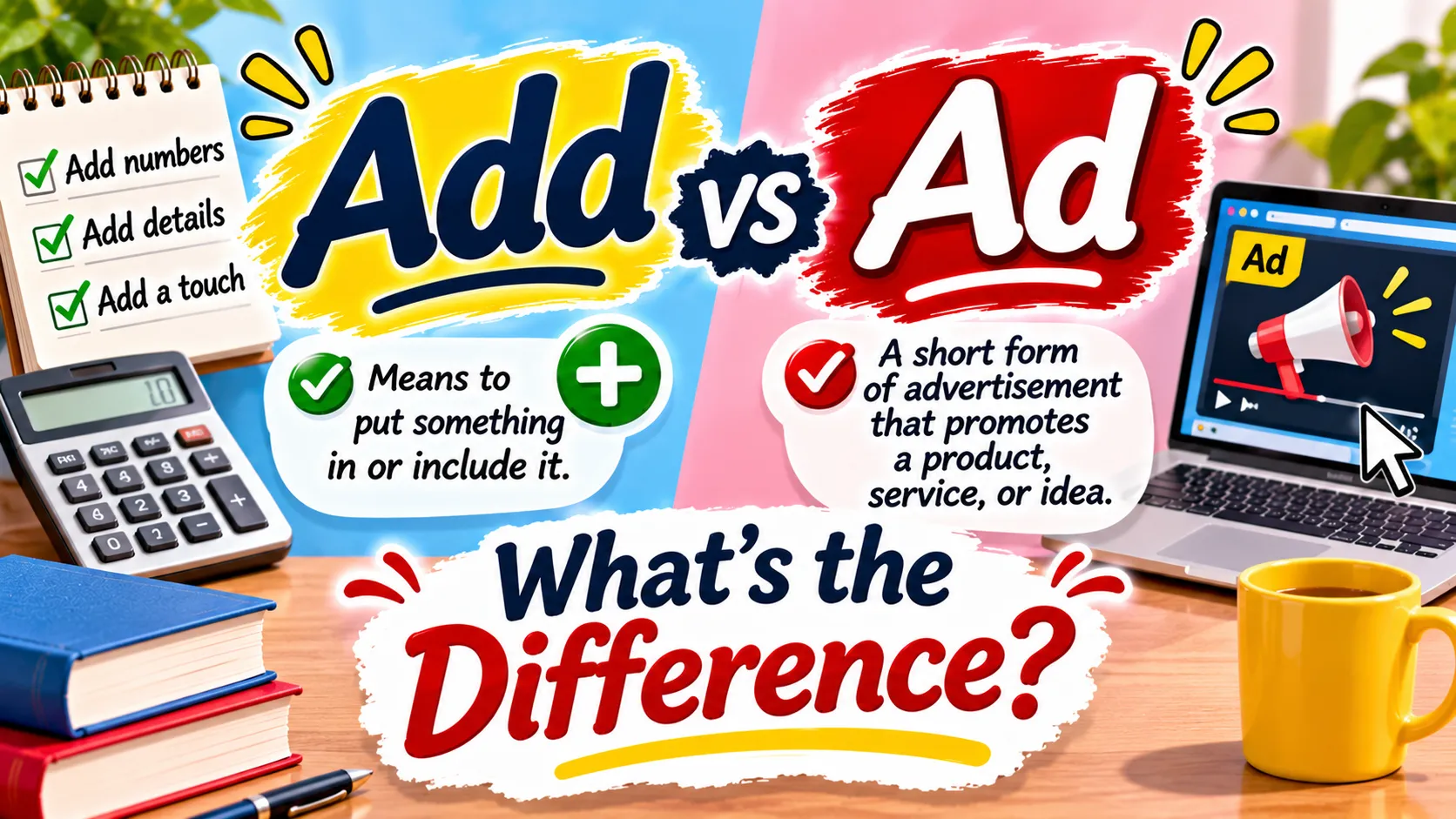
The words “add” and “ad” sound identical when spoken, differ by just one letter, and appear in completely different contexts. The add vs ad confusion ranks among the most common spelling errors in English writing, appearing in everything from social media posts to business proposals.
“Add” is a verb meaning to combine, include, or calculate a sum. “Ad” is a noun, short for “advertisement,” referring to promotional content. These words share identical pronunciation but no shared meaning. This comprehensive guide explains the difference, explores their origins, provides practical examples, and helps you choose the correct word every time you write.
Quick Answer
“Add” is a verb meaning to combine, include, or calculate, as in “add sugar to the recipe” or “add these numbers.” “Ad” is a noun meaning advertisement, as in “I saw an ad for a new phone.” Remember: add has two D’s like “addition”; ad has one D like “advertisement.” They sound the same but mean completely different things.
Meaning Overview Table
| Aspect | Meaning |
|---|---|
| Definition | Add: to combine, include, or calculate. Ad: a short form of advertisement |
| Pronunciation | Both: /æd/ |
| Part of Speech | Add: verb. Ad: noun |
| Usage | “Add milk to the coffee” vs. “The ad appeared on TV” |
| Context | Add: math, cooking, inclusion. Ad: marketing, media, advertising |
Main Meaning
Definition
Add is a verb meaning to join or combine something with something else, to include an item in a group or list, or to calculate the sum of numbers. Ad is a noun, a shortened form of “advertisement,” referring to a public promotion of a product, service, event, or idea.
Origin
“Add” comes from the Latin verb addere, meaning “to give to” or “to put to,” combining ad- (“to”) and dare (“to give”). It entered English in the 14th century. “Ad” is a 19th-century American shortening of “advertisement,” which itself comes from the Latin advertere, meaning “to turn toward.” The clipped form “ad” became standard in informal and journalistic English.
Context
The distinction matters across several contexts:
- Mathematics: “Add” appears in arithmetic, equations, and calculations
- Cooking and Recipes: “Add” appears in instructions for combining ingredients
- Marketing and Media: “Ad” appears in discussions of advertising, commercials, and promotions
- Everyday Writing: Confusing the two creates embarrassing errors in emails, essays, and social media posts
- Digital Contexts: “Ad” appears in discussions of online advertising, ad blockers, and sponsored content
Modern Usage
Today, “add” appears constantly in both speech and writing, especially in instructions and calculations. “Ad” appears frequently in marketing discussions, media commentary, and everyday conversation about commercials. The confusion between the two persists because they sound identical and spell-check often fails to catch the error.
Detailed Explanation
Literal Meaning
Literally, “add” means to put something together with something else. “Ad” literally means a public notice or announcement promoting something.
Common Meaning
Commonly, people use “add” when combining ingredients, including items in lists, or calculating sums. They use “ad” when discussing commercials, online promotions, or marketing campaigns.
Mathematical Meaning
In mathematics, “add” describes the operation of combining numbers to find a total. “Add 5 and 3 to get 8.” The word appears constantly in arithmetic instruction and financial calculations.
Culinary Meaning
In cooking, “add” appears in recipe instructions. “Add the flour gradually.” “Add salt to taste.” The word signals the inclusion of an ingredient in a mixture.
Marketing Meaning
In marketing, “ad” refers to any promotional message. Television commercials, online banners, social media sponsored posts, and print advertisements all count as ads. The word appears constantly in media commentary and marketing discussions.
Digital Meaning
In digital contexts, “ad” appears in discussions of online advertising, ad blockers, click-through rates, and targeted ads. “Add” appears in digital instructions, such as “add to cart” or “add a comment.”
Examples Table
| Example | Meaning |
|---|---|
| Add the eggs to the batter. | Combine ingredients |
| I saw an ad for a new car. | Advertisement |
| Please add your name to the list. | Include in a list |
| The ad appeared on social media. | Promotional content |
| Add these numbers together. | Calculate a sum |
| She clicked on the ad by mistake. | Advertisement |
| Can you add more details to the report? | Include additional information |
| The company spent millions on ads. | Advertisements |
| Add a pinch of salt to the soup. | Combine an ingredient |
| The ad was misleading and got banned. | Advertisement |
Related Meanings Table
| Related Term | Meaning |
|---|---|
| Add | To combine, include, or calculate |
| Ad | A shortened form of advertisement |
| Addition | The act of adding; a mathematical operation |
| Advertisement | A public promotion of a product or service |
| Additive | A substance added to something |
| Adder | A person or device that adds |
| Advertising | The business of promoting products |
| Advertiser | A person or company that advertises |
| Ad-blocker | Software that blocks online ads |
| Ad campaign | A coordinated series of advertisements |
| Added value | Extra benefit included with a product |
| Additional | Extra; added on |
| Add-on | Something extra added to a product |
| Ad-free | Without advertisements |
| Classified ad | A short advertisement in a newspaper |
Common Uses
People use “add” and “ad” across numerous contexts:
Mathematics and Finance: People add numbers, add expenses, and add interest. “Add” appears constantly in financial calculations and accounting.
Cooking and Baking: Recipes instruct cooks to add ingredients in specific order. “Add” appears in every cookbook and food blog.
Marketing and Media: Advertisers create ads for television, radio, print, and digital platforms. “Ad” appears constantly in media commentary, marketing reports, and consumer discussions.
Digital Technology: Websites display ads. Users install ad blockers. Marketers track ad performance. “Add” appears in user interfaces: “Add to cart,” “Add a comment,” “Add to favorites.”
Everyday Instruction: Teachers tell students to add details to essays. Managers tell employees to add items to agendas. “Add” appears in countless everyday instructions.
Common Mistakes
| Mistake | Correction |
|---|---|
| Writing “ad the milk” | Write “add the milk” (combine an ingredient) |
| Writing “I saw an add” | Write “I saw an ad” (advertisement) |
| Writing “add campaign” | Write “ad campaign” (advertising campaign) |
| Writing “add blocker” | Write “ad blocker” (software that blocks ads) |
| Writing “please ad your name” | Write “please add your name” (include) |
| Writing “the add was funny” | Write “the ad was funny” (advertisement) |
| Writing “add these numbers” as “ad these numbers” | Write “add these numbers” (calculate a sum) |
| Writing “classified add” | Write “classified ad” (advertisement) |
| Assuming spell-check will catch the error | Spell-check often misses homophones; proofread manually |
| Writing “add revenue” | Write “ad revenue” (income from advertisements) |
Related Questions
Is it “add” or “ad”?
It depends on meaning. Use “add” as a verb meaning to combine, include, or calculate. Use “ad” as a noun meaning advertisement.
What does “add” mean?
“Add” is a verb meaning to join or combine something with something else, to include an item in a group or list, or to calculate the sum of numbers.
What does “ad” mean?
“Ad” is a noun, short for “advertisement,” referring to a public promotion of a product, service, event, or idea.
What is the difference between “add” and “ad” in a sentence?
“Add” relates to combining or calculating. “Ad” relates to advertising or promotion.
Why do people confuse “add” and “ad”?
They sound identical and differ by only one letter. Spell-check often misses homophones, so the error persists in written communication.
How can I remember the difference?
Remember: add has two D’s like “addition” (a mathematical operation). Ad has one D like “advertisement” (promotional content).
Can “ad” be a verb?
No. “Ad” is only a noun. The verb form is “advertise.”
What is an “ad blocker”?
An ad blocker is software that prevents advertisements from appearing on websites and apps.
FAQs
What does “add” mean?
“Add” is a verb meaning to combine, include, or calculate. It describes joining things together or finding a sum.
What does “ad” mean?
“Ad” is a noun, short for “advertisement,” referring to promotional content for a product, service, or event.
Is it “add the milk” or “ad the milk”?
The correct phrase is “add the milk.” Add is the verb meaning to combine ingredients.
Is it “I saw an ad” or “I saw an add”?
The correct phrase is “I saw an ad.” Ad is the noun meaning advertisement.
Can “add” be a noun?
“Add” is primarily a verb. In informal usage, “add” can function as a noun meaning an addition, but this is rare.
Can “ad” be a verb?
No. “Ad” is only a noun. The verb form is “advertise.”
How can I remember the difference?
Remember: add has two D’s like “addition” (a mathematical operation). Ad has one D like “advertisement” (promotional content).
What is the origin of “ad”?
“Ad” is a 19th-century American shortening of “advertisement,” which comes from the Latin advertere, meaning “to turn toward.”
Conclusion
Mastering the add vs ad distinction protects your writing from embarrassing spelling errors. “Add” is a verb meaning to combine, include, or calculate. “Ad” is a noun meaning advertisement. Remember the simple rule: add has two D’s like “addition”; ad has one D like “advertisement.” Whether you’re writing a recipe, a math problem, a marketing report, or a social media post, choosing the correct word ensures your meaning is clear. Practice using “add” for combining and calculating, and “ad” for promotional content, and your readers will understand exactly what you intend. Small distinctions like this separate careful writers from careless ones.

Natalie Brooks is a content researcher and writer with a strong interest in word meanings, dream interpretations, symbolism, and cultural insights. She is passionate about creating clear, informative, and easy-to-understand content that helps readers discover the deeper meanings behind words, names, dreams, and symbols. Through her work at Meanzly, Natalie aims to make knowledge accessible and valuable for readers around the world.









