The words “further” and “farther” sound similar, look similar, and both relate to distance or advancement. Yet careful writers distinguish between them. The further vs farther distinction ranks among the most debated grammar questions in English, with traditional rules, modern usage, and regional preferences all influencing the choice.
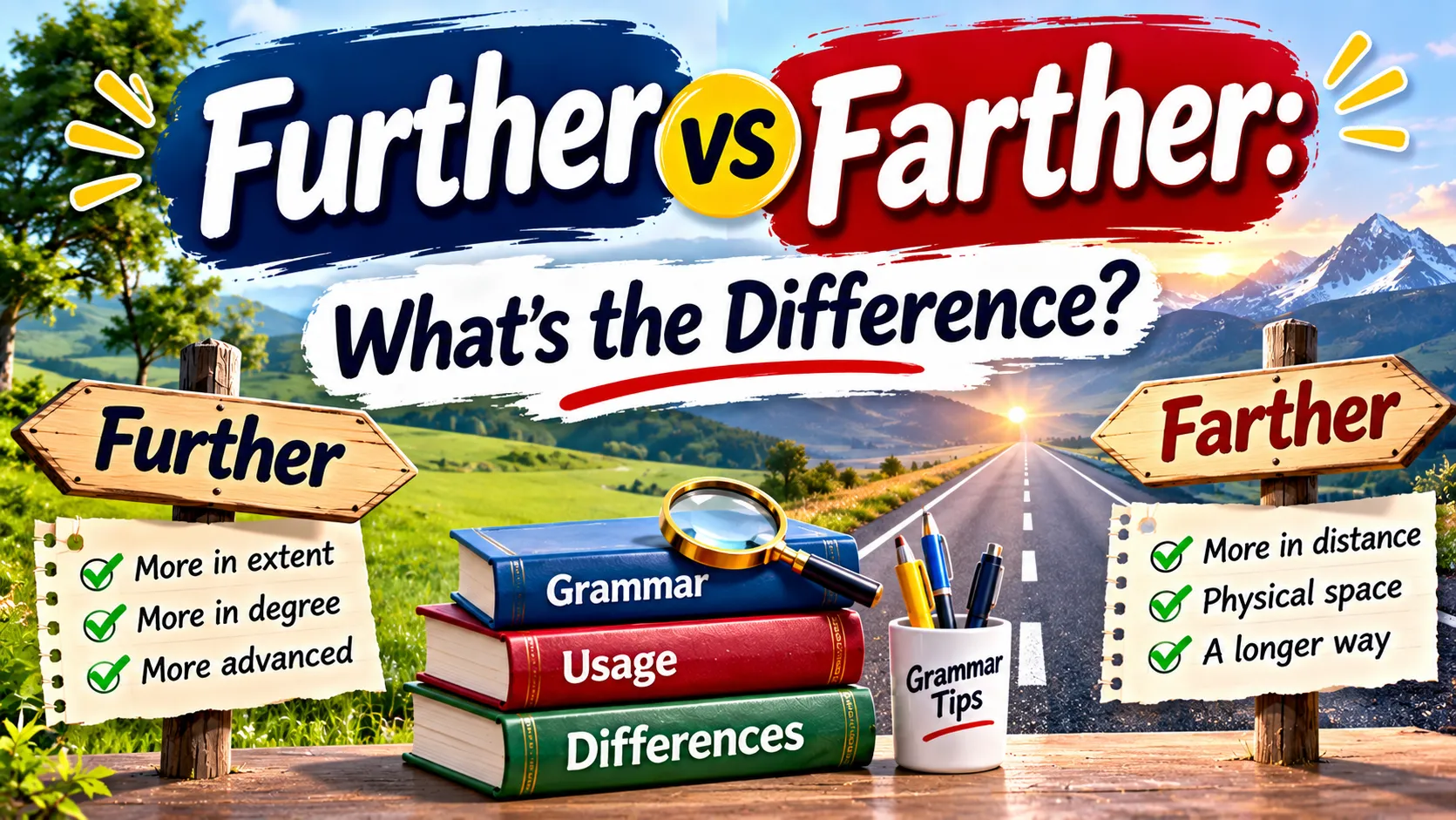
“Farther” traditionally refers to physical distance—how far you can walk, drive, or throw. “Further” refers to figurative distance—how far you can advance in a career, explore an idea, or develop an argument. The distinction dates back to the 19th century, when grammarians began separating the two forms. This comprehensive guide explains the difference, explores their origins, provides practical examples, and helps you choose the correct word every time you write.
Quick Answer
Use “farther” for physical distance, as in “The store is farther down the road.” Use “further” for figurative distance or additional extent, as in “We need further discussion” or “She advanced further in her career.” Both words mean “at a greater distance,” but “farther” measures physical space while “further” measures abstract progress or additional amounts.
Meaning Overview Table
| Aspect | Meaning |
|---|---|
| Definition | Farther: at a greater physical distance. Further: at a greater figurative distance or to a greater extent |
| Pronunciation | Both: /ˈfɜːrðər/ |
| Part of Speech | Both are adverbs and adjectives; further is also a verb |
| Usage | “Walk farther down the road” vs. “Discuss the issue further” |
| Context | Farther: physical travel, geography, distance measurement. Further: education, argument, business, abstract progress |
Main Meaning
Definition
Farther functions as an adverb and adjective meaning “at a greater physical distance.” It describes measurable space between objects or locations. Further functions as an adverb, adjective, and verb. As an adverb and adjective, it means “to a greater extent,” “additional,” or “more distant” in abstract terms. As a verb, it means to promote or advance something.
Origin
Both words come from the Old English furþor, the comparative form of forþ, meaning “forth” or “forward.” For centuries, English speakers used “further” for both physical and figurative distance. The distinction between “farther” and “further” emerged in the 19th century, when grammarians sought to differentiate the two forms. They assigned “farther” to physical distance and “further” to figurative distance. This rule has never been absolute, and many writers and style guides continue to treat the words as interchangeable.
Context
The distinction matters across several contexts:
- Physical Travel: “Farther” appears in directions, geography, and descriptions of distance
- Abstract Progress: “Further” appears in discussions of education, careers, and ideas
- Business Writing: “Further” appears in discussions of additional action or investigation
- Academic Writing: “Further” appears in discussions of research and analysis
- Everyday Speech: Many speakers use “further” for both meanings, especially in British English
Modern Usage
Today, both words appear frequently in English. American English tends to preserve the distinction more strictly, while British English often uses “further” for both physical and figurative distance. Dictionaries and style guides increasingly accept “further” for physical distance, though “farther” remains the safer choice for clarity in American writing.
Detailed Explanation
Literal Meaning
Literally, both words mean “at a greater distance.” “Farther” measures physical space. “Further” measures abstract extent. The literal meanings overlap, but the contexts differ.
Common Meaning
Commonly, people use “farther” when discussing physical distance: “How much farther is the gas station?” They use “further” when discussing additional action or abstract progress: “We need further information.”
Physical Distance Meaning
“Farther” describes measurable distance between physical locations. “The house is farther from the road than I thought.” “He threw the ball farther than anyone else.” These sentences describe actual space.
Figurative Distance Meaning
“Further” describes abstract distance or additional extent. “She advanced further in her career.” “Let’s discuss this further.” These sentences describe progress, discussion, or additional action rather than physical space.
Verb Meaning
“Further” functions as a verb meaning to promote or advance. “She furthered her education.” “The grant furthered his research.” This usage is formal and appears mostly in academic and professional writing.
Educational Meaning
In education, “further” appears in phrases like “further education” (British English for post-secondary education) and “further your studies.” The word describes advancement in knowledge rather than physical distance.
Examples Table
| Example | Meaning |
|---|---|
| The gas station is farther down the road. | Physical distance |
| We need to discuss this further. | Additional discussion |
| She ran farther than anyone expected. | Physical distance |
| He furthered his career by earning a degree. | Advanced his career |
| The mountains are farther away than they look. | Physical distance |
| Please provide further details. | Additional information |
| I can’t walk any farther. | Physical distance |
| The investigation went further than expected. | Extended in scope |
| The store is farther from here than the bank. | Physical distance |
| Further research is needed. | Additional research |
Related Meanings Table
| Related Term | Meaning |
|---|---|
| Farther | At a greater physical distance |
| Further | At a greater figurative distance or extent |
| Far | At a great distance |
| Farthest | At the greatest physical distance |
| Furthest | At the greatest figurative distance |
| Additional | Extra; more |
| Moreover | In addition; furthermore |
| Furthermore | In addition; besides |
| Advance | To move forward; to promote |
| Promote | To help something develop or progress |
| Distance | The amount of space between two points |
| Extent | The degree to which something happens |
| Beyond | At or to the farther side of |
| Additional information | More details |
| Progress | Forward movement or development |
Common Uses
People use “farther” and “further” across numerous contexts:
Physical Travel and Geography: “Farther” appears in directions, maps, and travel discussions. “How much farther is the airport?” “The trail goes farther into the woods.”
Education and Careers: “Further” appears in discussions of advancement. “She pursued further education.” “He furthered his career with a promotion.”
Business Writing: “Further” appears in phrases like “further action,” “further investigation,” and “further details.” These phrases describe additional steps or information.
Academic Writing: “Further” appears in research contexts. “Further study is needed.” “This research furthers our understanding.”
Everyday Speech: Many speakers use “further” for both physical and figurative distance, especially in British English. American speakers tend to distinguish more strictly.
Common Mistakes
| Mistake | Correction |
|---|---|
| Writing “farther discussion” | Write “further discussion” (additional) |
| Writing “further down the road” in American formal writing | Write “farther down the road” (physical distance) |
| Writing “farther your education” | Write “further your education” (advance) |
| Writing “further away” for physical distance in formal American writing | Write “farther away” (physical distance) |
| Assuming the distinction is absolute | Both words are often interchangeable; context matters |
| Using “farther” as a verb | “Farther” is not a verb; use “further” |
| Writing “farther details” | Write “further details” (additional) |
| Writing “further than I can throw” for physical distance | “Farther than I can throw” is more precise |
| Forgetting British usage | British English often uses “further” for both meanings |
| Using “farther” for abstract progress | Use “further” for abstract progress |
Related Questions
Is it “further” or “farther”?
It depends on meaning. Use “farther” for physical distance. Use “further” for figurative distance or additional extent.
What is the difference between “further” and “farther”?
“Farther” measures physical space. “Further” measures abstract progress or additional extent.
Can “further” be used for physical distance?
Yes, especially in British English. The distinction is a guideline, not a strict rule.
Can “farther” be used for figurative distance?
Rarely. Traditional grammar reserves “farther” for physical distance, but some writers use it for both.
What does “further” mean as a verb?
“Further” means to promote or advance something, as in “She furthered her career.”
Why do people confuse “further” and “farther”?
They sound similar and both mean “at a greater distance.” The distinction between physical and figurative distance is subtle.
FAQs
What is the difference between “further” and “farther”?
“Farther” refers to physical distance. “Further” refers to figurative distance or additional extent.
Is it “farther” or “further” down the road?
“Farther” down the road is the traditional choice for physical distance, though “further” is also acceptable in many contexts.
Can I use “further” for physical distance?
Yes, especially in British English. Many writers use “further” for both physical and figurative distance.
What does “further” mean in “further education”?
“Further education” is a British term for post-secondary education. It describes advancement in learning, not physical distance.
Is “farther” a word?
Yes. “Farther” is a standard English word meaning “at a greater physical distance.”
Why do some people say “further” instead of “farther”?
Both words come from the same root, and the distinction is relatively recent. Many speakers use “further” for both meanings, especially in British English.
What is the superlative form of “farther”?
The superlative of “farther” is “farthest.” The superlative of “further” is “furthest.”
How can I remember the difference?
Remember: “farther” has “far” in it — it measures how far you travel. “Further” has “fur” — think of going further into a subject, like burrowing deeper.
Conclusion
Mastering the further vs farther distinction sharpens your writing and clarifies your meaning. “Farther” measures physical distance. “Further” measures figurative distance or additional extent. Remember the simple rule: farther for physical space, further for abstract progress. In American English, the distinction is more strictly observed. In British English, “further” often covers both meanings. Whether you’re writing directions, a business report, or an academic paper, choosing the correct word ensures your readers understand whether you mean physical distance or additional action. Practice using “farther” for travel and “further” for progress, and your writing will gain precision and clarity.

Natalie Brooks is a content researcher and writer with a strong interest in word meanings, dream interpretations, symbolism, and cultural insights. She is passionate about creating clear, informative, and easy-to-understand content that helps readers discover the deeper meanings behind words, names, dreams, and symbols. Through her work at Meanzly, Natalie aims to make knowledge accessible and valuable for readers around the world.