Buddhism, one of the world’s oldest and most profound spiritual traditions, communicates its core teachings not only through words but through a rich visual language of symbols. These buddhist symbols and meanings have evolved over more than two millennia, offering practitioners and seekers alike a gateway to understanding the Dharma. From the iconic Dharma wheel to the serene lotus flower, each symbol carries layers of wisdom that reflect the Buddha’s path to enlightenment.
The use of symbolic imagery in Buddhism began around the 4th century BCE, initially avoiding human representations of the Buddha. Early Buddhists expressed their faith through aniconic symbols like the stupa, the Bodhi tree, and the Dharma wheel. By the 1st century CE, anthropomorphic depictions emerged, blending with existing symbols to create a rich iconographic tradition. This comprehensive guide explores the most significant Buddhist symbols and their meanings, from the earliest emblems to the elaborate iconography of Tibetan Vajrayana Buddhism.
Quick Answer
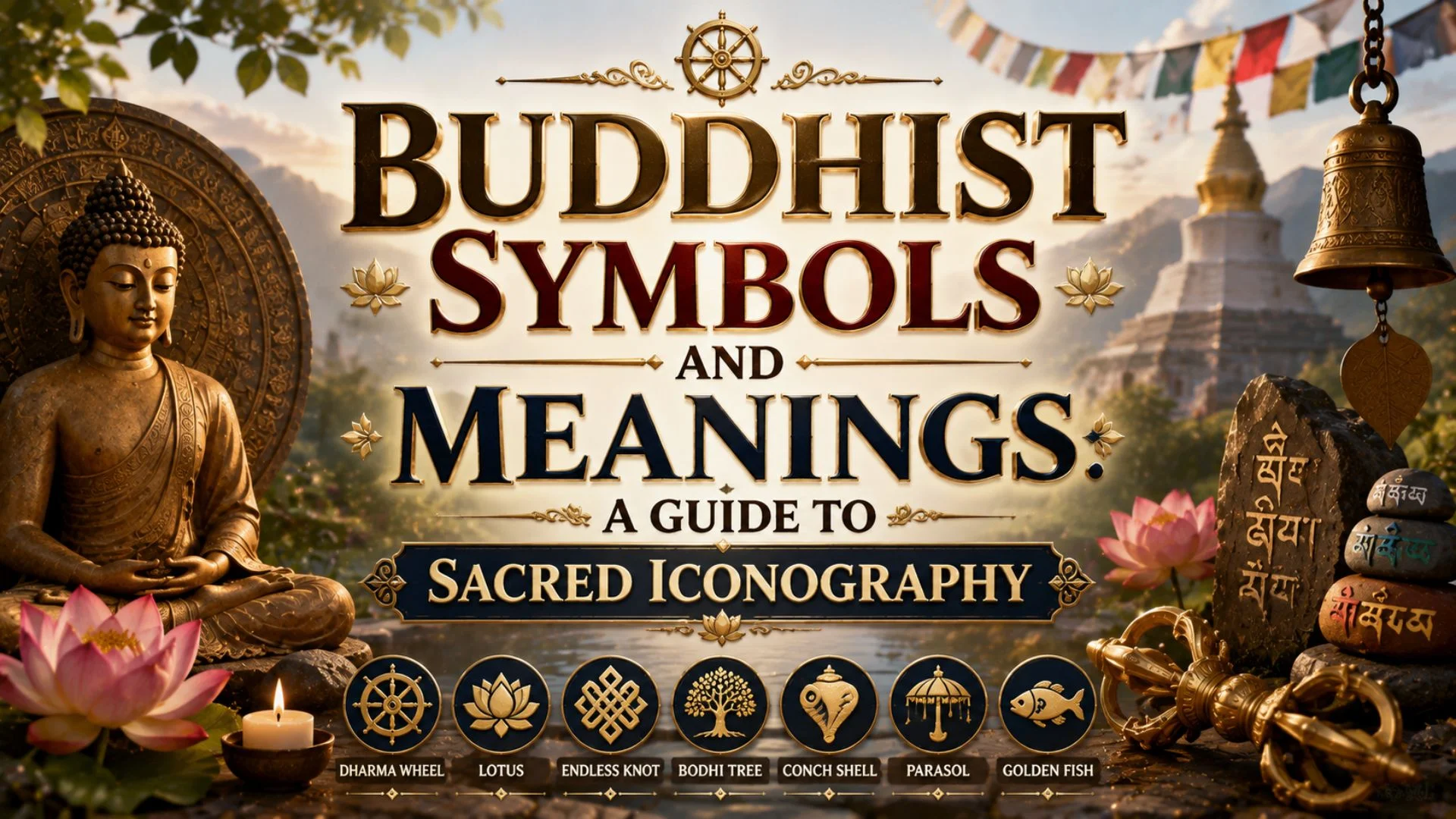
Buddhist symbols and meanings represent core teachings of the Dharma through visual imagery. Key symbols include the Dharma wheel (eight-spoked wheel representing the Noble Eightfold Path), the lotus flower (purity and enlightenment emerging from muddy waters), the stupa (a mound-like structure housing relics), the Bodhi tree (the site of the Buddha’s enlightenment), and the eight auspicious symbols of Tibetan Buddhism, including the conch shell, parasol, golden fish, and endless knot.
Meaning Overview Table
| Aspect | Meaning |
|---|---|
| Definition | Visual symbols used in Buddhist traditions to represent aspects of the Dharma, the Buddha’s life, and spiritual concepts |
| Pronunciation | BOO-dihst SIM-bulz and MEE-ningz |
| Part of Speech | Noun phrase |
| Usage | “Understanding Buddhist symbols and meanings helps practitioners deepen their meditation practice.” |
| Context | Religious practice, art history, cultural studies, meditation, spiritual exploration |
Main Meaning
Definition
Buddhist symbols and meanings encompass the visual language used across Buddhist traditions to represent the Dharma, the Buddha’s life, and key spiritual concepts. These symbols function as teaching tools, meditation aids, and objects of reverence that help practitioners understand and connect with Buddhist philosophy.
Origin
The use of symbols in Buddhism began shortly after the Buddha’s lifetime. Early Buddhists avoided depicting the Buddha in human form, using symbols to represent his presence and teachings instead. Among the earliest and most common symbols were the stupa, the Dharma wheel, and the lotus flower. The Dharma wheel originally represented the concept of royalty (the “Monarch of the Wheel” or Chakravartin), but Buddhists adopted it on the Pillars of Ashoka during the 3rd century BCE. Human representations of the Buddha began appearing around the 1st century CE, influenced by the arts of Mathura and Greco-Buddhist Gandhara.
Context
Buddhist symbols appear in various contexts:
- Temples and Monasteries: Symbols decorate walls, altars, and sacred spaces
- Art and Sculpture: Statues, paintings, and thangkas incorporate symbolic elements
- Ritual Practice: Practitioners use symbols like vajras, bells, and malas in meditation
- Everyday Life: Symbols appear in homes, jewelry, and personal items as reminders of the Dharma
- Modern Culture: Many Buddhist symbols have entered global popular culture as decorative or inspirational motifs
Modern Usage
Today, Buddhist symbols have become widely recognized beyond the Buddhist community. People use them in personal practice, art and design, wellness culture, academic study, and interfaith dialogue. Meditators use symbols as focal points for contemplation. Designers incorporate them into jewelry, home decor, and tattoos. Wellness culture features symbols in yoga studios, meditation apps, and products. Scholars analyze symbols for historical and cultural insights, and interfaith dialogue uses symbols as entry points for understanding Buddhist philosophy.
Detailed Explanation
Literal Meaning
Literally, Buddhist symbols are visual representations of concepts, beings, or events central to Buddhism. They include depictions of the Buddha, bodhisattvas, and deities, as well as abstract symbols like the Dharma wheel and the endless knot.
Common Meaning
Commonly, people understand Buddhist symbols as representing enlightenment, peace, and spiritual awakening. The lotus flower, for example, symbolizes purity emerging from suffering, while the Dharma wheel represents the Buddha’s teachings and the path to liberation.
Text Meaning
In written and online contexts, Buddhist symbols and meanings refer to the extensive body of literature, art history, and iconographic studies that decode these symbols. Many resources help people understand the significance of symbols they encounter in temples, museums, or personal practice.
Cultural Meaning
Culturally, Buddhist symbols represent the wisdom of ancient traditions and the universal human aspiration for peace and enlightenment. They have transcended religious boundaries to become symbols of mindfulness, compassion, and inner peace.
Esoteric Meaning
In Vajrayana (Tibetan) Buddhism, symbols often carry esoteric meanings revealed through initiation and practice. For example, the union of male and female deities represents the inseparability of wisdom and compassion.
Examples Table
| Example | Meaning |
|---|---|
| Dharma Wheel (Dharmachakra) | The Buddha’s teachings and the Noble Eightfold Path |
| Lotus Flower (Padma) | Purity, enlightenment, and spiritual rebirth |
| Stupa | A reliquary mound representing the Buddha’s presence and enlightenment |
| Bodhi Tree | The site of the Buddha’s enlightenment under the Bodhi tree |
| Conch Shell (Sankha) | The propagation of the Dharma and the Buddha’s voice |
| Parasol (Chattra) | Protection from evil and the crown of royalty |
| Golden Fish (Matsyayugma) | Liberation from suffering and fertility |
| Endless Knot (Shrivasta) | Long life, never-ending love, and the interconnectedness of all things |
| Treasure Vase (Kalasha) | Spiritual wealth and inexhaustible treasure |
| Victory Banner (Dhvaja) | The victory of Buddhist wisdom over ignorance |
| Vajra (Dorje) | Indestructibility, truth, and spiritual power |
| Bell (Ghanta) | Wisdom and emptiness |
| Buddha Footprint | The presence of the Buddha and his path |
| Mandala | The cosmic abode of a deity and the process of enlightenment |
| Three Jewels (Triratna) | The Buddha, the Dharma, and the Sangha |
Related Meanings Table
| Related Term | Meaning |
|---|---|
| Mudra | Symbolic hand gestures representing specific teachings or states of mind |
| Mantra | Sacred sounds or phrases used in meditation |
| Mandala | A geometric diagram representing the cosmos and the enlightened mind |
| Thangka | A Tibetan Buddhist painting on cloth, often depicting deities or mandalas |
| Stupa | A dome-shaped structure containing relics or sacred objects |
| Bodhisattva | A being who postpones enlightenment to help others |
| Nirvana | Liberation from the cycle of birth, death, and rebirth |
| Samsara | The cycle of birth, death, and rebirth |
| Karma | The law of cause and effect |
| Ashtamangala | The eight auspicious symbols of Tibetan Buddhism |
| Five Dhyani Buddhas | The five cosmic Buddhas representing the five wisdoms |
| Padmapani | “Holder of the Lotus,” a form of Avalokiteshvara |
| Vajrayana | The “Diamond Vehicle,” a form of Tantric Buddhism |
| Aniconic | Symbolic art that avoids human representations |
| Cetiya | A reminder or memorial of the Buddha |
Common Uses
Buddhist symbols appear in various contexts:
Meditation Practice: Practitioners use symbols as focal points for meditation. For example, visualizing a lotus flower can help cultivate purity and detachment, while contemplating the Dharma wheel can remind one of the path to enlightenment.
Ritual and Ceremony: Symbols are integral to Buddhist rituals. In Tibetan Buddhism, practitioners use vajras and bells in deity yoga practices, where the vajra represents compassion and the bell represents wisdom. Mandalas serve as visualization tools in initiations and empowerments.
Art and Architecture: Temples, stupas, and monasteries incorporate symbols in their design. The stupa itself is a symbol of the Buddha’s enlightened mind, with each architectural element carrying specific meaning.
Devotional Practice: Buddhists make offerings to symbols, such as lighting incense before a Buddha statue or offering flowers to a lotus image. These acts cultivate merit and devotion.
Personal Expression: Many people wear Buddhist symbols as jewelry or display them in their homes as reminders of the Dharma’s teachings.
Common Mistakes
| Mistake | Correction |
|---|---|
| Confusing Buddhist and Hindu symbols | While some symbols overlap (like the lotus and Om), their meanings differ across traditions |
| Assuming all Buddhist symbols have one fixed meaning | Symbols can have multiple layers of meaning depending on context and tradition |
| Believing the swastika is always a negative symbol | In Buddhism, the swastika is an ancient symbol of good fortune |
| Using sacred symbols as purely decorative items | Many Buddhists consider some symbols sacred and view their use as decoration as inappropriate |
| Misunderstanding the lotus’s meaning | The lotus symbolizes purity and enlightenment, not just beauty |
| Confusing the different lotus colors | Each color has specific significance: white for spiritual perfection, pink for the supreme Buddha, red for compassion, blue for wisdom |
| Thinking the Dharma wheel has exactly eight spokes | While eight is most common, some depictions have different numbers of spokes |
| Believing the Buddha had no symbolic representation | Early Buddhism used many symbols, even before human representations appeared |
| Assuming all Buddhist art is purely symbolic | Some Buddhist art is representational, depicting historical events or narratives |
| Using symbols without understanding their meaning | Take time to understand a symbol’s significance before using it |
Related Questions
What is the most important Buddhist symbol?
The Dharma wheel (Dharmachakra) is one of the most important symbols, representing the Buddha’s teachings and the Noble Eightfold Path.
What does the lotus flower symbolize in Buddhism?
The lotus symbolizes purity, enlightenment, and spiritual rebirth. It grows from muddy waters but emerges unstained, representing the potential for enlightenment despite worldly suffering.
What are the eight auspicious symbols of Buddhism?
The eight auspicious symbols (Ashtamangala) are the parasol, golden fish, conch shell, lotus, victory banner, endless knot, treasure vase, and Dharma wheel.
What does the Buddha’s hand gesture (mudra) mean?
Mudras are symbolic hand gestures that represent specific teachings or states of mind. Common mudras include the earth-touching gesture (Bhumisparsha), which symbolizes the Buddha’s enlightenment, and the teaching gesture (Dharmachakra), representing the turning of the wheel of Dharma.
What does the vajra symbolize?
The vajra (dorje) symbolizes the indestructible truth of the Dharma. It represents both the power of a thunderbolt and the purity of a diamond, signifying the unshakable nature of awakened wisdom.
What is a mandala in Buddhism?
A mandala is a geometric diagram representing the cosmic abode of a deity. It serves as a meditation tool, helping practitioners visualize the enlightened mind and the process of awakening.
Why is the Buddha often shown with long earlobes?
The Buddha’s long earlobes are one of the 32 physical marks of a “Great Man” (Mahapurisa). They symbolize his former life as a prince who wore heavy earrings, representing his renunciation of worldly wealth and status.
FAQs
What does the Dharma wheel represent?
The Dharma wheel (Dharmachakra) represents the Buddha’s teachings. The eight spokes symbolize the Noble Eightfold Path, the hub represents discipline, and the rim signifies the cycle of birth, death, and rebirth (samsara).
What do the different lotus colors symbolize?
Different lotus colors have specific meanings: white represents spiritual perfection, pink symbolizes the supreme Buddha, red stands for compassion and love, blue represents wisdom, and purple signifies mysticism.
What is the meaning of the endless knot?
The endless knot symbolizes the interconnectedness of all things, eternal harmony, and the never-ending cycle of birth, death, and rebirth. It also represents the infinite compassion and wisdom of the Buddha.
What is the significance of the Buddha’s throne?
The Buddha is often depicted seated on a lotus throne, which represents his purity and enlightenment. The throne itself symbolizes the Buddha’s sovereignty over the world and his transcendence of worldly suffering.
What is the meaning of the conch shell in Buddhism?
The conch shell symbolizes the propagation of the Dharma. Its sound represents the Buddha’s voice calling beings to awakening. In Tibetan Buddhism, the white conch shell specifically signifies the auspiciousness of the Buddha’s teachings.
What is a stupa and what does it represent?
A stupa is a dome-shaped structure that originally served as a reliquary for the Buddha’s remains or relics. It symbolizes the Buddha’s enlightened mind and the path to liberation.
What is the significance of the Bodhi tree?
The Bodhi tree is the sacred fig tree under which the Buddha attained enlightenment. It symbolizes the potential for awakening and the importance of spiritual practice.
What does the treasure vase symbolize?
The treasure vase (Kalasha) symbolizes spiritual wealth and inexhaustible treasure. It represents the abundance of the Buddha’s teachings and the practitioner’s capacity to accumulate merit and wisdom.
Conclusion
Buddhist symbols and meanings offer a profound visual language that communicates the essence of the Dharma across cultures and centuries. From the lotus flower rising from muddy waters to the Dharma wheel turning the path to liberation, each symbol carries layers of wisdom that support practitioners on their spiritual journey. The earliest aniconic symbols evolved into the rich iconography of Mahayana and Vajrayana traditions, reflecting Buddhism’s ability to adapt while preserving its core teachings.
Understanding these symbols deepens one’s appreciation of Buddhist art, practice, and philosophy. Whether you are a practitioner seeking to enhance your meditation, a student of religion exploring iconography, or simply someone drawn to the beauty of these symbols, you will find that their meanings continue to inspire and guide countless souls on the path to awakening.

Natalie Brooks is a content researcher and writer with a strong interest in word meanings, dream interpretations, symbolism, and cultural insights. She is passionate about creating clear, informative, and easy-to-understand content that helps readers discover the deeper meanings behind words, names, dreams, and symbols. Through her work at Meanzly, Natalie aims to make knowledge accessible and valuable for readers around the world.