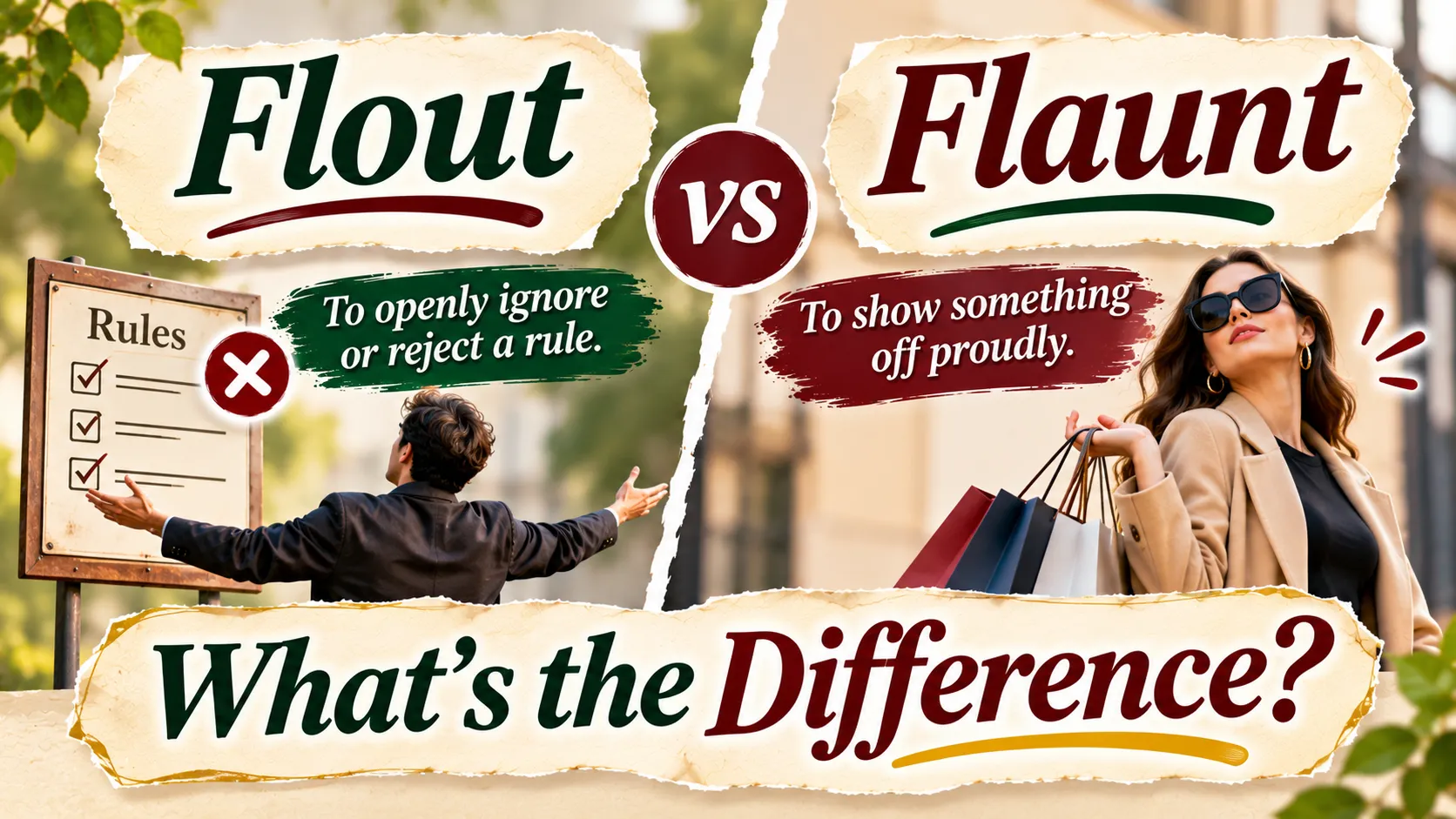
The words “flout” and “flaunt” sound similar and often appear in discussions of rules, behavior, and social conduct. Yet the flout vs flaunt distinction trips up even experienced writers, making this pair one of the most commonly confused verb pairs in English. Both words describe conspicuous behavior, but they mean very different things.
“Flout” means to openly disregard or defy a rule, law, or convention. “Flaunt” means to display something ostentatiously to attract attention or admiration. Someone who flouts the rules breaks them openly; someone who flaunts wealth shows it off. This comprehensive guide explains the difference, explores their origins, provides practical examples, and helps you choose the correct word every time you write.
Quick Answer
“Flout” means to openly disobey or disregard a rule or law, as in “flout the regulations.” “Flaunt” means to show off something ostentatiously, as in “flaunt expensive jewelry.” Remember: flout has “out” like “breaking out of rules”; flaunt has “aunt” like “showing off to your aunt.” They sound similar but mean completely different things.
Meaning Overview Table
| Aspect | Meaning |
|---|---|
| Definition | Flout: to openly disregard or defy a rule. Flaunt: to display something ostentatiously |
| Pronunciation | Flout: /flaʊt/; Flaunt: /flɔːnt/ |
| Part of Speech | Both are verbs (flaunt also functions as a noun in rare usage) |
| Usage | “Flout the law” vs. “flaunt a new car” |
| Context | Flout: law, rules, conventions, authority. Flaunt: fashion, wealth, appearance, social display |
Main Meaning
Definition
Flout is a verb meaning to openly disregard, defy, or show contempt for a rule, law, convention, or authority. It implies deliberate and visible disobedience. Flaunt is a verb meaning to display something ostentatiously or showily, often to provoke envy or admiration. It implies attracting attention to something one possesses or has achieved.
Origin
“Flout” likely comes from the Middle English flouten, meaning “to play the flute” or “to mock,” possibly influenced by the Dutch fluiten (“to jeer”). The word developed the meaning of mocking or showing contempt, which evolved into open defiance of rules.
“Flaunt” likely comes from the Old French flaunter, meaning “to flutter” or “to display proudly.” The word entered English in the 16th century and has always carried the sense of ostentatious display.
Context
The distinction matters across several contexts:
- Law and Authority: “Flout” appears in discussions of breaking rules and defying authority
- Fashion and Wealth: “Flaunt” appears in descriptions of showing off possessions or appearance
- Social Commentary: Both words appear in critiques of behavior, but with different meanings
- Everyday Writing: Confusing the two creates embarrassing errors in news reports, essays, and social media posts
Modern Usage
Today, “flout” appears frequently in news reports about people breaking laws or ignoring regulations. “Flaunt” appears in fashion writing, celebrity news, and social commentary about wealth display. The confusion persists because the words sound similar and both describe conspicuous behavior.
Detailed Explanation
Literal Meaning
Literally, “flout” means to mock or show contempt for something, especially rules. “Flaunt” literally means to display or wave something showily.
Common Meaning
Commonly, people use “flout” when describing someone who breaks rules openly. “The company flouted environmental regulations.” They use “flaunt” when describing someone showing off possessions or appearance. “She flaunted her new diamond ring.”
Legal Meaning
In legal contexts, “flout” describes deliberate violation of laws or court orders. “The defendant flouted the court’s ruling.” This usage appears frequently in legal reporting and judicial opinions.
Social Meaning
In social contexts, “flaunt” describes showing off wealth, beauty, or status. “He flaunted his expensive watch.” The word carries connotations of vanity or ostentation, though it can also describe confident self-expression.
Fashion Meaning
In fashion, “flaunt” appears in descriptions of bold style choices. “She flaunted her designer dress.” The word suggests confident display and visible luxury.
Authority Meaning
In discussions of authority, “flout” describes defiance of rules, laws, and conventions. “The protesters flouted the curfew.” The word emphasizes open disobedience.
Examples Table
| Example | Meaning |
|---|---|
| The company flouted safety regulations. | Openly disregarded rules |
| She flaunted her new sports car. | Displayed ostentatiously |
| He flouted the judge’s order. | Defied authority |
| They flaunted their wealth at the party. | Showed off possessions |
| Drivers who flout traffic laws face fines. | Break rules openly |
| The celebrity flaunted her designer wardrobe. | Displayed fashion showily |
| The politician flouted ethical standards. | Ignored conventions |
| He flaunted his intelligence during the debate. | Showed off knowledge |
| The rebels flouted the government’s authority. | Defied authority |
| She flaunted her diamond necklace at the gala. | Displayed jewelry ostentatiously |
Related Meanings Table
| Related Term | Meaning |
|---|---|
| Flout | To openly disregard or defy a rule |
| Flaunt | To display ostentatiously |
| Defy | To openly resist or refuse to obey |
| Disregard | To ignore or pay no attention to |
| Break | To violate a rule or law |
| Violate | To break a law or agreement |
| Show off | To display something to attract attention |
| Display | To show something prominently |
| Exhibit | To show something publicly |
| Parade | To display showily |
| Brandish | To wave or display something, often threateningly |
| Ostentatious | Showy, designed to attract attention |
| Contempt | Open disrespect for rules or authority |
| Defiance | Open resistance to authority |
| Vanity | Excessive pride in appearance or achievements |
Common Uses
People use “flout” and “flaunt” across numerous contexts:
News Reporting: Journalists use “flout” when reporting on people breaking laws. “The company flouted environmental protections.” They use “flaunt” when describing celebrity displays of wealth.
Legal Writing: Attorneys and judges use “flout” to describe deliberate violations of court orders or legal requirements.
Fashion and Entertainment: “Flaunt” appears in descriptions of bold style, celebrity outfits, and luxury displays.
Social Commentary: Both words appear in critiques of behavior—”flout” for rule-breaking, “flaunt” for showing off.
Everyday Conversation: People use “flout” in discussions of rules and “flaunt” in discussions of appearance and possessions.
Common Mistakes
| Mistake | Correction |
|---|---|
| Writing “flaunt the rules” | Write “flout the rules” (disregard rules) |
| Writing “flout wealth” | Write “flaunt wealth” (display wealth) |
| Writing “flaunt the law” | Write “flout the law” (defy the law) |
| Writing “flout a new dress” | Write “flaunt a new dress” (display a dress) |
| Writing “flouting his success” | Write “flaunting his success” (showing off success) |
| Writing “flaunting the regulations” | Write “flouting the regulations” (defying regulations) |
| Assuming the words are interchangeable | They have different meanings and cannot be swapped |
| Writing “flout her beauty” | Write “flaunt her beauty” (display beauty) |
| Writing “flaunt authority” | Write “flout authority” (defy authority) |
| Writing “flout a new car” | Write “flaunt a new car” (show off a car) |
Related Questions
Is it “flout” or “flaunt”?
It depends on meaning. Use “flout” for openly disregarding rules or laws. Use “flaunt” for showing off possessions or appearance.
What does “flout” mean?
“Flout” is a verb meaning to openly disregard, defy, or show contempt for a rule, law, or convention.
What does “flaunt” mean?
“Flaunt” is a verb meaning to display something ostentatiously or showily, often to attract attention.
What is the difference between “flout” and “flaunt” in a sentence?
“Flout” relates to breaking rules. “Flaunt” relates to showing off possessions or appearance.
Why do people confuse “flout” and “flaunt”?
They sound similar and both describe conspicuous behavior. Many people mistakenly use “flaunt” when they mean “flout.”
Is it “flaunt the rules” or “flout the rules”?
The correct phrase is “flout the rules.” Flout means to openly disregard rules.
Is it “flout wealth” or “flaunt wealth”?
The correct phrase is “flaunt wealth.” Flaunt means to display wealth ostentatiously.
How can I remember the difference?
Remember: flout has “out” like “breaking out of rules.” Flaunt has “aunt” like “showing off to your aunt.”
FAQs
What does “flout” mean?
“Flout” is a verb meaning to openly disregard, defy, or show contempt for a rule, law, or convention.
What does “flaunt” mean?
“Flaunt” is a verb meaning to display something ostentatiously or showily, often to attract attention or admiration.
Is it “flout the law” or “flaunt the law”?
The correct phrase is “flout the law.” Flout means to openly disregard the law.
Is it “flaunt wealth” or “flout wealth”?
The correct phrase is “flaunt wealth.” Flaunt means to display wealth ostentatiously.
Can “flout” mean to show off?
No. “Flout” means to defy or disregard rules. “Flaunt” means to show off.
Can “flaunt” mean to break rules?
No. “Flaunt” means to display something showily. “Flout” means to break rules.
Why do people confuse “flout” and “flaunt”?
They sound similar and both describe conspicuous behavior. Many people mistakenly use “flaunt” when they mean “flout.”
How can I remember the difference?
Remember: flout has “out” like “breaking out of rules.” Flaunt has “aunt” like “showing off to your aunt.”
Conclusion
Mastering the flout vs flaunt distinction improves your writing and clarifies your meaning. “Flout” means to openly disregard or defy rules, laws, and conventions. “Flaunt” means to display possessions, appearance, or achievements ostentatiously. Remember the simple rule: flout has “out” like breaking out of rules; flaunt has “aunt” like showing off to your aunt. Whether you’re writing a news report, a legal document, or a social media post, choosing the correct word ensures your meaning is clear. Practice using “flout” for rule-breaking and “flaunt” for showing off, and your readers will understand exactly what you intend. Small distinctions like this separate careful writers from careless ones.

Natalie Brooks is a content researcher and writer with a strong interest in word meanings, dream interpretations, symbolism, and cultural insights. She is passionate about creating clear, informative, and easy-to-understand content that helps readers discover the deeper meanings behind words, names, dreams, and symbols. Through her work at Meanzly, Natalie aims to make knowledge accessible and valuable for readers around the world.