Music often sounds effortless to the ear, but behind every performance lies a carefully written language that directs how musicians create and express sound. Written symbols on a musical score guide performers, telling them when to play, when to pause, and how each note should sound and feel. Understanding music symbols and meanings is essential for anyone learning to read sheet music, whether you are a beginner pianist, a vocalist, or an aspiring composer.
For someone new to reading music, understanding these markings is like learning to read emotion in another language—each sign carries direction, timing, and expression, shaping how the player transforms ink into sound. Musical notation serves two primary purposes: to aid memory and to facilitate communication. By providing a visual record of musical sounds, notation helps musicians remember and shape complex compositions that would be impossible to develop through oral tradition alone. This guide explores the essential music symbols and meanings, from the basic notes to the most nuanced dynamic and articulation marks.
Quick Answer
Music symbols and meanings refer to the visual notation system used to represent musical sounds, rhythms, dynamics, and articulations on paper. Common symbols include the treble clef (high-pitched notes), bass clef (low-pitched notes), staff lines, notes (indicating pitch and duration), rests (silence), time signatures (meter), and dynamic markings like piano (soft) and forte (loud). These symbols form a universal language for musicians across all genres and instruments.
Meaning Overview Table
| Aspect | Meaning |
|---|---|
| Definition | A visual notation system of symbols that represent musical sounds, rhythms, dynamics, tempo, and articulation |
| Pronunciation | MYOO-zik SIM-bulz and MEEN-ingz |
| Part of Speech | Noun phrase |
| Usage | “Before you can play that piece, you need to understand the music symbols and meanings written on the score.” |
| Context | Music education, composition, performance, music theory |
Main Meaning
Definition
Music symbols and meanings refer to the comprehensive system of visual signs musicians use to represent pitch, rhythm, dynamics, articulation, tempo, and expression in written music. This system allows composers to communicate their musical ideas precisely and enables performers to interpret and reproduce those ideas accurately. The notation includes everything from basic note heads and rests to complex ornamentation and expressive markings that give music its character and emotion.
Origin
The earliest known form of musical notation dates back to ancient Greece and Mesopotamia, where musicians used letters and symbols to represent pitch. Modern musical notation began developing in the 9th century with the use of neumes—small marks above text that indicated the direction of the melody. Guido of Arezzo, a music theorist in the 11th century, created the foundation of the modern staff system, which evolved over time to include precise rhythmic notation. By the Renaissance and Baroque periods, notation had largely taken its modern form, allowing composers like Bach and Mozart to write with the clarity we recognize today.
Context
Musicians use music symbols and meanings across all genres and instruments. Classical music relies heavily on detailed notation to preserve and reproduce works accurately. Jazz and popular music may use lead sheets with symbols and chord charts, while contemporary music often incorporates graphic notation and experimental symbols. Regardless of genre, the foundational symbols—clefs, notes, rests, dynamics, and articulations—remain consistent, creating a universal language for musicians worldwide.
Modern Usage
In the 21st century, music notation has expanded beyond paper to include digital formats. Software like Sibelius, Finale, and Dorico allow composers to write music electronically. MIDI (Musical Instrument Digital Interface) uses a different set of symbols to represent music digitally. However, the core system of notation remains largely unchanged, preserving the rich tradition of written music while embracing modern technology.
Detailed Explanation
Literal Meaning
Literally, music symbols are visual representations of sound. Each note head denotes a pitch, its position on the staff determines the exact frequency, and its shape and stem indicate the duration. Rests represent silence, and dynamics tell the musician how loud or soft to play. Each symbol has a precise, defined meaning within the system.
Common Meaning
Commonly, when people refer to music symbols and meanings, they are referring to the standard notation system used to read and write music. This includes the staff, clefs, notes, rests, time signatures, key signatures, dynamics, articulations, and tempo markings. These are the building blocks of sheet music that every musician must learn.
Text Meaning
In written communication, “music symbols and meanings” often appears in educational materials, music theory textbooks, and reference guides. These resources help students and hobbyists decode sheet music and understand the language of musical notation.
Internet Meaning
Online, music symbols and meanings are widely discussed in tutorials, forums, and educational websites. YouTube is an immense resource with play-along tutorials that teach users to read music. Interactive apps and games also help students identify symbols and build confidence in sight-reading.
Social Media Meaning
On social media, musicians often share charts and infographics to help beginners learn notation quickly. Memes about “confusing symbols” or “what does this marking mean?” have become popular, making music theory more approachable and engaging for a wider audience.
Cultural Meaning
Culturally, music notation represents a profound human achievement. It allowed humanity to record and share musical ideas across time and space, preserving the works of great composers and enabling global musical exchange. Even in cultures where oral tradition dominates, notation often plays a role in preserving and teaching music, especially as classical and folk traditions intersect.
Examples Table
| Symbol | Meaning |
|---|---|
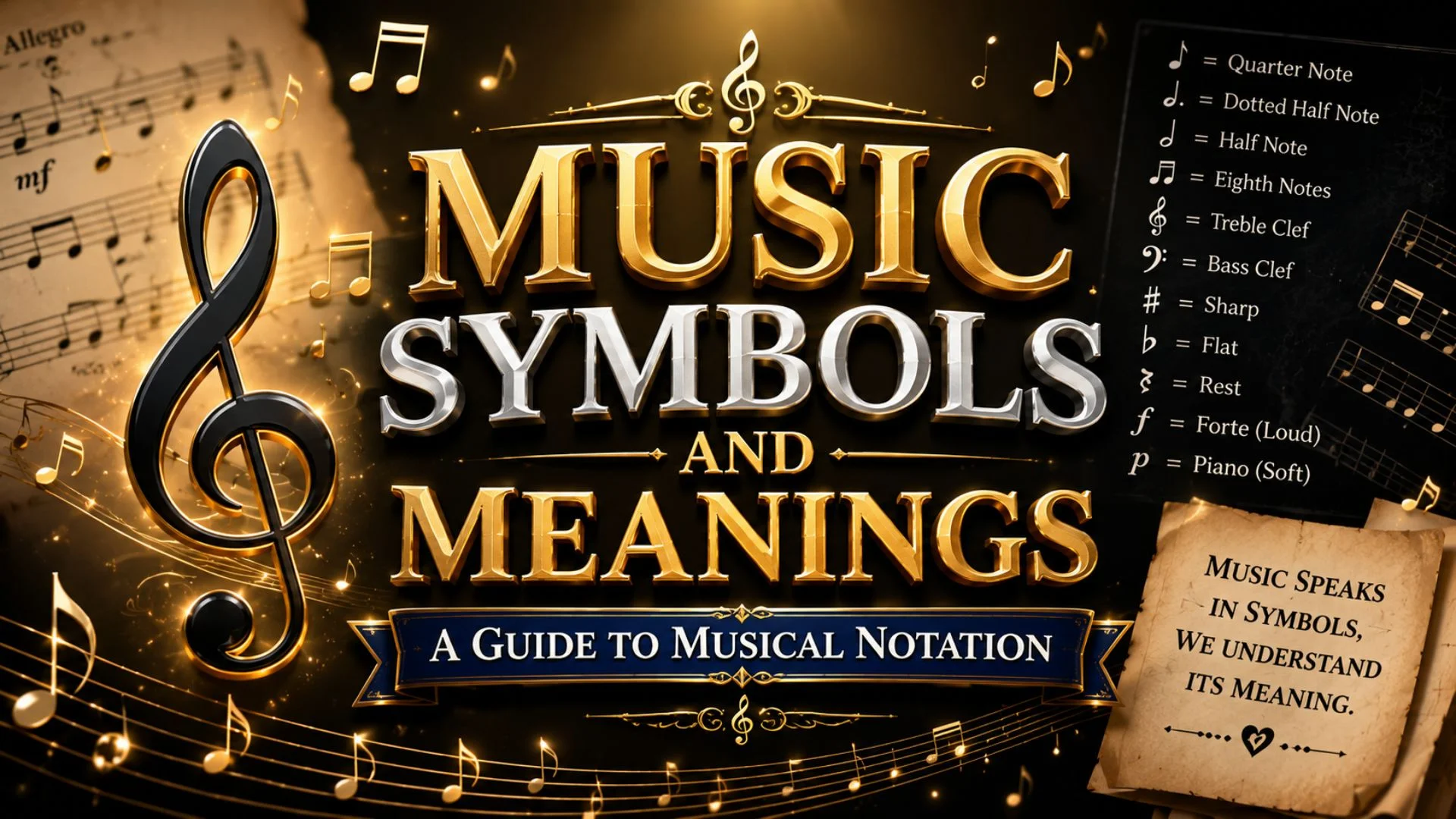
| Treble Clef | Indicates high-pitched notes, such as those played by the right hand on piano or by a violin |
| Bass Clef | Indicates low-pitched notes, like those played by the left hand on piano or by a cello |
| Whole Note | A hollow oval note head without a stem; lasts for four beats in 4/4 time |
| Half Note | A hollow oval note head with a stem; lasts for two beats |
| Quarter Note | A filled-in oval note head with a stem; lasts for one beat |
| Eighth Note | A filled-in note head with a stem and one flag; lasts for half a beat |
| Sharp (♯) | Raises the pitch of a note by one semitone |
| Flat (♭) | Lowers the pitch of a note by one semitone |
| Natural (♮) | Cancels a previous sharp or flat |
| Dot | Adds half the value of the note it follows (e.g., a dotted half note lasts for three beats) |
Related Meanings Table
| Symbol | Meaning |
|---|---|
| Staff | The five lines and four spaces on which musicians write notes |
| Clef | A symbol at the beginning of the staff that indicates the pitch range |
| Time Signature | Two numbers at the start of a piece indicating beats per measure and note value |
| Key Signature | Sharps or flats at the beginning of the staff indicating the scale used |
| Rest | A symbol indicating silence for a specific duration |
| Whole Rest | A rectangle hanging below the fourth line; silence for four beats |
| Half Rest | A rectangle sitting on the third line; silence for two beats |
| Quarter Rest | A squiggly line; silence for one beat |
| Eighth Rest | A diagonal line with a flag; silence for half a beat |
| Tie | A curved line connecting two notes of the same pitch, combining their duration |
| Slur | A curved line connecting different notes, indicating smooth, connected playing |
| Staccato | A dot above or below a note, indicating the musician should play it short and detached |
| Accent | A mark indicating the musician should emphasize a note with extra force |
| Tenuto | A line above or below a note, indicating a slight emphasis or full duration |
| Fermata | A dot with an arc over it, indicating the musician should hold the note longer than its value |
| Tremolo | A marking indicating rapid repetition of a single note or alternation between two notes |
| Trill | Ornamentation indicating rapid alternation between two adjacent notes |
| Glissando | A line indicating a continuous slide between two pitches |
| Piano (p) | Dynamic marking meaning “soft” |
| Forte (f) | Dynamic marking meaning “loud” |
Common Uses
Musicians use music symbols and meanings in various settings:
Reading Sheet Music: Performers read the notation to know which notes to play, how long to play them, and how to shape the music expressively.
Writing Music: Composers use notation to record their ideas, ensuring that others can perform their works accurately.
Teaching and Learning: Music educators use these symbols to teach students how to read and understand music, building foundational skills in music literacy.
Arranging and Transcribing: Musicians who arrange or transcribe music convert audio recordings into written notation, preserving musical works in a format others can read.
Sight-Reading: Performers often play unfamiliar music at first sight, quickly interpreting symbols and making split-second decisions about pitch, rhythm, and expression.
Music Theory: Students of music theory analyze written scores to understand harmony, form, and composition techniques.
Common Mistakes
| Mistake | Correction |
|---|---|
| Confusing treble and bass clef notes | Practice reading both clefs separately; they use different spatial positions for notes |
| Ignoring dynamics and expression marks | The composer writes these as part of the music—they are not optional additions |
| Misreading sharps and flats in key signatures | Remember that key signatures affect every note in the piece unless marked with a natural |
| Rushing through rests | Rests are part of the music; count them carefully to maintain the rhythm |
| Misinterpreting dotted notes | A dot adds half the value of the note it follows—calculate accurately |
| Confusing ties and slurs | Ties connect notes of the same pitch; slurs connect different pitches |
| Overlooking tempo markings | Tempo affects the overall feel of the piece; follow the composer’s intention |
| Misreading repeat signs | D.C. (da capo) means return to the beginning; D.S. (dal segno) means return to the sign |
| Forgetting to check key signature when sight-reading | Always check the key signature before you start playing |
| Ignoring articulation marks (staccato, accent, tenuto) | These marks indicate how to play the note; they shape the character and style of the music |
Related Questions
What does the treble clef mean?
The treble clef, also known as the G clef, indicates that the staff holds notes in the treble range—typically higher-pitched instruments like the flute, violin, and the right hand of the piano. It circles the G line (second line from the bottom), establishing that line as G above middle C.
What does the bass clef mean?
The bass clef, also known as the F clef, indicates that the staff holds notes in the bass range—typically lower-pitched instruments like the cello, bassoon, and the left hand of the piano. Two dots surround the F line (fourth line from the bottom), establishing that line as F below middle C.
What is a key signature?
A key signature is a collection of sharps or flats at the beginning of the staff, indicating which notes to play sharp or flat throughout the entire piece. It tells the performer which key the music is in.
What is a time signature?
A time signature consists of two numbers at the start of a piece. The top number indicates the number of beats per measure, and the bottom number indicates the note value that receives one beat (e.g., 4/4 means four quarter-note beats per measure).
FAQs
What are the most common music symbols?
The most common symbols include the treble clef, bass clef, notes (whole, half, quarter, eighth), rests, time signatures, key signatures, and dynamic markings like piano and forte.
What does the letter “P” mean in music?
The letter “P” stands for piano, indicating that the musician should play softly.
What does “F” mean in music?
“F” stands for forte, indicating that the musician should play loudly.
What is a fermata?
A fermata (a dot with an arc over it) means the musician should hold a note or rest longer than its written value—the length of the pause is at the performer’s discretion.
What is the difference between a tie and a slur?
A tie connects two notes of the same pitch, and the musician plays them as one continuous note. A slur connects notes of different pitches, and the musician plays them smoothly and connected (legato).
What does a dot after a note mean?
A dot adds half the value of the note it follows. For example, a dotted half note (three beats) lasts for two beats plus one more beat.
What does staccato mean?
Staccato (indicated by a dot above or below a note) means the musician should play the note short and detached from the following notes.
What is the symbol for silence in music?
The rests indicate silence. There are different rests for different durations: whole rest (four beats), half rest (two beats), quarter rest (one beat), etc.
What does D.C. al Fine mean?
D.C. al Fine (Da Capo al Fine) instructs the musician to return to the beginning of the piece and play until the word “Fine” (meaning end).
What is a glissando?
A glissando is a rapid slide across a series of notes, usually indicated by a wavy or straight line connecting two notes.
Conclusion
Music symbols and meanings form the foundation of musical literacy. Without this notation system, composers could not preserve their works, performers could not reproduce them accurately, and the rich tradition of Western classical music would simply not exist in its current form. By learning to read these symbols, you gain access to a world of musical expression, enabling you to bring scores to life and appreciate the depth of musical notation. Whether you are a beginner learning to read music or an experienced musician brushing up on theory, understanding music notation deepens your connection to the art form and empowers you to interpret and create music with confidence.

Natalie Brooks is a content researcher and writer with a strong interest in word meanings, dream interpretations, symbolism, and cultural insights. She is passionate about creating clear, informative, and easy-to-understand content that helps readers discover the deeper meanings behind words, names, dreams, and symbols. Through her work at Meanzly, Natalie aims to make knowledge accessible and valuable for readers around the world.