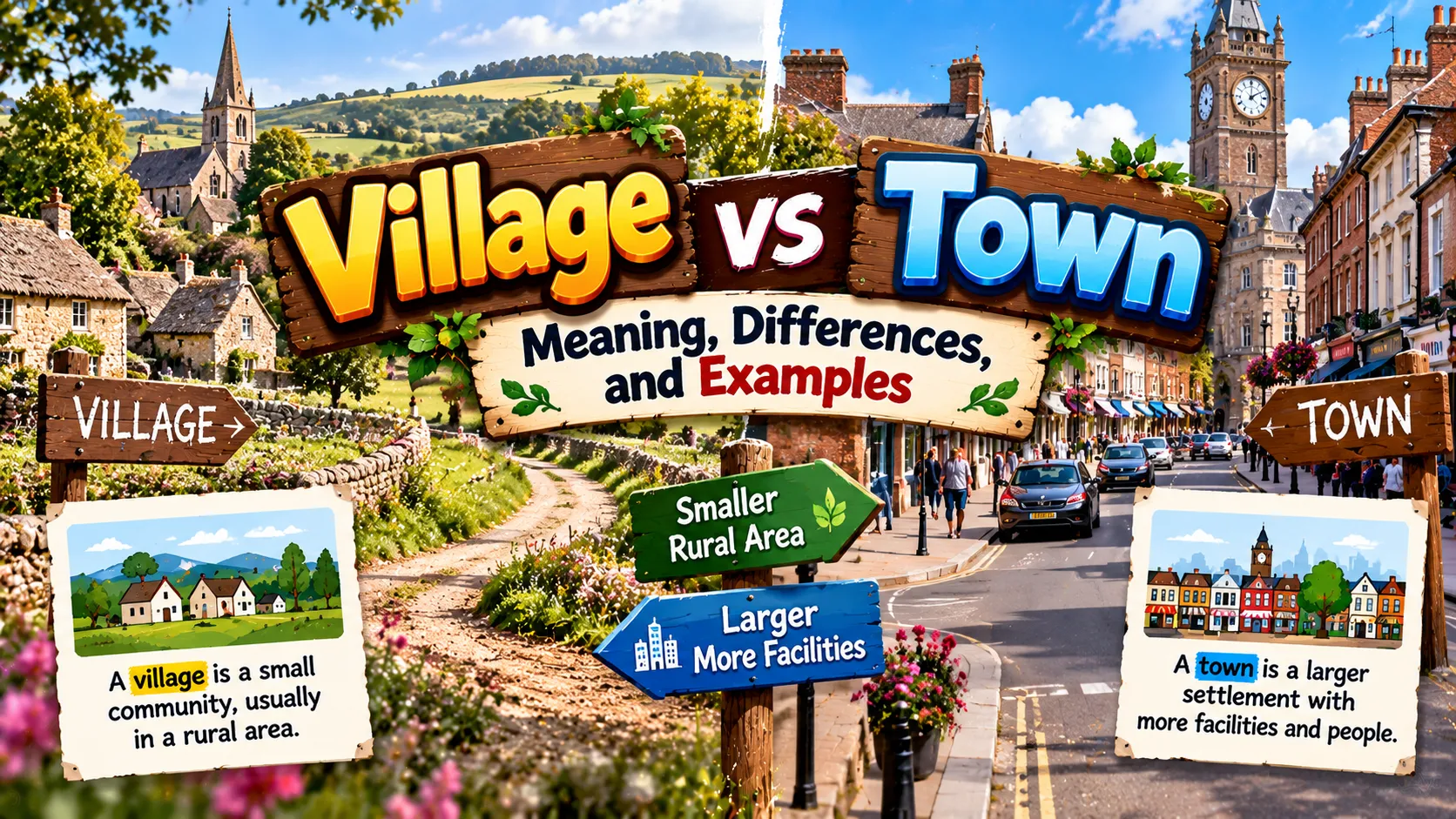
Understanding the difference between village vs town can help you describe places more accurately in everyday conversations, school assignments, travel writing, and geography lessons. Both villages and towns are settlements where people live, work, and interact, but they often differ in population, size, infrastructure, and available services.
A village is generally a small settlement with a relatively low population and a close-knit community. A town is usually larger and offers more services, shops, schools, healthcare facilities, and employment opportunities. However, the exact definitions vary by country because governments use different population limits and administrative rules to classify settlements.
In this guide, you will learn what a village and a town mean, explore their main differences, compare their advantages, and discover practical examples that make the distinction easy to understand.
What Is a Village? 🌾
A village is a small human settlement that often has a close-knit community and a quieter environment. Villages are commonly found in rural areas, although their location and characteristics vary around the world.
Many villages have homes grouped around local roads, farmland, community buildings, small shops, or places of worship. Residents may work in agriculture, small businesses, crafts, local services, or nearby towns and cities.
Villages often have fewer public services and commercial facilities than larger settlements. However, this does not mean every village lacks modern infrastructure. Many villages have paved roads, internet access, schools, healthcare services, and reliable transportation.
Examples of a Village
- A farming community surrounded by fields.
- A small settlement with a local market and primary school.
- A rural community where residents know many of their neighbors.
- A fishing settlement near a lake or coastline.
- A mountain community with a small number of homes and shops.
The defining characteristics of a village are generally its smaller scale and community structure, rather than one universal population limit.
What Is a Town? 🏘️
A town is generally a settlement larger than a village, often with a more developed commercial area and a wider range of public services. Towns serve as important centers for shopping, education, healthcare, transportation, and employment.
A town may have supermarkets, restaurants, banks, secondary schools, clinics or hospitals, public offices, and larger markets. People from surrounding villages may travel to a nearby town to work, study, shop, or access services.
Towns can still feel peaceful and community-oriented. Some have historic centers and low-density neighborhoods, while others have busy roads, apartment buildings, and expanding residential areas.
Examples of a Town
- A settlement with several schools, banks, and shopping areas.
- A local business center serving nearby rural communities.
- A growing residential area with public transportation and healthcare facilities.
- A market town where farmers sell their products.
- A small urban settlement with restaurants, offices, and recreational spaces.
Like villages, towns do not have a single worldwide population threshold. Their official status depends on local laws and administrative classifications.
Village vs Town: Key Differences 📊
Villages and towns can share many features, but they often differ in size, facilities, economic activity, and population density.
| Feature | Village | Town |
|---|---|---|
| Population | Generally smaller | Generally larger |
| Physical size | Often covers a smaller area | Often covers a larger area |
| Environment | Frequently rural and quieter | May be busier and more developed |
| Shops | Often has a few local shops | Usually has more shops and businesses |
| Healthcare | May have a small clinic or limited services | Often has more healthcare options |
| Education | May have a small school | Often has multiple schools or colleges |
| Employment | May rely on farming and local work | Usually offers a broader range of jobs |
| Transportation | May have fewer public transport options | Often has more transport connections |
| Community | Often close-knit | Can also have a close-knit community |
| Infrastructure | Varies by location | Often has more extensive services |
These are general patterns, not strict rules. A well-developed village may offer more facilities than a small town, depending on its location and local development.
Population and Size: Village vs Town 👥
One of the most noticeable differences between villages and towns is their population. Villages typically have fewer residents, while towns generally accommodate more people and a wider variety of activities.
However, there is no universal population number that separates a village from a town. A settlement classified as a town in one country might be considered a village or another type of administrative area elsewhere.
Population density also matters. A village may cover a large rural area with homes spread far apart, while a town may have compact neighborhoods, busy commercial streets, and apartment buildings.
For this reason, it is better to consider population alongside infrastructure, settlement patterns, local government rules, and the role the settlement plays in its surrounding region.
Lifestyle in a Village vs Town 🌳
Daily life can feel different in a village and a town, although personal experiences depend on the location and individual preferences.
Life in a Village
Village life is often associated with quieter surroundings, open spaces, and strong neighborhood connections. Residents may enjoy access to farmland, gardens, natural landscapes, and outdoor activities.
Some villages offer lower housing costs and less traffic, but residents may need to travel farther for specialized healthcare, higher education, or certain shopping options. Employment opportunities can also be more limited in some rural communities.
Life in a Town
Town life often provides greater convenience because shops, schools, healthcare facilities, workplaces, and recreational spaces may be closer together. Residents may have more choices for entertainment, education, and employment.
On the other hand, some towns experience heavier traffic, more noise, and higher housing costs than nearby villages. The experience varies considerably between small towns and larger, rapidly growing settlements.
Neither lifestyle is automatically better. The right choice depends on a person’s needs, budget, work, family situation, and preferred environment.
Advantages and Disadvantages of Villages and Towns ⚖️
Both settlement types offer benefits and challenges. Comparing their characteristics can help explain why people choose to live in different places.
| Factor | Village | Town |
|---|---|---|
| Peace and quiet | Often offers quieter surroundings | May have more traffic and activity |
| Access to services | Some services may be limited | Usually offers more choices |
| Job opportunities | May be fewer in certain industries | Often offers a wider range |
| Nature | Often has more nearby open space | Depends on location and development |
| Shopping | May have fewer stores | Usually has more shopping options |
| Community connections | Can offer strong local relationships | Community connections vary |
| Transportation | May require a personal vehicle | May offer better public transport |
| Housing | May offer more space in some areas | May have more housing types but higher costs in some markets |
These comparisons are generalizations. Housing costs, transportation, employment, and quality of life depend on local conditions rather than settlement labels alone.
Examples of Villages and Towns in Everyday Life 🌍
Imagine a small settlement surrounded by farms. It has a primary school, a few grocery shops, a community center, and a limited number of roads. Residents may travel to a nearby commercial center for major purchases. This would commonly be described as a village.
Now imagine a larger settlement with several schools, supermarkets, banks, restaurants, healthcare facilities, and a busy market serving surrounding communities. This would commonly be described as a town.
In Pakistan, for example, people often distinguish between villages and towns based on their size, development, local services, and administrative status. However, official classifications can differ from everyday usage.
In the United States, the meaning of town also varies by state and local government. Some towns are legally incorporated municipalities, while others use the term informally. Therefore, a place’s official classification cannot always be determined by population alone.
Frequently Asked Questions About Village vs Town ❓
What is the main difference between a village and a town?
A village is generally a smaller settlement, often with a rural character and fewer services. A town is usually larger and offers a wider range of shops, employment opportunities, and public facilities.
Is a village smaller than a town?
Generally, yes. Villages usually have fewer residents and less extensive commercial infrastructure than towns. However, population size alone does not determine official status everywhere.
Is a town urban or rural?
A town can have characteristics of either. Some towns are considered urban settlements, while others have a rural character and serve nearby villages.
Can a village become a town?
Yes. A village may grow in population, infrastructure, and economic activity over time. It may eventually be reclassified as a town if it meets the relevant local administrative requirements.
Is village life better than town life?
Neither is universally better. A village may appeal to people who prefer quieter surroundings and access to nature, while a town may suit people who value convenient services, education, and a wider range of jobs.
What is the difference between a village, a town, and a city?
A village is generally a small settlement, a town is often larger and more developed, and a city is typically a major population and economic center. However, official definitions and population thresholds vary by country.
Conclusion
The difference between village vs town mainly involves settlement size, population, infrastructure, and access to services. A village is generally smaller and often has a rural character, while a town usually provides more shops, employment opportunities, schools, and public facilities.
Still, these are general distinctions rather than universal rules. Local laws and administrative classifications determine the official status of a settlement. Understanding these differences will help you use both terms accurately in everyday English and writing.

Natalie Brooks is a content researcher and writer with a strong interest in word meanings, dream interpretations, symbolism, and cultural insights. She is passionate about creating clear, informative, and easy-to-understand content that helps readers discover the deeper meanings behind words, names, dreams, and symbols. Through her work at Meanzly, Natalie aims to make knowledge accessible and valuable for readers around the world.









