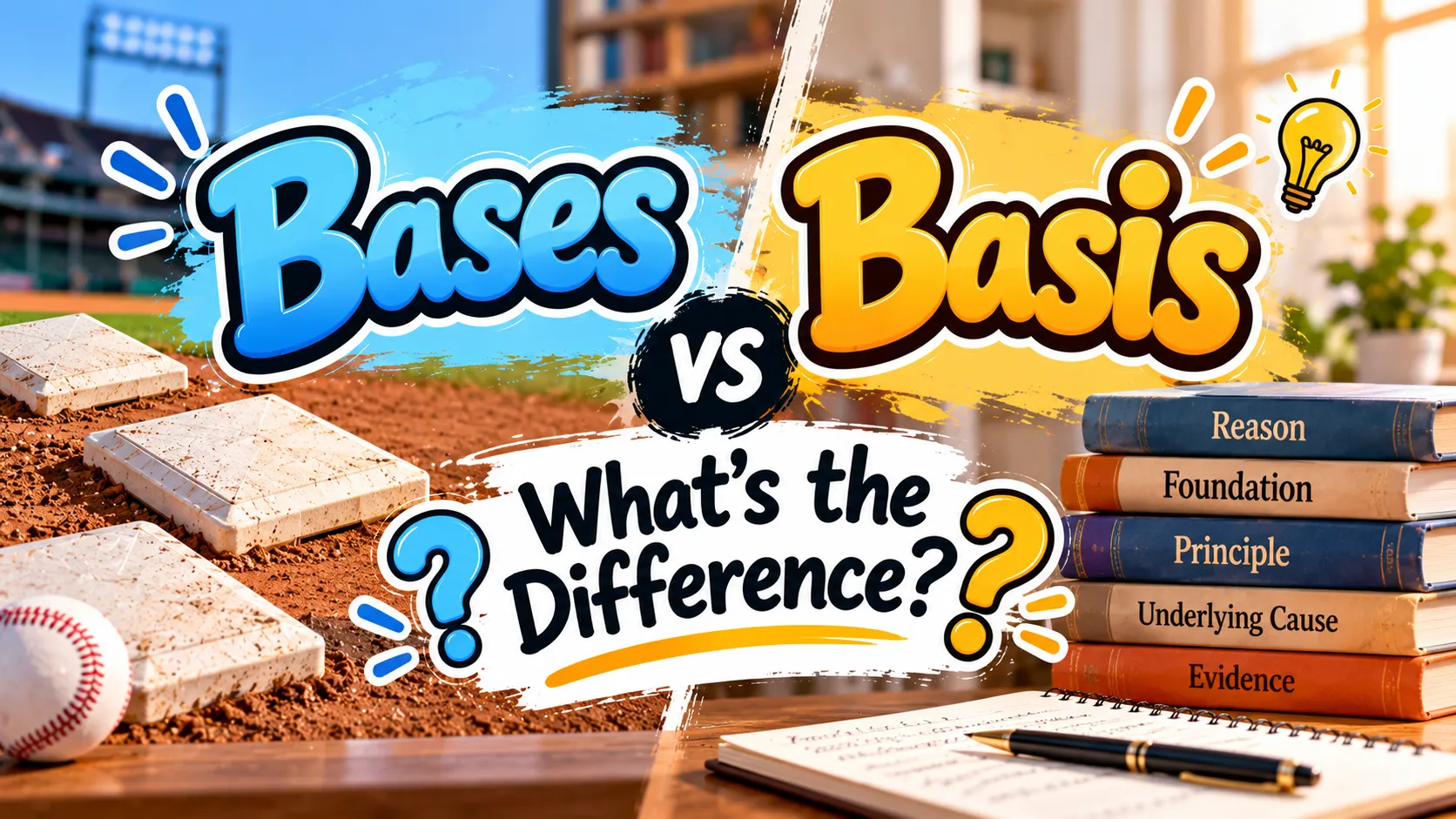
The words “bases” and “basis” look similar and sound related, yet they serve different grammatical roles and appear in different contexts. The bases vs basis distinction trips up many writers, especially those drafting business reports, academic papers, or legal documents where precision matters most.
“Bases” is the plural of “base”—it refers to multiple foundations, military installations, or starting points. “Basis” is a singular noun meaning the underlying principle, reason, or foundation for something. The confusion arises because both words relate to the concept of a foundation, but one is plural and concrete while the other is singular and abstract. This comprehensive guide explains the difference, explores their origins, provides practical examples, and helps you choose the correct word every time you write.
Quick Answer
“Bases” is the plural of “base,” meaning multiple foundations, locations, or starting points, as in “military bases” or “the bases of the argument.” “Basis” is a singular noun meaning the underlying principle or reason, as in “on a regular basis” or “the basis for the decision.” Remember: bases = plural and often physical; basis = singular and abstract.
Meaning Overview Table
| Aspect | Meaning |
|---|---|
| Definition | Bases: plural of base (foundations, locations). Basis: singular underlying principle or reason |
| Pronunciation | Bases: /ˈbeɪsɪz/; Basis: /ˈbeɪsɪs/ |
| Part of Speech | Both are nouns |
| Usage | “The company has offices in three bases” vs. “The decision rests on a solid basis” |
| Context | Business, law, science, everyday writing |
Main Meaning
Definition
Bases is the plural form of the noun “base.” It refers to multiple foundations, supporting structures, military or operational locations, or starting points. In baseball, “bases” refers to the four stations players must touch to score. In chemistry, “bases” are substances that neutralize acids.
Basis is a singular noun meaning the underlying principle, foundation, or reason for something. It describes the abstract ground on which a decision, argument, or system rests. The plural of “basis” is “bases,” which creates additional confusion because the plural of “basis” and the plural of “base” share the same spelling.
Origin
“Base” comes from the Latin basis, meaning “foundation” or “pedestal,” which itself derives from the Greek basis, meaning “a step” or “a stepping.” The word entered English through French in the 14th century.
“Basis” entered English directly from Latin in the 16th century, retaining its singular form. The plural “bases” serves both “base” and “basis,” which explains much of the modern confusion.
Context
The distinction matters across several contexts:
- Business Writing: Companies operate from multiple bases; decisions rest on a basis
- Legal Writing: Legal arguments have a basis; legal precedents form bases for future rulings
- Scientific Writing: Chemical bases neutralize acids; hypotheses have a basis in evidence
- Everyday Communication: People visit bases; they do things on a regular basis
Modern Usage
Today, “bases” appears frequently in military, sports, and business contexts. “Basis” appears in formal writing about reasons, principles, and foundations. The overlap in plural forms—both “base” and “basis” pluralize to “bases”—creates ongoing confusion for writers at all levels.
Detailed Explanation
Literal Meaning
Literally, “bases” means multiple foundations or supporting structures. “Basis” means a single foundation or underlying principle. The literal difference is between multiple concrete things and one abstract concept.
Common Meaning
Commonly, people use “bases” when discussing military installations (“troops returned to their bases”), sports (“he stole two bases”), or foundations (“the bases of the pillars”). People use “basis” when discussing reasons or principles (“on what basis did you decide?”).
Grammatical Meaning
Grammatically, “bases” is a plural noun. “Basis” is a singular noun. This distinction matters for verb agreement: “The bases are strong” versus “The basis is clear.” The plural of “basis” is also “bases,” which means context determines whether “bases” refers to multiple bases or multiple bases (principles).
Scientific Meaning
In chemistry, “bases” refers to substances that accept protons or donate electrons, such as sodium hydroxide or ammonia. In biology, “bases” refers to the nitrogenous bases in DNA and RNA: adenine, thymine, guanine, and cytosine.
Business Meaning
In business, “bases” describes multiple operational locations (“the company has bases in five countries”). “Basis” describes the foundation of decisions or agreements (“the contract forms the basis of our partnership”).
Mathematical Meaning
In mathematics, “bases” refers to multiple number systems (binary, decimal, hexadecimal). “Basis” in linear algebra refers to a set of vectors that span a vector space.
Examples Table
| Example | Meaning |
|---|---|
| The military maintains bases in three countries. | Multiple installations |
| The decision rests on a solid basis. | Underlying principle or reason |
| The company operates from bases in New York and London. | Multiple operational locations |
| We meet on a weekly basis. | Regular schedule |
| The bases of the argument are weak. | Multiple foundations |
| On what basis did you make that decision? | Reason or justification |
| Chemical bases neutralize acids. | Substances that accept protons |
| The team covered all the bases in their preparation. | Multiple starting points or considerations |
| The DNA bases are adenine, thymine, guanine, and cytosine. | Nitrogenous bases |
| The basis for the ruling was a 1990 precedent. | Underlying legal principle |
Related Meanings Table
| Related Term | Meaning |
|---|---|
| Base | A single foundation or starting point |
| Basis | A singular underlying principle |
| Bases | Plural of base; also plural of basis |
| Foundation | The underlying support for something |
| Grounds | Reasons or justification for something |
| Premise | A proposition supporting an argument |
| Rationale | The underlying reason for something |
| Footing | The basis or foundation of a relationship |
| Platform | A foundation or basis for action |
| Infrastructure | The basic physical systems underlying an organization |
| Fundamental | Forming a necessary base or core |
| Baseless | Without foundation or reason |
| Based on | Founded on; derived from |
| On the basis of | Because of; using as a reason |
| Basic | Forming a foundation; fundamental |
Common Uses
People use “bases” and “basis” across numerous contexts:
Military and Operations: “Bases” refers to installations where troops or equipment are stationed. “The military maintains bases on three continents.”
Business and Finance: “Bases” describes multiple operational locations or customer groups. “Basis” describes the foundation of a financial transaction, as in “the basis of the agreement.”
Chemistry and Science: “Bases” refers to alkaline substances. “The lab tested several bases for the experiment.”
Law and Policy: “Basis” describes the legal foundation for a decision. “The court’s ruling rested on a constitutional basis.”
Everyday Communication: “On a regular basis” appears constantly in speech and writing. “Cover all the bases” is a common idiom meaning to prepare thoroughly.
Common Mistakes
| Mistake | Correction |
|---|---|
| Writing “on a regular bases” | Write “on a regular basis” (singular abstract noun) |
| Writing “the basis for the decision are clear” | Write “the basis for the decision is clear” (singular subject) |
| Writing “the bases of the argument is weak” | Write “the bases of the argument are weak” (plural subject) |
| Writing “three basis of operation” | Write “three bases of operation” (plural of base) |
| Writing “the company has a basis in Tokyo” | Write “the company has a base in Tokyo” (singular location) |
| Confusing the plural of “basis” with the plural of “base” | Both are “bases”; context determines meaning |
| Writing “on what bases did you decide?” | Write “on what basis did you decide?” (singular reason) |
| Writing “the basis of the pillars” | Write “the bases of the pillars” (concrete foundations) |
| Writing “she covered all her basis” | Write “she covered all her bases” (plural starting points) |
| Assuming the two words are interchangeable | They differ in number and concreteness; precision matters |
Related Questions
Is it “bases” or “basis”?
It depends on meaning and number. “Bases” is plural, referring to multiple foundations or locations. “Basis” is singular, referring to one underlying principle or reason.
What does “on a regular basis” mean?
“On a regular basis” means regularly or at consistent intervals. The phrase uses the singular “basis” because it describes one underlying schedule.
What does “cover all the bases” mean?
“Cover all the bases” is an idiom meaning to prepare thoroughly for every possible situation. It comes from baseball, where players must cover all four bases.
What is the plural of “basis”?
The plural of “basis” is “bases,” which is identical to the plural of “base.” This shared spelling creates confusion in writing.
Can “basis” be plural?
Yes, technically the plural is “bases,” but in practice, English speakers rarely use “basis” in the plural. They usually rephrase to avoid the confusion.
What is the difference between “base” and “basis”?
“Base” is typically concrete and physical, like a military base or the base of a statue. “Basis” is abstract, like the basis for a decision or argument.
FAQs
What does “bases” mean?
“Bases” is the plural of “base.” It refers to multiple foundations, military installations, sports stations, or starting points. In chemistry, it refers to alkaline substances.
What does “basis” mean?
“Basis” is a singular noun meaning the underlying principle, reason, or foundation for something. It appears in phrases like “on a regular basis” and “the basis for the decision.”
Is it “on a regular basis” or “on a regular bases”?
The correct phrase is “on a regular basis.” “Basis” is singular because it describes one underlying schedule or principle.
What is the plural of “basis”?
The plural of “basis” is “bases.” However, the same spelling serves as the plural of “base,” so context determines which meaning applies.
Can I use “bases” to mean reasons?
Yes, but only in the plural. “The bases of his argument are weak” means multiple reasons or foundations are weak. For a single reason, use “basis.”
What does “the basis of the argument” mean?
“The basis of the argument” means the underlying principle or foundation on which the argument rests. It is singular.
Why do people confuse “bases” and “basis”?
They look similar and share a common root. The plural of “basis” is also “bases,” which creates overlap. Many writers mix the singular and plural forms.
How can I remember the difference?
Remember: “basis” is singular and abstract; “bases” is plural and often concrete. If you can count them, use “bases.” If you’re describing one underlying principle, use “basis.”
Conclusion
Mastering the bases vs basis distinction protects your writing from common grammatical errors. “Bases” is the plural of “base,” referring to multiple foundations, locations, or starting points. “Basis” is a singular noun meaning the underlying principle, reason, or foundation for something. Remember the simple rule: “basis” is one abstract principle; “bases” is multiple concrete foundations. The shared plural form creates genuine confusion, so context matters. Whether you’re writing a business report, a legal brief, or a casual email, choosing the correct word ensures your meaning is clear. Practice using “basis” for singular reasons and “bases” for plural foundations, and your readers will understand exactly what you intend. Small distinctions like this separate careful writers from careless ones.

Natalie Brooks is a content researcher and writer with a strong interest in word meanings, dream interpretations, symbolism, and cultural insights. She is passionate about creating clear, informative, and easy-to-understand content that helps readers discover the deeper meanings behind words, names, dreams, and symbols. Through her work at Meanzly, Natalie aims to make knowledge accessible and valuable for readers around the world.









